
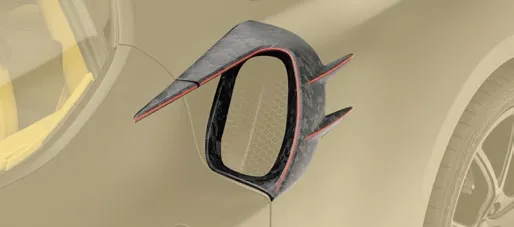
Rear fender air intakes splitter Mansory for Ferrari 296 GTB


Rear Fender Air-Intake Splitter Mansory for Ferrari 296 GTB
The rear quarter panel of the Ferrari 296 GTB is one of the most aerodynamically active surfaces on the car: it channels ventilation air into the engine compartment through the intake ducts flanking the rear glass, manages the complex flow field at the rear wheel arch exit, and transitions the boundary layer from the door surface into the diffuser entry zone. The Mansory Rear Fender Air-Intake Splitter attaches to the leading edge of the rear quarter duct aperture, dividing the incoming air column into a controlled upper duct feed and a lower bypass stream — a functional inlet management device executed in autoclave carbon fibre as part of the Mansory Carbon Fiber Body kit set for Ferrari 296 GTB. The 296 GTB's hot-vee twin-turbo V6 places both turbos inside the 120° bank angle, generating intense radiated heat that the rear duct system must manage continuously at full load. The PHEV pack's power electronics and battery cooling system add a secondary thermal load that also relies on rear-quarter airflow for heat rejection under sustained hybrid-electric operation. The splitter's blade edge optimises the partition between these competing thermal consumers, increasing total duct throughput without enlarging the aperture — a solution that preserves the 296 GTB's tightly resolved rear-quarter silhouette while delivering measurably improved engine bay thermal management.
Construction & Materials
The splitter blade is a precisely formed carbon fibre laminate, laid up in 3K twill pre-preg over a CNC-machined male form that reproduces the exact curvature of the 296 GTB's rear quarter duct leading edge to within 0.25 mm. The part is vacuum-infused at the perimeter radii — where panel curvature is greatest and fibre bridging must be prevented — then autoclave-cured at 120 °C under 6 bar. The main blade span is 2.2 mm thick, thickening to 3.5 mm at the mounting root where the splitter interfaces with the OEM duct aperture frame. The trailing edge of the blade is ground post-cure to a 0.6 mm radius using a diamond-tip wheel — sharp enough to generate a clean flow separation at the blade exit without creating a knife-edge that would be susceptible to stone-impact fracture. Weight per pair is approximately 0.45 kg. Mansory's finishing team applies the UV-stable lacquer to all visible faces including the inboard blade surface, which is visible through the open duct aperture when the car is viewed at a slight angle from the rear quarter.
- Weave: 3K twill pre-preg, visual A-face on both outer and inboard surfaces
- Cure: vacuum infusion at perimeter radii + autoclave 120 °C / 6 bar, 4 h dwell
- Blade thickness: 2.2 mm span; 3.5 mm at mounting root
- Trailing edge: ground post-cure to 0.6 mm radius, diamond-tip wheel
- Weight per pair: ≈ 0.45 kg
- Mounting: dual-sided 3M VHB HS on OEM duct frame plus 2 × M5 countersunk bolts through existing pilot holes in duct surround
- Finish: UV-stable gloss lacquer on all visible faces including inboard blade face
- Dimensional accuracy: duct leading-edge profile tolerance ±0.25 mm over full span
Design & Visual Function
The rear quarter duct of the 296 GTB is a convergent intake scoop — wider at the forward entry, narrowing as it transitions to the engine bay aperture at the B-pillar trailing edge. Without a splitter blade, the incoming air mass attaches to whichever duct wall offers the least resistance under the prevailing aerodynamic conditions, leading to unequal distribution between the upper intercooler feeds and the lower engine-bay ventilation path. The Mansory splitter introduces a horizontal partition at the optimal pressure-balance point, creating two discrete flow channels of controlled hydraulic area ratio. This geometry ensures that the upper duct consistently feeds the intercooler inlets — which serve the twin-turbo V6's air-to-air charge cooling system — at adequate mass-flow rate even when the car is running below the velocity threshold at which ram-pressure alone is sufficient for full charge cooling. The lower channel simultaneously maintains ventilation flow through the gearbox bay and power-electronics cooling stack of the hybrid system, both of which generate substantial heat during fast road driving.
At the exterior surface, the blade's leading edge creates a visible horizontal cut across the duct aperture — a detail that reads as a motorsport-derived architectural decision, signalling that the rear quarter duct is a functional aero device rather than a styled scoop. This is consistent with the visual language of Ferrari's own GT3 and XX-programme cars, which use multiple parallel blade splitters in the same zone for maximum flow partition control. Mansory has chosen a single-blade solution that maximises the visual clarity of the carbon detail at the 296 GTB road-car aperture size, avoiding the mechanical busyness of a multi-blade stack that would be appropriate on a full race car but visually overwhelming on a street machine. The 3K twill weave visible on the outboard face aligns diagonally at 45° to the duct horizontal, creating a dynamic diagonal accent that contrasts with the smooth painted rear quarter above and below the duct surround.
Compatibility & Fitment
The Rear Fender Air-Intake Splitter is designed for the Ferrari 296 GTB coupé (2022+), 296 GTS spider (2023+), and 296 Assetto Fiorano. The part fits the same rear quarter duct aperture on all three variants. The 296 GTB's rear duct does not carry active sensors or electrical connections, so no wiring work is required. No steering-side restriction: the rear quarter ducts are structurally symmetric on LHD and RHD 296 GTBs, and the same splitter pair fits both configurations. Assetto Fiorano cars that have been specified with additional carbon underbody panels may have slightly different approach-airflow characteristics but the same duct aperture geometry; the splitter fits without modification. The 296 Speciale features a modified rear quarter duct with additional louvre detail — confirm fitment at order stage.
Installation & Reversibility
Installation begins with cleaning the OEM duct aperture frame with isopropyl alcohol and allowing to dry completely. Position the splitter blade in the duct entry, using the 2 × M5 pilot holes in the OEM duct surround as locating features; fit the M5 countersunk bolts hand-tight first to confirm alignment, then apply 3M VHB HS tape to the full blade root contact face, press firmly into position, and torque the M5 bolts to 5 Nm. Allow 4 hours for the VHB bond to reach working strength before driving. Total installation time per side is 20–30 minutes. The installation is fully reversible: remove the M5 bolts and lift the blade root from the VHB bond using a dental-floss cutter along the bond line, leaving no marks on the OEM duct frame surface. No specialist tools required; the work is within the capability of a careful DIY installer.
Pairing within the Mansory 296 GTB programme
The rear fender splitter's flow management function is most effective when the air it feeds arrives in good order from the front of the car — making the Rear Diffuser with Brake Light Mansory for Ferrari 296 GTB an ideal functional companion, as it manages the flow at the rear underbody exit and prevents the high-pressure rear wake from disturbing the duct intake boundary layer. For a complete lower-body lateral aero package, pair with the Side Skirts II Mansory for Ferrari 296 GTB, which channels sill air rearward toward the rear arch zone and sets up the flow that the fender splitter then manages. Owners specifying high downforce configurations should also consider the Rear Wing Mansory for Ferrari 296 GTB to balance the rear downforce contribution of the diffuser at high speed.
Maintenance & Durability
The inboard blade face — visible through the open duct aperture — accumulates engine heat, oil vapour, and dust from the engine bay and requires periodic cleaning with a damp cloth and a mild, pH-neutral automotive shampoo. Avoid solvent-based degreasers on the lacquer surface inside the duct aperture; the narrow confines make rinsing difficult and solvent residue can attack the lacquer over time. The outboard face requires the same stone-protection and ceramic-coating routine as other exterior carbon panels. Inspect the trailing edge annually for blade-tip chip damage from high-velocity road debris entering the duct at speed; the 0.6 mm radius trailing edge, while functional, is more delicate than a blunt edge and should be protected with a clear trailing-edge film applied during the installation session. The M5 mounting bolts should be checked for torque integrity every 12 months on track cars, where vibration from the V6 at high RPM can slowly back the bolts out if threadlock was not applied at installation — use a medium-strength threadlock compound on reassembly if any looseness is detected.
Inspect annually for any signs of delamination or VHB bond degradation.Lead Time & Warranty
Rear fender splitters are precision-profiled to the duct leading edge geometry and require careful post-cure finishing; lead time is 3–4 weeks from order confirmation. The 12-month manufacturer's warranty covers delamination, trailing edge voids, and dimensional fitment tolerance failures at the duct frame mounting interface. Impact damage at the trailing edge and lacquer degradation from incorrect cleaning chemistry are outside warranty scope. Contact Hodoor with order reference and photographic documentation for all warranty enquiries.
FAQ
Q: Can the rear fender splitter be fitted to the 296 GTS spider or only the GTB coupé?
A: Both — the 296 GTS and GTB share the same rear quarter duct aperture geometry. The same splitter pair fits both body styles without modification.
Q: Does the splitter improve cooling measurably, or is it primarily a visual detail?
A: The flow-partitioning function is physically real — it increases duct throughput efficiency by ensuring consistent hydraulic area distribution between the upper intercooler feeds and the lower ventilation path. The magnitude of the cooling benefit depends on driving conditions; at track speeds and sustained full-hybrid output, the improvement is most relevant. The visual impact of the carbon blade at the duct entry is also a genuine design contribution in its own right.
Q: Do I need to remove the rear bumper or engine bay panels to install the splitter?
A: No. The splitter installs entirely from the exterior at the duct aperture face. Access to the OEM pilot holes is from outside the car, and the M5 bolts are reached with a standard short extension from the duct entry — no interior panels or bodywork removal is required.
Q: Is the splitter supplied as a pair (both sides) or a single unit?
A: The splitter is supplied as a pair — both rear quarter duct blades are included. The product as listed is for the full pair. Single-side replacement units for warranty or damage repair are available on request.
To order the Rear Fender Air-Intake Splitter or discuss its pairing with the diffuser and rear wing programme, contact us via WhatsApp +44 7488 818 747 or [email protected].