
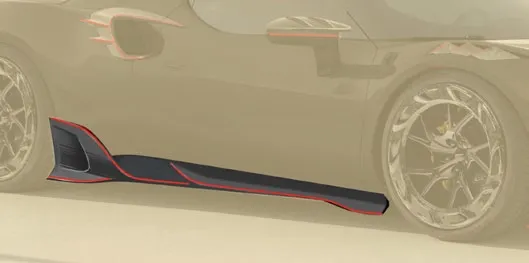
Side skirts I Mansory for Ferrari 296 GTB


Side skirts I Mansory for Ferrari 296 GTB
The aerodynamic seal between the front and rear wheel arches is the load-bearing link in any mid-engine car's underbody downforce chain. On the Ferrari 296 GTB — 830 hp PHEV pairing the 2.992 L F163 twin-turbo V6 in a 120° hot-vee with a 165 hp axial-flux electric motor, mid-rear transverse layout, 7.45 kWh battery biased rearward — the underbody is the primary downforce source at speed, with the rear diffuser generating the majority of that force through its Venturi effect. But the diffuser only functions if the pressure differential between the high-pressure exterior air and the low-pressure underbody zone is maintained across the car's full lateral span. That differential is what the side skirt preserves: a continuous carbon barrier along the sill face that prevents pressure equilibration between inside and outside the underbody. Mansory's Side Skirts I are part of the Mansory Carbon Fiber Body kit set for Ferrari 296 GTB and were developed alongside the front lip, splitter, and rear diffuser as an integrated aero system. The hot-vee's rearward thermal concentration and the PHEV battery's rearward mass bias both make consistent rear-axle aerodynamic downforce especially important on the 296 — the side skirts are a critical enabler of that consistency. They work directly with the Mansory side skirts II and connect the lateral seal begun by the Mansory front lip.
Construction & Materials
Each side skirt spans approximately 1400 mm along the sill face — the longest single carbon component in the 296 Mansory programme. Producing a panel of this length without twist or bow demands matched male-female tooling rather than the single-surface tools adequate for smaller aero parts. Mansory uses CNC-machined aluminium matched tooling for the side skirts, ensuring the panel's curvature matches the 296 GTB's sill face across its full span to ±0.8 mm. The primary laminate is 3K twill prepreg; the lower edge adds a unidirectional carbon strip oriented parallel to the panel's length, providing in-plane flexural stiffness at the zone most exposed to kerb strikes and airstream-pressure bending without disrupting the 3K twill pattern on the outer visible face.
Autoclave cure at 120 °C runs for 90 minutes under 5 bar — the extended dwell accounts for the panel's greater thermal mass. After demolding, each skirt undergoes a full-length dimensional scan against the CAD reference before moving to the finishing shop, where five coats of UV-stable clear lacquer are applied with a final wet-sand-and-polish cycle producing the piano-gloss depth consistent across the body programme.
- Panel span: ~1400 mm — longest single carbon component in the 296 Mansory kit
- Primary weave: 3K twill prepreg — consistent with front and rear aero components
- Lower edge reinforcement: UD carbon strip, parallel to length — flexural stiffness at kerb-strike zone without visible disruption to outer weave face
- Tooling: matched male-female CNC aluminium — panel curvature controlled to ±0.8 mm over 1400 mm span
- Cure: autoclave 120 °C / 5 bar / 90 min — extended dwell for full thermal soak of large panel
- Mass per panel: ~1.6 kg vs ~2.8 kg OEM polyurethane sill protector — ~1.2 kg saving per side
- Mounting: 6 × M6 stainless bolts into OEM sill captive nuts + 4 × factory polyamide retention clips — no drilling
- Finish: 5-coat piano-gloss UV-stable clear lacquer, wet-sand-and-polish exit inspection
Design & Visual Function
The side skirt's aerodynamic function is passive but indispensable: it extends the sill's effective depth by approximately 35 mm below the factory sill face, reducing the gap between the car's lower body structure and the road surface. This gap reduction increases the resistance to lateral air migration — in practical terms, the high-pressure freestream running along the car's exterior cannot as easily bleed under the sill into the underbody low-pressure zone. The result is a maintained sub-floor pressure gradient from front axle to rear diffuser, directly improving the diffuser's capacity to accelerate boundary-layer air and generate the rear-axle downforce it is calibrated for. Without a correctly specified side skirt, the diffuser's efficiency is reduced because the pressure differential it exploits is partially neutralised by inboard leakage at the sill.
On the 296 GTB's PHEV layout, where the battery pack's rearward placement creates a deliberate rearward aerodynamic bias — the aero setup is calibrated to match the mechanically heavier rear with greater rear aerodynamic load — a well-sealed sill preserves this calibration across the full speed range. At 250 km/h, a 5 % reduction in sill-seal effectiveness translates to a perceptible shift in aerodynamic balance, because the diffuser is near peak efficiency and most sensitive to upstream supply conditions at that speed. The Mansory skirts ensure the diffuser consistently receives the boundary-layer conditions it was designed for.
Visually, the deepened sill line drops the car's visual centre of gravity. The Mansory skirt's angular lower edge creates a shadow line that optically separates the car from its own shadow — making the 296 GTB appear lower and wider without altering the underbody ground-clearance datum. The 3K twill weave running the full 1400 mm span catches directional light in long, sweeping diagonals that emphasise the panel's length and the car's stretched proportions. This visual quality is impossible to replicate in flat-black polyurethane. Combining these skirts with the Mansory mirror LHD cover and Mansory side skirts II creates a complete lateral carbon strip from door mirror to rear arch with a coherent, track-programme visual signature.
Compatibility & Fitment
Designed for the Ferrari 296 GTB coupé (2022+), 296 GTS spider (2023+), and 296 Assetto Fiorano. Sill face geometry and OEM captive nut positions are identical across all 296 configurations. The Assetto Fiorano carbon floor extension does not interfere with the side skirt's lower edge mounting line; the components meet at the sill-floor junction but do not overlap. Panels are symmetric left-right; each side ships with its own hardware set. Installation requires both axles at normal ride height simultaneously — use a flat surface or a two-post lift to verify lower-edge clearance before final bolt torque.
Installation & Reversibility
Requires a two-post lift or flat ground with both axles loaded. Remove the OEM sill protector by releasing its six captive nuts and four retention clips. Position the Mansory skirt against the sill face starting at the front arch cutout and work rearward; secure with six M6 stainless bolts and four polyamide clips. Verify lower-edge parallelism with the ground before final torque. Estimated time: 45 minutes per side. Fully reversible — no trace on the sill structure.
Pairing within the Mansory 296 GTB programme
Side skirts I are the fourth element of the front-to-rear aero chain: front lip, splitter, race flaps, then the skirt sealing the gap from front to rear arch. They connect aerodynamically to the Mansory side skirts II, which continue the sill treatment rearward with a profile geometry tuned for the rear axle's higher-pressure environment. Together, the two skirt sets provide a continuous lateral seal that the rear diffuser depends on. At the front, the Mansory front lip establishes the geometry that the skirt's forward edge transitions into, eliminating any flow discontinuity between the bumper's lower face and the sill leading edge.
Maintenance & Durability
A 1400 mm side skirt faces stone strike along its full length from both front and rear tyres, road film and salt spray along the lower edge, and UV exposure across the entire outer face. Mansory's five-coat lacquer provides robust initial protection; the lower edge is where damage accumulates first, as kerb strikes from urban parking produce point-load chips in the UD reinforcement zone. Address chips with clear touch-up lacquer within one week to prevent moisture wicking along UD fibre tows. Outer face care: quarterly carnauba or ceramic polymer sealant; pH-neutral hand wash with a long-handled microfibre brush; rinse from at least 500 mm with a wide fan jet — do not use rotating brush car washes, which abrade the lacquer preferentially at the sharp lower edge. Road salt should be flushed after winter driving to protect the stainless bolt heads from corrosion; an annual anti-corrosion treatment on exposed hardware is recommended.
Lead Time & Warranty
Ships as a left-right pair. Lead time: 3–4 weeks from order confirmation, reflecting the 90-minute autoclave cycle, dimensional scan, and five-coat lacquer finishing schedule. 12-month warranty against delamination, bow or twist exceeding ±2 mm across span, and mounting-foot failure during correct installation torque. Stone strike, kerb abrasion, and chemical damage are excluded.
FAQ
Q: Do side skirts I and II need to be ordered together?
A: They are separate catalogue items and each provides a meaningful improvement individually. Aerodynamically they complement each other — skirts I manage the forward sill zone, skirts II the rear zone — and the full pair produces the greatest total sill-seal benefit.
Q: Will the skirts affect door opening on the 296 GTS spider?
A: No. The skirts attach to the sill face below the door's opening sweep arc. The door's lower edge clears the skirt's upper profile at all opening angles.
Q: Can skirts be installed on a 296 GTB with the AF factory carbon sill insert already fitted?
A: The AF carbon sill insert sits on the sill face upper section behind the door seal; the Mansory skirt mounts to the lower sill face. The components do not overlap. The visual junction between AF upper insert and Mansory lower skirt should be reviewed with a body-shop professional before ordering to confirm the aesthetic blend meets the owner's expectations.
Q: Is there a risk of the skirt grounding on speed humps in Sport suspension mode?
A: The skirts extend sill depth by 35 mm but do not lower the underbody clearance below the sill's existing lowest structural point. Standard Sport ride height provides adequate clearance for typical road speed humps. Comfort mode provides additional margin for unusually tall humps.
Q: Can I order a single replacement skirt if one is damaged?
A: Yes. Individual side replacements are available. Mansory supplies them to the same weave batch and lacquer specification as the current programme, matching the surviving panel as closely as possible.
Complete the lateral aerodynamic envelope on your 296 GTB with Mansory's precision-formed carbon side skirts. Enquire via WhatsApp +44 7488 818 747 or email [email protected] to confirm specification and delivery schedule.