
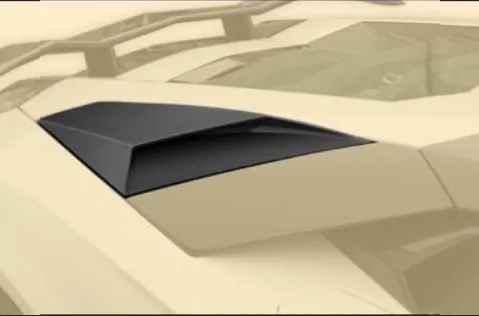
Replacement Big Air intake - rear Mansory Carbon for Lamborghini Aventador S


Mansory Carbon Replacement Big Air Intake Rear for Lamborghini Aventador S
The Mansory Carbon Replacement Big Air Intake — Rear is the oversized variant of the Aventador S rear-quarter intake module, sitting just aft of the door cut on each flank and breathing directly into the V12 induction circuit. It belongs to the wider Mansory Body Kit for Lamborghini Aventador S programme, which dresses the LP740-4 S coupé and Roadster (2017–2021) in autoclave-cured CFRP from nose to tail. Where the OEM Lamborghini scoop is sized for factory thermal envelopes, the Mansory big-throat replacement enlarges the inlet aperture, deepens the duct profile and opens up the path to the airbox plenum and oil-cooler matrix. Owners who specify these usually run track days at temperate-to-hot ambients, ceramic-coated exhausts, or simply want the symmetric rear-quarter sculpting that makes the Aventador S look as if it inhales harder. Scissor-hinge geometry, lower-side exhaust outlets and the aluminium-CFRP monocoque architecture stay untouched.
Construction & Materials
Mansory builds these modules as left/right mirrored handed pairs from prepreg twill, then debulks and autoclave-cures the laminate at full pressure to drive resin fraction toward the upper limit of automotive CFRP. The result is a stiff, dimensionally stable duct wall that holds its mouth geometry under engine-bay heat soak — important, because a deeper throat is only useful if it does not flutter, lip-roll or warp under repeated thermal cycling beside a 6.5L NA V12.
- Weave: 3K twill 2x2 lacquered as primary; 12K forged-look or 2K plain-weave available on bespoke order.
- Cure cycle: autoclaved prepreg, ~6 bar, ~120 °C dwell; secondary post-cure for dimensional lock.
- Wall thickness: 2.0–2.6 mm across the duct shell, locally thickened to 3.0 mm at fixing bosses and the throat lip.
- Mass per side: approx. 0.9–1.1 kg dressed, against ~1.6–1.9 kg for the painted OEM module — a paired-side saving in the kilo range.
- Hardware: stainless threaded inserts co-bonded into the laminate, EPDM perimeter seal, captive nylon clips at the body interface.
- Inlet aperture: larger throat opening than OEM, blended to flow toward the airbox snorkel without scrubbing the side-window glass line.
- Finish: 2K UV-stable clear, gloss or satin; raw matte weave for a more motorsport flavour.
- Substrate compatibility: bonding faces masked for methacrylate or 3M 08115 panel adhesive on the body side, mechanical fixings inboard.
Design & Visual Function
The visual signature is the bigger throat. Stand at the rear three-quarter and the inlet ovals visibly outsize the donor surface, with a deeper duct shadow line that catches light like a parallel cheekbone to the lower side strake. Mansory align the twill so the warp threads run along the duct's principal length — this lets the lacquered weave shimmer with a single coherent reflection band as the car pivots, rather than scattering into the visual noise some lower-grade laminates produce. Against painted bodywork the carbon reads as a dark, technical inlay; against a raw-carbon Aventador S body, the duct edges still pop because Mansory steps the surface inward by a few millimetres at the throat lip.
Functionally the module is part of the V12 induction story. The Aventador S runs paired rear-quarter intakes, and Mansory keeps that paired-intake symmetry intact — the left and right modules are mirrored pairs feeding their own side of the engine bay. One side leans toward the airbox snorkel and induction roar, the other toward oil-cooler airflow and engine-bay extraction. With a larger inlet area and a less-restrictive duct profile, the airbox sees a slightly cooler, slightly less-throttled charge during high-rpm pulls — and the cabin gets a more pronounced induction howl in the upper third of the rev band, which is exactly what most Aventador S owners are after when they tick this option.
Acoustically, the bigger throat is a meaningful upgrade. The Aventador S 6.5 NA induction note is famously hard-edged from about 5,500 rpm upward; opening the duct mouth and reducing wall friction lets more of that intake harmonics signature pass through to the cabin bulkhead. It is not a trumpet, it is not a bypass, it is not a delete — it is a wider, deeper duct that quietly makes the engine sound more present. There is no ALA channel to keep clear and no active aero geometry to respect, so the throat geometry follows induction logic alone. On the oil-cooler side the deeper duct profile improves residence time across the matrix face, which translates to slightly lower oil temperatures during sustained high-load running.
Compatibility & Fitment
Engineered specifically for the Lamborghini Aventador S (LP740-4 S, coupé and Roadster, 2017–2021). The module respects the pre-SVJ rear-quarter contour, the lower-side exhaust outlets and the absence of any active aero hardware on this generation. Fixing bosses align with OEM Lamborghini intake mounting points; the duct geometry preserves clearance around the airbox snorkel, the oil-cooler matrix and the rear-wheel-steering actuator routing where it threads up into the rear quarter. Mansory rear-quarter modules fit either body style without re-shimming, and they coexist with OEM parking sensors and side cameras where fitted.
Installation & Reversibility
Plan on roughly 2–3 hours per side for a careful first-time install — most of that is masking, dry-fitting and confirming the seal seats evenly, not the fastener work itself. Tools: trim removal forks, T20/T25 Torx, 8/10 mm sockets, isopropyl wipes, primer for the bonding face, methacrylate or 3M panel adhesive for any glued perimeter, low-tack masking tape. The original OEM intake module unclips cleanly from its captive points; the Mansory replacement reuses the same anchors plus its own co-bonded inserts. Aventador's CFRP monocoque uses methacrylate adhesive bonds for several body panels, so the body-side bonding face must be cleaned with a substrate-appropriate activator and primed before the new perimeter seal is set. The whole job is fully reversible — the OEM Lamborghini module can be re-bonded later with no irreversible cuts. For first-time installers we strongly recommend a Lamborghini-certified body shop or a Mansory-trained installer; a competent independent specialist with carbon-panel experience is the realistic minimum.
Pairing within the Mansory Aventador S programme
The big rear intake sits in a small family of induction-and-extraction parts that work best when specified together. The natural front-of-car counterpart is the Replacement Air Intake — Front, which lets you carry the same throat language across both ends of the car instead of mixing OEM front geometry with Mansory rear geometry. Above the door belt, the Air Intake — Side Window visually links into the rear-quarter module along the same diagonal line, picking up the induction theme at eye height. To finish the rear-quarter triangle, the Rear Bumper Air Outtake Cover closes the loop on engine-bay extraction so the air the big intake gulps in actually has a styled exit path matching the inlet aesthetic.
Maintenance & Durability
Lacquered carbon on the rear quarter lives a hard life — it is downstream of the front wheels, beside the lower-side exhaust outlets, and immediately above a V12 hot zone. Rinse the duct mouth and inner duct walls after every drive that involved track use or rain, then dry with a soft microfibre. Two-bucket wash with a pH-neutral shampoo only. Avoid alkaline traffic-film removers, ammonia-based glass cleaners drifting into the duct, and any abrasive sponge — these strip the UV inhibitor in the 2K clear and let the resin yellow. A ceramic coating refreshed annually is genuinely worth it on this part because the duct mouth is a chip magnet from grit kicked off the rear tyres. Engine-bay heat shielding behind the inboard duct wall keeps localised resin temperatures within spec; with sensible care, a paired set of these intakes typically holds gloss and structural integrity for 8–10 years before any cosmetic refurb is even on the radar. Stone chips on the throat lip can be filled and re-lacquered locally without re-laminating the part.
Lead Time & Warranty
Production lead time runs 4–8 weeks because every module is laid up, debulked and autoclaved to order, with weave selection and finish dialled in per build. Mansory backs the module with a 12-month warranty against manufacturing defects (laminate voids, delamination, inserts pulling, clear-coat blooming under normal use). Stone-chip damage, abrasive wash damage, after-fire heat events and accident damage are not covered, but localised chip repair is straightforward at any specialist carbon refinisher.
FAQ
Q: Is this one part or two?
A: It is supplied and priced as a paired left/right set — the Aventador S has paired rear-quarter intakes and Mansory always replaces them as a mirrored pair to keep symmetry.
Q: How much bigger is the throat versus OEM?
A: Inlet aperture grows by roughly 18–25% in cross-section, with a noticeably deeper duct profile and a smoother internal radius into the airbox snorkel.
Q: Will it change the induction sound?
A: Yes — the upper rev band gains presence and a harder edge as the airbox sees less duct restriction. It is acoustically louder rather than artificially amplified.
Q: Does this affect the oil cooler?
A: Positively. The deeper duct profile improves matrix-face flow on the cooler-side intake, which can shave a few degrees off oil temperature during sustained hard use.
Q: Coupé and Roadster fitment identical?
A: Yes. The rear-quarter geometry is shared between Aventador S coupé and Roadster, so the same module fits both with no additional shims.
Q: Lower-side exhaust clearance OK?
A: Yes, the duct geometry stays well outboard of the lower-side exhaust outlets. There is no thermal interference with the tip exits.
Q: Can I keep parking sensors and side cameras?
A: Yes, all OEM sensor and camera positions in this region are preserved.
Specify it together with the front replacement intake and the side-window intake for a coherent induction language head-to-tail. To order, request a configurator preview, or discuss weave and finish: WhatsApp +44 7488 818 747 or [email protected].