
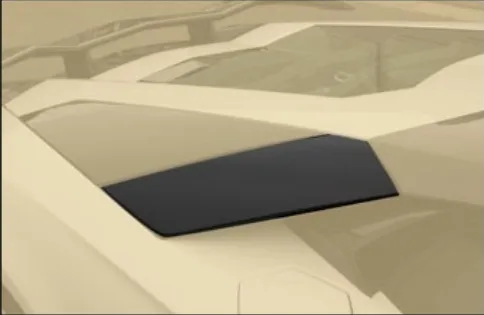
Replacement Air intake - front Mansory Carbon for Lamborghini Aventador S


Mansory Carbon Replacement Air Intake — Front for Lamborghini Aventador S
This panel is a true drop-in swap, not a layered overlay. Where the bumper-lip and the air-intake-cover sit on top of OEM plastic, the replacement front intake removes the factory plastic carrier altogether and bolts a Mansory carbon counterpart into the same aperture, with the same fixings, the same duct geometry, and the same downstream airflow paths feeding the front brake rotors and the radiator pack. Owners specify it when they want carbon weave to live where the eye actually lingers — directly behind the mesh of the front bumper inlets — rather than only on the painted surfaces around it. It belongs to the wider Mansory Body Kit for Lamborghini Aventador S programme, and is one of the few items in that catalogue that is genuinely OEM-replacement on the LP740-4 S facelift. The naturally aspirated 6.5-litre V12 sat behind the cabin still draws nothing through this aperture — the rear deck and side scoops handle the airbox — so this part is purely about cooling air, not induction; that distinction matters for how it is engineered.
Construction & Materials
The replacement panel is laid up over a hard tool taken from a factory carrier, then debulked and cured in a single autoclave cycle. Because the panel is a structural carrier (it holds the mesh, retains the duct lip, and indexes against the bumper skin), the schedule uses a heavier core than a cosmetic overlay would: a closed-cell foam in the duct walls and a multi-ply twill skin on the visible face. The mesh itself is a separately produced stainless honeycomb that drops into a bonded carbon frame on the inboard side; the two halves can be parted for cleaning or repair without disturbing the bumper.
The visible carbon is a 3K twill set on the bias so that the diagonal weave line continues smoothly into the surrounding bumper trim instead of clashing with it. Behind the mesh, where the eye can still resolve weave through the honeycomb cells, the prepreg is laid plain rather than satin to keep contrast crisp under low light.
- Visible face: 3K twill prepreg, 0/45 bias-aligned to bumper master
- Inboard face (visible through mesh): plain weave for crisper read-through
- Cure: autoclave, full-vacuum bag, 6 bar, 125 °C dwell
- Wall thickness: 1.5–2.0 mm at duct walls, 1.2 mm at flange
- Weight: replaces a factory plastic carrier of ≈ 1.4–1.6 kg with a carbon panel at ≈ 0.85–1.0 kg
- Mesh: stainless honeycomb, separately bonded, replaceable
- Hardware: factory M5/M6 self-tapping fasteners reused, plus three new well-nuts
- Finish: gloss 2K clearcoat by default, matt or raw-weave on request
Design & Visual Function
The visual idea here is layered depth. A bumper-lip adds a horizontal carbon line below the splitter; an intake-cover adds a frame around the aperture; this part adds carbon inside the aperture, behind the mesh. From two metres away an observer reads three discrete carbon planes at different depths — lip, cover, and intake throat — and the mesh sits at the second plane, casting a soft grid shadow onto the twill behind it. That mesh-on-weave interplay is what people pay for; it is what a painted carrier or a flat overlay cannot replicate.
Functionally the duct is sized to match the OEM cross-section. Air entering the intake splits inboard toward the radiator and outboard toward a small brake-cooling scoop integrated into the duct wall. Mansory keeps that split unchanged, but cleans up the OEM mould-flash on the inner duct walls; the resulting wall is smoother by feel and slightly less turbulent in cold-day flow visualisation, though the difference is not something a road-driven owner will measure on a stopwatch. What an owner does feel is consistent brake pedal on long descents in Sport mode, because the duct geometry is preserved exactly.
Aesthetically the part rewards a vehicle in a darker body colour. On Nero Pegaso or Grigio Lynx, the intake reads as a deep carbon void with a metallic mesh suspended in it; on a lighter Bianco Isi, the same panel reads more graphic, with the weave acting as texture rather than depth. Owners often pair raw-weave on this part with lacquered weave on the surrounding cover — the contrast between matt structural surface and gloss frame surface looks deliberate, not accidental.
Compatibility & Fitment
Lamborghini Aventador S (LP740-4 S, coupé and Roadster, 2017–2021). The panel is mapped to the pre-SVJ front bumper geometry; it will not interchange with the SVJ-era bumper aperture, which uses a different inboard wall radius. It accepts the OEM stone guard, the OEM mesh fixings, and the factory wiring run for the sensor harness if a vehicle was specified with it. The lower-side exhaust outlets at the rear of the car are unaffected. The duct exit lines up with the radiator shroud and the brake-cooling hose stub on the chassis side; no shortening or extension of plumbing is needed.
Installation & Reversibility
This is one of the cleaner installs in the Aventador S carbon catalogue because the bumper does not need to come off the car. The technician releases the mesh frame, removes the factory plastic carrier through the front of the aperture, and threads the carbon panel back through the same opening, indexing it onto the existing bumper studs. Total bench time is typically 60–90 minutes per side, plus the time to refit and re-torque the mesh.
Because no body panel is bonded or painted in the process, the swap is fully reversible — the original carrier can be retained and refitted later without any visible trace at the bumper. That makes this part attractive to owners who lease or who plan to return to OEM at sale. Where adhesive is used at all it is a small bead of low-modulus polyurethane on three locator points, easily released with a thin nylon wedge. No methacrylate is required, since the part does not bond to the CFRP monocoque shell. DIY-capable owners with lift access and basic trim tools can perform the swap; for first-time installers a Mansory-trained workshop is still recommended to set the mesh-to-carbon gap consistently.
Pairing within the Mansory Aventador S programme
This part is one third of a coherent front-end carbon stack. The most common pairing is with the surrounding aperture frame and the splitter beneath it: the Front bumper air intake cover wraps the outside of the aperture, and the Front bumper lip closes the line below it. Together those three parts create the layered carbon depth described above. As a thematic counter-part at the rear, the Replacement big air intake — rear applies the same drop-in philosophy to the rear quarter: a structural carbon carrier rather than an overlay, again with weave visible behind mesh. Specifying the front and rear replacement intakes together gives a car a consistent material story end-to-end, which is hard to achieve with cover parts alone.
Maintenance & Durability
The clearcoat used on the visible face is UV-stable for several years of outdoor exposure, but lacquered carbon at the front of a car catches more grit than any other panel on the body. A two-bucket wash with a pH-neutral shampoo, a soft microfibre, and no brush is the right routine; do not pressure-wash the mesh from inside the engine bay area when cleaning, because trapped dirt can be driven into the duct and lodge behind the carbon face. A hard ceramic coating extends life and makes brake-dust release easier on the inboard surface, which is the part that gets dirtiest fastest. Avoid alkaline wheel cleaners drifting onto the panel — they will haze 2K clearcoat in a single application.
Stone chips on a lacquered front intake are normal and addressed with a touch-up sequence: degrease, fill, level, polish. Because the part is visible, paint shops should colour-match the clear, not the carbon — the weave already reads through correctly. Engine-bay heat from the V12 sits behind the cabin and does not reach this panel, so no heat shielding is required at the front aperture.
Lead Time & Warranty
Lead time is typically four to eight weeks because each panel is laid up to order and the mesh frame is bonded at final assembly rather than held as stock. A 12-month warranty applies against manufacturing defects — delamination, clearcoat failure, fastener pull-out at the flange. Wear, stone-chip, and improper-cleaning damage are excluded. Replacement mesh inserts are stocked separately and can ship faster than the carbon panel itself.
FAQ
Q: How is this different from the front bumper air intake cover?
A: The cover sits on top of the OEM plastic frame around the aperture; this part replaces the OEM plastic carrier inside the aperture. They are complementary, not alternative.
Q: Does it fit the Roadster?
A: Yes. The front bumper geometry of the LP740-4 S is shared between coupé and Roadster, so the panel fits both.
Q: Will I lose any cooling capacity at the brakes or radiator?
A: No. The duct cross-section is matched to OEM and the brake-cooling split is preserved. Mansory cleans up mould-flash on the inner walls, which marginally improves flow but is not a performance modification.
Q: Can I run raw weave behind the mesh and lacquered weave on the surrounding cover?
A: Yes — this is a popular specification because it adds depth contrast at the aperture. Both finishes use the same UV stabilisers; only the topcoat differs.
Q: Is it reversible if I sell the car?
A: Fully. Keep the OEM carrier; the swap back is the same procedure in reverse, with no paintwork or adhesive trace at the bumper.
Q: Does it interfere with parking sensors?
A: No. Sensor cut-outs and harness routing are mapped to the factory positions; sensors transfer across.
Specify front and rear replacement intakes as a pair for a coherent material story, or combine the front intake with the surrounding cover and lip for a layered front-end stack. WhatsApp +44 7488 818 747 or email [email protected] to confirm finish and lead time.