
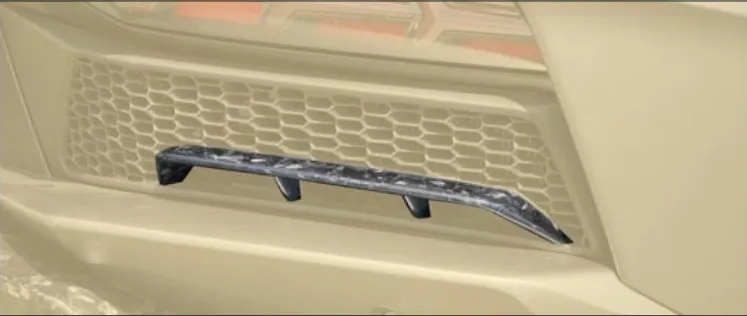
Rear bumper air outtake cover Mansory Carbon for Lamborghini Aventador S


Mansory Carbon Rear Bumper Air Outtake Cover for Lamborghini Aventador S
The Mansory Carbon Rear Bumper Air Outtake Cover is the louvred trim panel that frames the twin side outlets on the Aventador S rear bumper — the apertures Lamborghini sculpted to bleed engine-bay heat away from the naturally aspirated 6.5-litre V12 sitting just inboard of the rear quarters. On the factory bumper this panel is a black-painted insert; the Mansory replacement keeps the slat geometry one-for-one and rebuilds the surround in autoclaved carbon weave, so every louvre is now bordered by visible 3K twill instead of solid black plastic. It is part of the wider Mansory Body Kit for Lamborghini Aventador S, and it slots into the LP740-4 S programme alongside the rear diffuser, the rear bridge and the side-skirt outtake cover. Aventador S has lower-side exhaust outlets rather than a high-mount central twin, so the side outtake apertures sit visually above the tailpipes — the louvred carbon panel anchors the upper edge of the rear corner and reads against the dark exhaust shadow below it. Coupé and Roadster fitments are identical, since this is a rear-bumper accent, not a roof or rear-deck part.
Construction & Materials
The panel is a single-skin autoclaved carbon shell pressed in a multi-part tool that captures the louvre slats, the inboard step where the panel meets the bumper substrate, and the outer sweep that follows the rear quarter line. Mansory runs a 3K twill across the visible faces, with optional 2x2 forged-look patches on commission. The slats are not added later — they are built into the same skin so the weave runs continuously across each louvre face, which is the visual cue that distinguishes a Mansory cover from third-party stick-on imitations.
- Weave: 3K 2x2 twill standard, plain weave or forged-composite available on request
- Cure cycle: prepreg autoclave at 120 °C with vacuum-bag debulk between plies
- Wall thickness: 1.6–2.0 mm across the louvre webs, ~2.4 mm at the perimeter flange
- Weight per side: roughly 0.55–0.7 kg vs ~1.0 kg for the OEM painted insert
- Finish: clear UV-stable lacquer (gloss or satin); raw-feel matte protectant available
- Mounts: factory clip pockets retained, plus 3M VHB perimeter bond on the flange
- Heat tolerance: post-cure at 130 °C for stability against rear-quarter thermal soak from the V12 bay
- Edges: rolled and sealed, no exposed core, drainage chamfers at the lower louvre tips
Design & Visual Function
The role of the side outtake on Aventador S is engine-bay heat purge. The naturally aspirated V12 runs hot under sustained load — the dry-sump oil circuit, the catalysts, and the bay walls all radiate into the rear corners, and Lamborghini routes some of that warm-air bleed out through these flank apertures rather than relying solely on the rear-deck louvres above the engine cover. The Mansory panel does not change the aperture area or the slat pitch; it dresses what is already an OEM thermal vent. What it changes is how the eye reads the corner of the car. With painted plastic, the louvres recede into a black slab. With twill carbon, each slat catches reflected light along its leading edge, and the panel becomes a gridded surface that breaks up the rear quarter the way a vented carbon hood breaks up the front bonnet.
Weave alignment is the part of the brief Mansory takes most seriously here. The twill bias on each louvre face is set to mirror the bias on the louvre directly above it, so when you walk past the car the diagonals sweep in a consistent direction rather than checker-boarding. The perimeter flange runs straight twill, parallel to the bumper edge. Around the slat tips the weave is rolled rather than cut, so there is no exposed warp showing at the louvre exits. On a body painted in solid black or grey the lacquered carbon disappears into the bumper from a distance and reads as fine texture; on bright colours — Verde Mantis, Arancio Atlas, Bianco Isi — the panel becomes a deliberate dark accent that ties the rear corners to the diffuser fins below.
Lower-side exhaust geometry matters to the visual layering. Because the Aventador S tailpipes exit through the diffuser at the lower edge of the bumper, the side outtake panel is not fighting for attention with a high tailpipe cluster. It can sit as the dominant graphic on the upper third of the rear quarter, with the diffuser fins and tailpipe trims doing their work below. Owners who lacquer the diffuser and the outtake covers in the same gloss level get a continuous carbon band wrapping the back half of the car; owners who run the diffuser in raw matte and the outtake covers in gloss get a deliberate two-tone read between the upper vent grid and the lower aero structure.
Compatibility & Fitment
Lamborghini Aventador S (LP740-4 S, 2017–2021), coupé and Roadster, both supplied as a left/right pair. The panel matches the pre-SVJ rear bumper contour — the corner sweep, the louvre count, and the inboard step are all S-spec, so this part will not retrofit cleanly to an SVJ bumper or to the older pre-2017 Aventador. Nothing in the rear bumper substrate interferes with the panel mounts. OEM rear parking sensors sit below the outtake panel on the bumper face and are untouched. The panel does not alter the aperture dimensions of the side outlet, so the underlying engine-bay heat purge path is preserved as Lamborghini specified it.
Installation & Reversibility
This is one of the easier accent retrofits on the Aventador S programme. Budget 30–60 minutes per side once the bumper area is clean. The OEM painted insert is removed first — three perimeter clips engage on the inboard side, plus a small adhesive bead at the upper edge that is broken with a plastic spudger and warmed line wire. With the OEM panel out, the cavity is wiped with isopropyl alcohol and dried before the carbon piece is offered up. The Mansory cover engages the same factory clip pockets and is then secured with a perimeter VHB bead pressed against the bumper substrate; a tooled-edge plastic roller applied around the flange seats the bond evenly.
Reversibility is good. The OEM clip pockets are not modified, and the VHB bead releases cleanly with heat (a heat gun at moderate setting along the perimeter, then a fishing-line pull) if the original painted insert ever needs to go back on. No drilling, no body trimming, no wiring touched. Adhesive choice respects the bumper substrate — Lamborghini uses a methacrylate-friendly substrate around this aperture, and the supplied VHB family is rated for that chemistry. DIY-capable for an owner with patience and the right spudger; otherwise any Lamborghini-trained body shop or Mansory-approved installer will do both sides inside an hour.
Pairing within the Mansory Aventador S programme
The outtake cover is a corner accent — it works best when the surrounding rear-end carbon is also Mansory-spec rather than mixed with third-party trim. Three siblings make the strongest case as pairing partners.
The first is the rear diffuser. The diffuser fins occupy the lower edge of the same rear bumper; lacquering the diffuser and the outtake covers to the same gloss level creates a continuous carbon band across the back of the car. The second is the side-skirt outtake cover, the matching louvred trim that frames the side-skirt outlet just ahead of the rear wheel — pairing the side-skirt outtake with the rear-bumper outtake creates a louvred carbon line that runs from the door cut to the rear quarter. The third is the rear bridge, which sits above the outtake panel on the upper rear deck and ties the rear-quarter accents into the deck-level carbon. With those three plus the outtake cover you have the complete carbon graphic for the rear three-quarter view.
Maintenance & Durability
Lacquered carbon on a vented panel asks for slightly more attention than lacquered carbon on a flat trim — the louvres collect road film at the slat tips and trap brake dust in the channels behind them. Routine wash care is pH-neutral shampoo with a soft mitt, agitating between the louvres with a long-bristle detail brush rather than a stiff sponge. Avoid alkaline wheel cleaners migrating onto the panel; alkaline chemistry haze the lacquer. Ammonia-based glass cleaner is the other agent to keep off the carbon — overspray dulls the clearcoat over time. Ceramic coating on the panel face protects the lacquer for two to three years and makes between-louvre cleaning faster, since road film no longer keys into the surface.
Engine-bay thermal soak from the naturally aspirated V12 is the durability question owners ask about most often. The post-cure cycle on the Mansory panel is set above the worst-case thermal soak it will see at the rear-quarter wall, and a thin reflective foil shield can be added inside the bumper substrate behind the panel for cars that see frequent track use, where the bay walls reach their highest sustained temperatures. UV exposure on the lacquer is the slow killer over years; garaged cars or cars with regular ceramic refresh show no perceptible weave fade at the five- to seven-year point. Stone-chip damage at the louvre tips, is a localised resin-and-clearcoat repair, not a panel swap.
Lead Time & Warranty
Mansory cuts the panels in pairs to order. Lead time is normally 4–8 weeks from confirmation to dispatch, depending on weave and finish — gloss 3K twill is at the short end, forged-composite in matte at the long end. A 12-month warranty against manufacturing defects covers laminate voids, clearcoat delamination, and weave irregularities; it does not cover stone chips or chemical damage from incompatible cleaners. Panels ship with installation notes and a touch-up clearcoat vial.
FAQ
Q: Does the Mansory panel change how much heat the rear bumper vents from the V12 bay?
A: No. The aperture dimensions and the slat pitch are identical to the OEM insert, so the engine-bay heat purge path is unchanged. The cover is an aesthetic upgrade over a thermal aperture Lamborghini already designed.
Q: Are the coupé and Roadster panels the same part?
A: Yes. The rear bumper geometry is shared between coupé and Roadster on Aventador S, so the same left/right pair fits both. Only roof-area parts differ between the two body styles.
Q: Will the panel fit a pre-2017 Aventador or an SVJ?
A: No. The corner sweep and louvre count are S-spec. Pre-2017 cars and the SVJ have different rear bumper substrates and need their own panels.
Q: How much weight does it save versus the OEM painted insert?
A: Roughly 0.3–0.45 kg per side. The headline value here is the visual change at the rear corner rather than mass reduction.
Q: Can I run a forged-look weave to match my engine cover?
A: Yes. Forged-composite or 2x2 plain weave is offered on commission alongside the standard 3K twill, with the same lacquer options.
Q: Does the lower-side exhaust on Aventador S leave enough clearance to the panel?
A: Yes. The tailpipes exit through the diffuser at the lower bumper edge; the outtake panel sits well above the exhaust path and sees no direct exhaust gas wash.
Q: Will removing the OEM insert leave any visible damage on the bumper?
A: No, when done with the right tools. The factory clip pockets and the substrate around the aperture stay intact, so reverting to the OEM panel later is straightforward.
Pair it with the rear diffuser and the side-skirt outtake cover for a coherent rear-quarter carbon graphic, and add the rear bridge if you want the deck and the rear corners speaking the same weave. Order, configure, or ask weave-and-finish questions via WhatsApp +44 7488 818 747 or [email protected].