Rear kit 4xx high flap Mansory Carbon for Ferrari 488 Siracusa 4XX


Rear Kit 4xx High Flap — Mansory Carbon for Ferrari 488 Siracusa 4XX
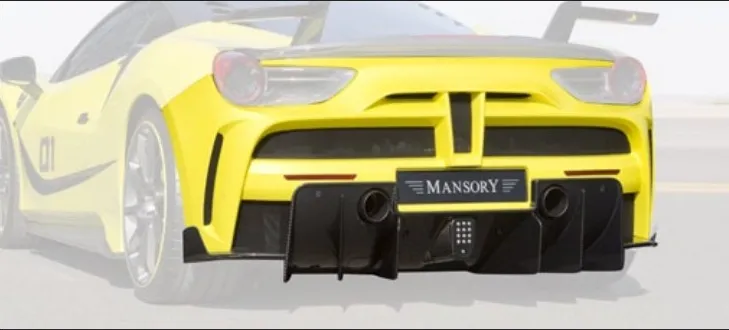
The 4xx high-flap rear kit is the track-spec rear of the Siracusa programme. It replaces the OEM rear bumper and diffuser with a single autoclave-cured carbon shell, but the diffuser kick angle is steeper than on the road variant and the trailing flap rises significantly higher above the bumper trim line. Within the wider Mansory Carbon Fiber Body kit set for Ferrari 488 Siracusa 4XX programme this part exists for one reason: to match the peak download numbers of the high-flap front so the car carries balanced aero to the rear axle through fast corners and under high-speed braking. Fitting it without the matching front pushes the car toward oversteer; fitting it with the matching front gives a 488 a circuit-ready aero balance with track-day grip the OEM Siracusa cannot match.
Construction & Materials
The rear high-flap kit takes the same single-shell logic as the road version but reinforces every load path that sees the higher pressure differentials. The diffuser ceiling carries a thicker bias-laid backing because suction loads at peak speed are higher, the strake roots carry a unidirectional cap layer to resist peel, and the trailing flap is co-cured into the bumper face with a unidirectional spine running across its full width to stop it from unloading at speed.
The OEM exhaust-tip cut-outs are preserved exactly to factory geometry. The carbon shell sits on the same bumper carriers, exhaust hangers and under-tray fasteners as the OEM rear, with no chassis modification of any kind. The harness clips, reverse-light and number-plate housing transfer over from the OEM bumper using the original brackets.
- Outer ply: 3K 2x2 twill prepreg, weave aligned to the car centreline through bumper face, diffuser strake tops and flap upper surface
- Backing: bias-laid 200 gsm plus heavy unidirectional reinforcement under the diffuser ceiling and across the flap spine
- Cure: autoclave at 125 °C, 6-bar consolidation, 100-minute dwell, post-cure free-stand at 80 °C
- Resin: high-Tg epoxy, 150 °C continuous service, 180 °C peak — chosen for sustained track loading next to the exhaust
- Wall thickness: 2.6–3.0 mm bumper face, 3.5–4.0 mm diffuser ceiling, 5.0 mm at strake roots and flap spine
- Mounting: OEM rear-bumper carriers, exhaust hangers, under-tray fasteners — no chassis modification
- Hardware: stainless ferrules at all fastener points, factory exhaust-tip cut-outs preserved
- Finish: deep gloss 2K clear standard, satin matte and exposed-weave matte black on request
Design & Visual Function
The high-flap rear is built around two aerodynamic levers. The first is the diffuser expansion angle. Where the road-spec rear holds expansion to around 12 degrees inside the attached-flow envelope, the high-flap version opens up to roughly 16–18 degrees through the upper section of the diffuser. That steeper kick increases the volume of low-pressure air pulled through the underbody at speed, which raises peak rear-axle download but also demands cleaner flow into the diffuser entry — meaning the kit only does its real job when paired with a high-flap front bumper that delivers undisturbed flow under the floor.
The second lever is the tall trailing flap. The flap rises around 35–45 mm above the bumper trim line, sits at a sharper angle than the road version and is set back further from the diffuser exit. That geometry creates a small but useful pressure dam at the trailing edge of the upper bodywork, helping to hold the wake closer to the rear of the car at high speed and adding a few additional kilograms of rear download. Estimated steady-state rear-axle download at 250 km/h is in the order of 45–60 kg over the OEM bumper — roughly 2.5× the figure of the low-flap variant — at the cost of a measurable drag rise.
Visually, the steeper diffuser and taller flap give the rear of the car a more openly aggressive presence. The strake fences are visible from a much wider photo angle than the low-flap version, and the trailing flap reads as a distinct horizontal bar floating above the bumper line. Carbon weave alignment is square to the strake tops and the flap upper surface, so the diagonal grid runs continuously across the rear graphic.
Pressure mapping during development showed that the high-flap rear loads the diffuser more in the central section than the road version does, which is why the strake roots are reinforced with the unidirectional cap layer mentioned earlier — without that reinforcement the strakes would peel forward over time as the suction load worked them loose at the laminate interface. The trailing flap also takes a steady downforce vector that tries to bend it back over the bumper line at speed; the unidirectional spine across the flap stops the bend before it starts. Both reinforcements are invisible from outside but are the structural reason the high-flap rear holds geometry through repeated track sessions where a thinner laminate would creep out of shape.
The flap also closes the wake more tightly behind the car than the OEM rear bumper does, which has a small but useful side effect on stability under high-speed braking — air no longer tumbles up behind the deck line in the same way, so the car is less prone to the rear-end lightness some 488 owners notice when standing on the brakes from autobahn speed. That stability gain is not the primary purpose of the part, but it is a real consequence of how the high-flap geometry shapes the wake.
Compatibility & Fitment
Fits Ferrari 488 GTB coupé and Ferrari 488 Spider, model years 2015–2020, with the 3.9-litre V8 twin-turbo. OEM tip cut-outs match factory exhaust geometry exactly; aftermarket sport exhausts with non-OEM tip diameter or position should be confirmed by photograph before ordering. Reverse-light, fog-light and number-plate housings transfer from the OEM bumper. The kit is structurally tuned to be paired with the high-flap front bumper — fitting it with the road-spec low-flap front is not recommended.
Installation & Reversibility
Body-shop work, plan a half-day. The OEM rear bumper drops as a single assembly once the rear arch liners and under-tray fasteners are out. Transfer the lights, number-plate housing and harness clips into the carbon shell. Refit using the original bolts. The exhaust hangers, the rear crash-bar geometry and the boot release are all unchanged. Total bench time is around four hours. Reversibility is full — OEM rear stores flat and refits with the same bolts.
Pairing within the Mansory Ferrari 488 Siracusa programme
The high flap rear is the matched partner of the Front kit 4xx high flap — the two are aerodynamically tuned together. Track-spec builds typically add the Rear wing on top of the high-flap rear so the rear axle has both diffuser-side and wing-side load contributions, plus the Air outtakes on the rear quarters to bleed engine-bay heat at speed.
Maintenance & Durability
The high-flap rear lives next to the exhaust and sees track-cycle thermal load. Standard care: pH-neutral shampoo, soft mitt, no pressure washer within half a metre of the diffuser exit. After each track session inspect the strake undersides for kerb contact and the flap underside for stone strikes. The high-Tg epoxy holds dimension across track-day temperatures without softening. UV exposure is limited because the part sits below the deck line; lacquer holds colour across the lifetime of the car under normal use. Light kerbing on a low-speed mis-park can be touched in by any competent paint shop without disturbing the laminate.
Lead Time & Warranty
Lead time is 3–4 weeks from confirmed order, longer for satin or matte-black finishes. Twelve-month warranty against manufacturing defects: laminate voids, delamination, ferrule pull-out and clearcoat lift are covered. Track contact damage, kerb impact and aggressive-cleaner damage are excluded.
FAQ
Q: Can I fit the high flap rear with the low flap front?
A: Strongly not recommended. The two aero packages are tuned in pairs; mixing biases the car toward oversteer at speed.
Q: How much rear download versus the road version?
A: Roughly 2.5× — around 45–60 kg additional rear-axle download at 250 km/h vs OEM, against 18–24 kg for the road-spec rear.
Q: Does it work with OEM exhaust?
A: Yes. Tip cut-outs are preserved to factory dimensions. Aftermarket exhaust geometry should be photographed for a clearance check before ordering.
Q: Will the diffuser drone or buzz?
A: No. Single-shell construction holds the strakes rigid; buzz and drone are characteristic of multi-piece kits.
Q: Can I add the carbon rear wing on top of this?
A: Yes. The rear wing is the natural complement to the high-flap rear — diffuser and wing contribute independently to rear-axle download and the combination is the standard track-spec rear configuration.
Pair the high flap rear with the high flap front and side set — this is the matched aero brief the kit was engineered around. CTA: WhatsApp +44 7488 818 747 or [email protected].