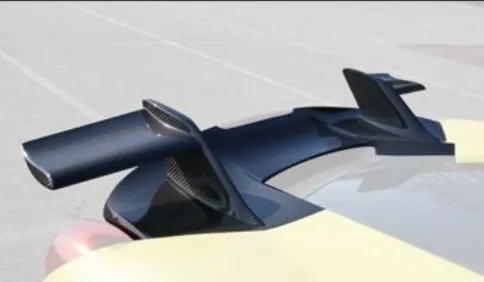
Rear wing Mansory Carbon for Ferrari 488 Siracusa 4XX


Rear wing Mansory Carbon for Ferrari 488 Siracusa 4XX
This is the structural rear wing in the Mansory Siracusa 4XX programme, a stand-alone carbon aerofoil that sits above the 488 engine deck on two carbon uprights and produces measurable downforce rather than a styling kick. Within the broader Mansory Carbon Fiber Body kit set for Ferrari 488 Siracusa 4XX kit it is the upper bookend of the aero story — the front splitter generates the front-axle balance, the side flaps manage the underbody flow, and the wing finishes the picture by loading the rear axle. It is bought by owners who want their 488 to behave differently at speed, not just look meaner standing still.
Construction & Materials
A rear wing is a load case in a way that bumpers and skirts are not. At motorway speed the aerofoil is generating tens of kilograms of vertical load, and at high circuit speed that climbs into three-figure territory. That load goes through two slim uprights into mounting plates on the rear deck and through them into the underlying structure. The wing has to carry that load without flex — flex changes the angle of attack, which changes the downforce, which changes the balance, which destabilises the car at exactly the wrong moment. So the lay-up is genuine engineering, not styling.
- Aerofoil shell: 3K 2x2 twill aerospace prepreg over a closed-cell foam core, structural rather than cosmetic
- Internal spars: unidirectional carbon spar caps running along the leading and trailing edges, taking bending load
- Uprights: solid laid-up carbon billets, machined for upright-to-aerofoil bond and for upright-to-deck mounting plate
- Cure: full autoclave cycle on the aerofoil, autoclave plus post-cure on the uprights for thermal stability
- End-plates: visible-carbon plates running the full chord of the wing, with leading-edge profile shaped to manage tip vortex
- Hardware: stainless mounting plates, bolted into the deck through OEM-spec threaded inserts; no body drilling
- Weight: roughly 5.8–6.4 kg complete (aerofoil + uprights + end-plates + hardware)
- Finish: 2K automotive clear over the visible faces, matte tooled finish on the underside; gloss or satin to order
Design & Visual Function
The aerofoil section is a fixed-geometry profile — no DRS flap, no active angle adjustment — so the work goes into the chord, the camber and the angle of attack, all set during the design phase and locked in at moulding. The chord is shorter and the camber tighter than a track-day-only wing because the part has to remain civil at motorway speed; an over-aggressive aerofoil generates so much drag at 100 mph that the car loses top-end and burns fuel without delivering useful corner-speed gain. The Siracusa wing is set up to add genuine rear-axle load through the 130–250 km/h band, which is where most fast road and trackday driving happens.
End-plate geometry is the other engineering story. Without end-plates an aerofoil leaks pressure off its tips — high-pressure air on the underside escapes around the wingtip into the low-pressure upper face, and that bleed cuts the wing's effective load. Full-chord end-plates close that path. They run the entire length of the wing rather than stopping short at the trailing edge, and the leading-edge profile is shaped to stage the tip vortex behind the wing rather than pulling it forward over the deck. Visually the end-plates are also where the eye lands — they are the largest visible-carbon faces on the wing, and the weave on them runs vertically so the diagonals frame the engine deck behind.
The uprights are the third design lever. Two slim, polished-carbon vertical struts carry the wing above the engine deck. They are positioned outboard of centre rather than at midspan, so the visual reading is a wing floating on legs rather than a ladder bolted to the car. The bond between upright and aerofoil is hidden inside the wing's lower surface, so from any normal viewing angle the wing reads as one continuous piece without visible fasteners. The mounting plates at the deck end of each upright are the only metal in the assembly; they are stainless, machined to fit OEM rear-deck threaded points, and concealed under the carbon foot of each upright once the wing is bolted down.
At speed the wing produces a clean, low-frequency airflow signature behind the car — there is no whistle, no buffet, no resonance from the cabin — because the chord, camber and end-plate dimensions were sized in CFD and then validated in real-world high-speed runs before the part went into production. A poorly-sized aftermarket wing can turn into a wind-noise generator at 110 mph; this one does not, because the trailing-edge geometry is sharp enough to shed flow cleanly and the leading edge is rounded enough to handle the angle changes that happen in a yawed corner.
Compatibility & Fitment
This rear wing fits the Ferrari 488 GTB coupé and the 488 Spider, model years 2015–2020, with the 3.9-litre twin-turbocharged V8. The mounting hardware locates onto threaded points already present in the rear deck structure of both body styles — no body drilling is required and the points are concealed under the engine cover trim. The Spider mounts the wing the same way the GTB does, with no clearance issues against the convertible roof stack because the aerofoil sits well above the deck line. The wing does not fit the 488 Pista, which has its own bespoke factory wing, nor the F8 Tributo, which has a different deck profile.
Installation & Reversibility
Installation is a specialist job — this is the part of the kit that justifies a paint shop or trim specialist most clearly, because the wing has to be square to the body, level across both uprights and torqued correctly into the deck inserts. Allow 3–4 hours of bench time. The mounting plates fit through small access cuts in the engine cover trim that are not visible from outside the car, so reversibility is total — when the wing is removed for sale or specification rollback, the mounting plates lift out, the trim is replaced, and there is no visible evidence on the body. Tools required are a torque wrench set to 18 Nm, a 13 mm socket, alignment shims, and a level for upright squareness. Most buyers have the wing fitted at delivery rather than fitting it themselves, and Mansory specifies a torque sequence that should be followed exactly.
Pairing within the Mansory Ferrari 488 Siracusa programme
The wing is the rear-axle aero finisher for the kit. Most owners pair it with the Rear kit 4xx high flap so the diffuser geometry below and the wing geometry above work the same air column, and add the Side set low flap or its high-flap counterpart depending on stance. Builds going for the full visible-carbon brief at the back of the car often add the Rear air outtake grills cover so the engine deck reads as one carbon surface beneath the floating wing.
Maintenance & Durability
Wash gently — high-pressure water aimed at the wing roots can loosen the rubber gaskets that seal the deck inserts, so keep the lance back when cleaning the area. Wax the visible-carbon faces twice a year to extend the lacquer's UV margin. Inspect the upright-to-deck bolts at every annual service and re-torque if needed; the wing is loaded in cycles every time the car is driven hard, and any structural fastener should be checked periodically. If a stone strike chips the lacquer on a leading edge, the carbon underneath is unaffected and a paint shop can flat-and-clear the affected area without disturbing the laminate. Expected service life is well beyond ten years.
Lead Time & Warranty
Lead time is typically 3–5 weeks from confirmed order to dispatch — longer than a simple trim part because the wing involves multiple sub-components (aerofoil, uprights, end-plates, hardware) that each have to clear autoclave and then be assembled. Satin matte adds about a week. The wing ships with a 12-month warranty against manufacturing defects covering laminate voids, delamination, upright bond failure, end-plate separation and clearcoat lift. Damage from incorrect installation, from impact, or from chemical attack by aggressive cleaners is not covered, but field repair by a competent specialist is straightforward in most cases.
FAQ
Q: How much downforce does the wing produce?
A: At motorway speed (around 130 km/h) the wing adds a few kilograms of rear-axle load; at sustained autobahn or trackday speed (200+ km/h) that climbs into the tens of kilograms. The number scales with the square of velocity, so the wing earns its keep at speed rather than at low cruising.
Q: Does it whistle or buffet at high speed?
A: No. The trailing edge is profiled sharply enough to shed flow cleanly and the leading edge is rounded enough to handle yaw, so the wing is acoustically quiet across the speed range.
Q: Will the wing fit a 488 Spider with the roof down?
A: Yes. The aerofoil sits well above the deck line and the convertible roof stack passes underneath it cleanly. There is no clearance issue when the roof opens or closes.
Q: Is the wing adjustable for angle of attack?
A: No. It is a fixed-geometry aerofoil — chord, camber and angle are set at moulding. Adjustable wings sound appealing but in practice introduce play at the upright joint and become a buffet source over time. A fixed wing is structurally and acoustically cleaner.
Q: Will it fit the 488 Pista?
A: No. The Pista runs its own bespoke factory aero pack including a different rear wing arrangement; this part is sized for the 488 GTB and 488 Spider rear deck geometry.
Pair this rear wing with a high-flap rear bumper and matching side flaps so the aero language at the back of the car reads as one composition. CTA: WhatsApp +44 7488 818 747 or [email protected].