
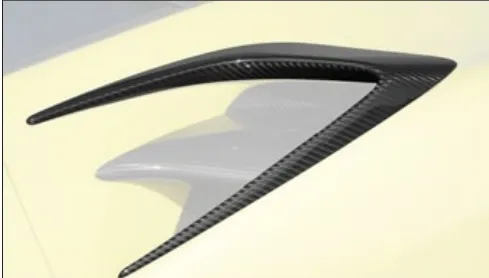
Air outtakes Mansory Carbon for Ferrari 488 Siracusa 4XX


Air outtakes Mansory Carbon for Ferrari 488 Siracusa 4XX
The air outtakes sit at the rear-quarter flanks of the 488, just behind the door cut, where the OEM ducts pull hot air out of the engine bay and dump it into the wake of the car at speed. They are functional ducts on a 488, not styling exercises — the V8 produces enough heat through the inboard turbos that the bay needs venting, and the OEM duct geometry is sized for that thermal job. Within the wider Mansory Carbon Fiber Body kit set for Ferrari 488 Siracusa 4XX kit the carbon outtake frames replace the OEM plastic surrounds while leaving the duct path itself untouched, so the thermal performance of the car is preserved and only the visible material changes.
Construction & Materials
An air outtake frame has a particular thermal duty cycle. The bay air leaving the duct can hit 80–110 °C after a hard run, and that air flows directly across the inside surface of the carbon frame on its way out into the wake. So the lay-up is biased toward thermal margin: the same prepreg is used as on the rest of the Siracusa programme, but the resin runs at the higher end of its Tg specification and the lay-up is locally thicker along the duct trailing edge where heat exposure is highest.
- Surface ply: 3K 2x2 twill aerospace prepreg, weave aligned with the duct opening so the diagonals frame the airflow path
- Backing plies: bias-laid 200 gsm carbon, doubled along the duct trailing edge for stiffness and thermal mass
- Cure: full autoclave at 125 °C, 6-bar consolidation, post-cure free-stand at 80 °C for thermal stability
- Resin: high-Tg epoxy, 150 °C continuous service rating, chosen specifically for under-bonnet and bay-vent thermal duty
- Wall thickness: 2.0–2.4 mm across the visible face, stepped to 3.0 mm along the duct trailing lip
- Edge profile: sharp trailing-edge geometry to shed flow cleanly without buffet at speed; rounded leading edge for chip resistance
- Mounting: reuses the OEM outtake clip and screw points; no body modification
- Finish: 2K automotive clear, UV-stable, gloss as standard, satin matte to order; underside left as tooled finish for thermal venting
Design & Visual Function
The outtake has two competing requirements that the design has to balance. Visually, it wants a clean, square frame around a deep aperture so the eye reads the duct opening as a deliberate carbon detail rather than a plastic afterthought. Functionally, it wants enough open area for the bay vent to work properly at speed, and a sharp enough trailing edge that the flow exits cleanly without setting up resonance or buffet. The Siracusa outtake design pulls both: the frame is shaped tightly around the OEM duct opening so visible carbon area is maximised, and the trailing edge of the frame steps down into the duct path with a sharp profile so the bay air leaves cleanly rather than rolling off a soft lip.
Edge work is where the part either succeeds or fails. The trailing edge is the most thermally-loaded face on the frame because hot bay air flows across it on its way out; if the carbon there is too thin, repeated heat cycling can haze the lacquer over time. The lay-up is locally thickened along that edge to add thermal mass — more carbon means slower heat-up and slower cool-down, which protects the clearcoat from cyclical thermal stress. The leading edge, by contrast, is the chip-exposure zone — stones lifted off the rear tyres at speed can reach the outtake faces — and that edge is rounded with a 2 mm radius rather than sharpened, so a stone strike chips the lacquer rather than splitting the laminate.
Weave alignment is the third design lever. The duct opening is roughly rectangular but slightly trapezoidal — the 488's rear-quarter sculpting tilts the duct opening slightly forward of vertical — and the weave is aligned with the duct opening rather than with the body. This means the diagonals run square to the airflow path, which reads more deliberately under bay light and in profile photography than a body-aligned weave would. It is the kind of detail nobody notices consciously but everybody registers when looking at the car.
Compatibility & Fitment
The outtake frames fit the Ferrari 488 GTB coupé and the 488 Spider, model years 2015–2020, with the 3.9-litre twin-turbocharged V8. Both body styles share the same rear-quarter outtake duct geometry, so a single frame design crosses both. The part does not fit the 488 Pista, which has its own bespoke aero pack including a different outtake treatment, nor the F8 Tributo, which has a different rear-quarter sculpting. If the car has been retrofitted with non-OEM rear-quarter trim or aftermarket outtake hardware, send a photograph of the existing duct before ordering and we will check the frame contour against the OEM duct opening before despatching the order.
Installation & Reversibility
Installation is a competent specialist job rather than a driveway one. Allow 1.5–2 hours per side. The OEM plastic outtake surround is removed by releasing the inner trim panel behind the rear-quarter glass and lifting the surround clear of the OEM clip points; the carbon frame then drops onto the same clip locations and the same screw points and is torqued down. Tools required: trim removal kit, T20 Torx driver, torque wrench set to 6 Nm, and a soft cloth to protect the rear-quarter paintwork during the swap. The change is fully reversible — the OEM plastic surround stores flat and can be refitted in an hour if the car is ever returned to factory specification for sale or PPF re-wrap.
Pairing within the Mansory Ferrari 488 Siracusa programme
The outtakes finish the carbon language at the rear flanks, so they pair most naturally with parts that finish the rear of the car overall. Most builds add either the Air outtakes splitter I or the Air outtakes splitter II as the inner vertical splitter inside the outtake aperture itself, depending on which geometry the customer prefers. Builds going for a fully carbon rear treatment usually add the Rear lights carbon cover so the carbon language wraps from the outtake frame around to the rear lighting surround.
Maintenance & Durability
The outtake faces sit in a high-airflow, high-particulate zone — they catch road grit, brake dust and rear-tyre spray — so they need slightly more attention than a B-pillar trim or a roof cover. Wash gently with pH-neutral shampoo and a soft mitt; avoid abrasive sponges, which can scratch the lacquer over time. Twice-yearly carnauba wax over the visible faces extends the lacquer's UV margin and helps the surface shed road grime. The trailing-edge thermal cycling does not damage the laminate or the lacquer when the resin selection is correct, and the high-Tg epoxy used here is specified for exactly this duty cycle. If a stone strike chips the leading-edge lacquer, the carbon underneath is rarely damaged and a paint shop can flat-and-clear the affected area locally without disturbing the laminate. Expected service life is well beyond ten years.
Lead Time & Warranty
Lead time is typically 2–3 weeks from confirmed order to dispatch, plus an extra week if satin matte is specified. The frames are made in pairs and shipped together with the matching hardware. Each pair ships with a 12-month warranty against manufacturing defects, covering laminate voids, delamination, clip and screw point failure, and clearcoat lift under normal thermal cycling. Damage from impact, from chemical attack by aggressive cleaners, or from forced installation onto non-OEM ducts is not covered, but most cosmetic damage is field-repairable by a competent paint shop without disturbing the laminate.
FAQ
Q: Will the carbon survive the heat coming out of the bay?
A: Yes. The high-Tg epoxy is rated to 150 °C continuous, the bay air leaving the duct typically peaks at 80–110 °C, and the trailing edge is locally thicker for thermal mass. The clearcoat is specified for under-bonnet and bay-vent service.
Q: Does the carbon outtake change how the bay vents?
A: No. The duct path itself is unchanged — the carbon replaces only the visible surround. Vent area, vent geometry and thermal performance are identical to the OEM setup.
Q: Do I need the splitter as well, or does the outtake stand alone?
A: It stands alone. The splitter is an inner vertical detail inside the duct aperture and is a separate aesthetic upgrade; many builds run only the outtake frame and skip the splitter. Adding the splitter sharpens the visual reading of the duct from a side angle.
Q: Will the frames vibrate at speed or buzz at idle?
A: No. They mount to the same OEM clip points the plastic surround uses, the laminate is stiff enough to resist resonance, and the trailing-edge geometry is sized to shed flow cleanly without setting up acoustic feedback.
Q: Can I run satin matte?
A: Yes. Specify at order. The matte is achieved by flatting the 2K clear rather than waxing, so the finish stays consistent over years rather than buffing back to gloss after wash cycles.
Pair these outtake frames with one of the splitter geometries inside the duct aperture and with the rear lights carbon cover so the rear flank reads as one carbon surface. CTA: WhatsApp +44 7488 818 747 or [email protected].