
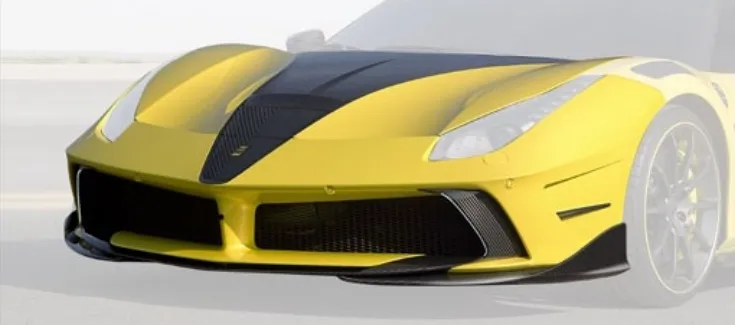
Front kit 4xx high flap Mansory Carbon for Ferrari 488 Siracusa 4XX


Front Kit 4xx High Flap — Mansory Carbon for Ferrari 488 Siracusa 4XX
The 4xx high-flap front kit is the track-biased version of the Siracusa front aero. It replaces the OEM front bumper with a longer, more aggressive carbon shell whose splitter projects further forward and whose leading flap sits taller and at a sharper angle of attack than the road-spec low-flap variant. Inside the wider Mansory Carbon Fiber Body kit set for Ferrari 488 Siracusa 4XX kit it is the loudest aerodynamic statement at the front of the car: where the low flap is tuned for attached, calm flow at autobahn speeds, the high flap is tuned to deliberately separate flow over the lip and trap the resulting low-pressure region against the underside of the splitter, producing a sharper peak download number at the cost of a steeper drag rise. Owners pick this front for cars that see real circuit time, hill-climb runs or track-day events where peak front grip matters more than ride-height compromise on the way home.
Construction & Materials
Because the high-flap splitter generates higher peak loads than the low-flap version, the laminate is built thicker through the leading edge and the flap is reinforced with a unidirectional cap layer. The flap itself is co-cured into the splitter, so there is no joint to fail under load. The shell is one continuous prepreg surface from the upper bumper line down through the splitter and into the flap, which is the only way to keep the aerodynamic surfaces dimensionally stable when the part is loaded at speed.
Sensor and radar cut-outs use the same OEM bracket geometry as the road version, but the splitter is set further forward — meaning the bumper carrier still bolts to factory points, but the visible nose line shifts forward by roughly 25 mm. The car still passes ADAS calibration on the same procedure.
- Outer ply: 3K 2x2 twill prepreg, weave centred on the car centreline so the diagonal grid runs square to the taller splitter trim line
- Backing: bias-laid 200 gsm carbon plus heavy unidirectional reinforcement at the leading edge and flap root
- Cure: autoclave at 125 °C, 6-bar consolidation, 100-minute dwell, post-cure free-stand at 80 °C
- Resin: high-Tg epoxy, 150 °C continuous, 180 °C peak — chosen for sustained track loading
- Wall thickness: 2.6–3.0 mm bumper face, stepped to 4.5 mm through the splitter and 5.0 mm at the flap root
- Mounting: OEM bumper carriers, OEM crash-bar bolts, OEM under-tray fasteners — no chassis modification
- Hardware: stainless ferrules pre-bonded at every fastener; additional ferrules along the splitter to take optional aero-canard mounting
- Finish: deep gloss 2K clear standard, satin matte and exposed-weave matte black on request
Design & Visual Function
A high flap is an aerodynamic device, not a styling cue. The taller flap presents a steep angle of attack to the oncoming flow; the boundary layer cannot follow that angle and separates off the leading edge, dropping the pressure on the underside of the splitter. With the splitter projecting further forward there is more swept area for that low-pressure region to act on, so peak front download rises sharply. Estimated steady-state front-axle download at 250 km/h is in the order of 35–48 kg over the OEM bumper — roughly 2.5× the figure of the low-flap variant — at the cost of around 6–9% additional drag at the same speed. That trade-off is the entire reason the high flap exists.
The aero geometry also drives a particular look. The splitter projection sits 60–70 mm forward of the OEM nose line, and the flap rises around 35–45 mm above the splitter floor — close to twice the visible height of the low-flap version. The leading edge is profiled with a tighter radius than the road-spec part because separation wants a sharper edge to key off; that gives the front of the car a more knife-cut appearance from a low photo angle.
Carbon weave alignment carries the same logic as the road kit — square to the splitter trim line, continuous across the bumper face — but here the splitter has more visible surface and the eye reads more of the diagonal grid. Mansory branding is laser-etched into the lacquer at the corner of the splitter. Optional canard ferrules are pre-bonded along the upper splitter edge so canards can be added later for additional peak download without drilling the laminate.
The high-flap geometry also influences the visual stance of the car. With the splitter projecting further forward and the flap rising taller, the nose looks lower and longer from a low photo angle, which is the look most circuit-spec Siracusa builds are after. The combination of a generously curved leading edge across the bumper face and a sharply profiled flap edge gives the car a deliberate dual-character front graphic — softness where the carbon has to absorb stone strikes, sharpness where the air has to separate. That is not a styling compromise; it is the consequence of letting the aerodynamics drive the geometry rather than the other way around. From three-quarter front the splitter reads as a continuous shelf carrying the flap above it, and the transition from bumper face to splitter top is held perfectly horizontal across the full width of the car.
Compatibility & Fitment
Fits Ferrari 488 GTB and 488 Spider across 2015–2020, with the 3.9-litre V8 twin-turbo. The OEM front-axle lift system retains travel but the splitter projection means lift clearance over a 1-in-6 ramp drops to roughly 25 mm — enough for most kerbs and entry ramps, but tighter than the low-flap variant. Cars run on track-spec lowered suspension should photograph the front ride height before ordering so we can confirm splitter ground clearance. The factory radar, parking sensors and grille mesh transfer into the new shell using OEM brackets.
Installation & Reversibility
Body-shop work, half a day. Drop the OEM bumper, transfer parking sensors, radar bracket and grille mesh into the carbon shell, re-fit using the original bolts. The crash-bar geometry is unchanged so the airbag system sees the same impact path. Total bench time is around four hours including ADAS calibration. Reversibility is full — OEM bumper refits with the same bolts when the car is sold or returned to factory specification.
Pairing within the Mansory Ferrari 488 Siracusa programme
The high flap front pairs naturally with the matching Rear kit 4xx high flap so front and rear download grow together — fitting the high flap front with a low flap rear pushes the car toward heavy understeer and is not advised. Track-spec builds typically add the Side set high flaps for the rocker line and the Rear wing on top of the rear kit so the rear axle has a corresponding peak download figure to match the front.
Maintenance & Durability
The high-flap splitter sees more stone-chip exposure than the road-spec part because it projects further forward; consider a clear paint-protection film over the leading edge if the car covers significant motorway mileage between track days. Wash with pH-neutral shampoo, avoid pressure washers within half a metre of the lip, and inspect the splitter underside after each track session for kerb scrapes. UV-stable 2K clear holds colour across the lifetime of the car under normal exposure. Stone chips touch in cleanly without disturbing the laminate. Expected service life is in line with the rest of the carbon programme.
Lead Time & Warranty
Lead time is 3–4 weeks from confirmed order, with satin or matte black adding around a week. Twelve-month warranty against manufacturing defects: laminate voids, delamination, ferrule pull-out and clearcoat lift covered. Track contact damage, kerb impact and aggressive-cleaner damage are excluded.
FAQ
Q: Can I run the high flap front with the low flap rear?
A: Strongly not advised. The aero balance was designed around matching front and rear flap heights; mixing them biases the car heavily toward understeer at speed.
Q: How much extra downforce versus the low-flap front?
A: Roughly 2.5× the front-axle download at 250 km/h — around 35–48 kg additional vs OEM, against 12–18 kg for the low-flap variant — at the cost of higher drag.
Q: Will it pass front-axle lift over driveway ramps?
A: Yes for normal kerbs and entry ramps; clearance over a 1-in-6 ramp at full lift drops to around 25 mm, so plan accordingly on aggressive ramps.
Q: Can I fit canards later?
A: Yes. Stainless ferrules are pre-bonded along the upper splitter edge specifically to accept canards without drilling the carbon.
Q: Does this affect ADAS or radar?
A: No. Radar and parking sensors use OEM brackets transferred into the carbon shell, and the standard ADAS calibration procedure applies.
Run the high flap front with the matching high flap rear and side set; that is the combination the aero is tuned around. CTA: WhatsApp +44 7488 818 747 or [email protected].