
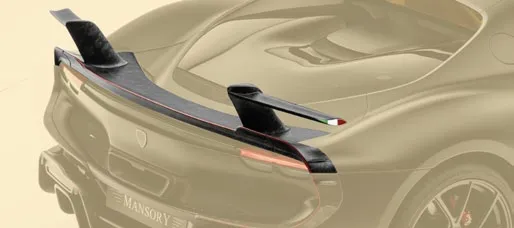
Rear wing Mansory for Ferrari 296 GTB


Rear Wing Mansory for Ferrari 296 GTB
The Mansory Rear Wing is the programme's highest-downforce exterior component — a full-span, trunk-mounted carbon aerofoil that elevates the 296 GTB's rear-axle aerodynamic load from road-car territory into a figure that a GT racer would recognise. Unlike the low-profile spoiler options in the kit, the Rear Wing mounts on dedicated aluminium uprights above the rear deck, positioning the main aerofoil element at the height where free-stream velocity is greatest and the boundary layer has separated cleanly from the deck surface — the aerodynamically optimal location for wing lift coefficient. Part of the Mansory Carbon Fiber Body kit set for Ferrari 296 GTB, this wing is conceived for owners who use the 296 GTB on track days or hillclimb events, where the 830 hp total output of the PHEV twin-turbo V6 drivetrain is exploited at sustained high velocity and the rear-weight-biased platform benefits most from the stability that high downforce delivers. The 7.45 kWh battery pack's rear-tunnel positioning adds meaningful mass behind the rear axle centreline — the same physics that makes the 296 GTB's power delivery feel planted also makes it sensitive to rear-axle aerodynamic instability at speed, and the wing's downforce directly addresses this sensitivity.
Construction & Materials
The main aerofoil element is fabricated from 3K twill pre-preg carbon, autoclave-cured at 120 °C under 6 bar, with a symmetric NACA 6412-derived cross-section adjusted for the 296 GTB's 0° ride-height reference plane at the wing mounting height. The chord is 220 mm at midspan, tapering to 195 mm at the endplates. The endplates themselves are 2.8 mm laminate thickness, with integral blade fences on the inboard face that minimise spanwise pressure leakage from the high-pressure upper surface to the low-pressure lower surface — the primary mechanism by which finite-span wings lose efficiency relative to infinite-span aerofoils. The aluminium uprights are CNC-machined 6082-T6 billet, anodised in matte black to resist environmental corrosion; each upright carries an internal cable routing channel for any LED accent lighting options that Mansory may specify at order stage. Total assembly weight including uprights, mounting hardware, and endplates is approximately 3.8 kg.
- Aerofoil section: NACA 6412-derived, chord 220 mm midspan / 195 mm at endplate
- Weave: 3K twill pre-preg, visual A-face on lower (suction) surface and endplate outer faces
- Cure: autoclave 120 °C / 6 bar, 4 h dwell
- Endplate thickness: 2.8 mm with integral blade fences on inboard face
- Uprights: CNC-machined 6082-T6 aluminium billet, matte-black hard anodised
- Upright mounting: 6 × M8 stainless bolts per side into deck lid reinforced mounting bosses
- Assembly weight: ≈ 3.8 kg including uprights and hardware
- Finish: UV-stable gloss lacquer on all carbon faces; aluminium uprights: matte hard-anodise
Design & Visual Function
The wing's visual statement is deliberate and unambiguous: it signals track capability before the car moves. At the three-quarter rear angle, the endplates frame the rear deck in a wide rectangle that references GT racing proportions — specifically the width-to-height ratio of FIA GT3 wing homologation specifications, which Mansory's design team uses as a visual reference for street-legal track-day parts. The main element's underside is the aerodynamically active surface — the suction side — and is finished with the same A-face 3K twill and gloss lacquer as the upper face, acknowledging that this surface is highly visible from directly behind the car and deserves the same finish quality as any external panel.
Aerodynamically, the wing operates in a region of attached, high-velocity free-stream flow at its mounting height of approximately 280 mm above the deck surface. At this elevation, the complex separated flow field that affects deck-mounted spoilers is largely irrelevant; the wing sees near-uniform upstream velocity and generates lift coefficient in the range predicted by thin-aerofoil theory. The endplate blade fences suppress the spanwise tip vortex that forms at the aerofoil tips — a vortex that would otherwise roll up into a counter-rotating pair that significantly reduces the wing's effective aspect ratio and degrades downforce per unit drag. By maintaining cleaner tip conditions, the Mansory wing achieves a higher lift-to-drag ratio than a comparable wing without endplate fences, meaning the driver gains more downforce per aerodynamic drag penalty. On a 296 GTB with 830 hp available, additional drag is manageable — but at circuit speeds above 200 km/h the total drag of the aero package affects top speed and acceleration out of slow corners, so every efficiency increment matters.
The uprights' matte-black anodised finish creates a deliberate visual contrast with the gloss carbon aerofoil element — a pairing that reads as a functional engineering assembly rather than a decorative appendage. This contrast is reinforced by the upright's machined profile, which reveals the structural logic of the wing's load path: the triangulated cross-section distributes bending moment from the aerofoil element to the deck mounting points in the same geometric pattern visible on professional GT3 racing cars. The endplates' carbon faces, terminated with a sharp edge on all four sides, complete the visual precision of the assembly.
Compatibility & Fitment
The Rear Wing is designed for the Ferrari 296 GTB coupé (2022+) and 296 Assetto Fiorano specification. The 296 GTS spider uses a different rear deck structure and confirmed fitment for the GTS should be verified at order stage. The mounting solution uses reinforced deck-lid bosses at the OEM spoiler positions — no drilling through the deck skin is required, but installation should be carried out by a Ferrari-certified bodyshop to ensure the upright torque loading is correctly distributed to the reinforced mounting interface. No steering-side restriction; LHD and RHD configurations use the same assembly. The 296 Speciale shares the GTB deck geometry; confirm at order stage for any Speciale-specific variations.
Installation & Reversibility
Installation requires removing any existing deck spoiler, positioning the upright bases over the reinforced mounting bosses, and torquing the 6 × M8 mounting bolts per side to 22 Nm in a cross-pattern to ensure even clamping at the boss interface. The aerofoil element is pre-assembled to the uprights before fitting to the car. Total installation time is approximately 1.5–2 hours at a bodyshop equipped with a torque wrench and access to the boot-interior side of the deck lid. The installation is reversible — remove the 12 × M8 bolts, lift the complete assembly clear, and refit the OEM spoiler in approximately 45 minutes. Professional installation is strongly recommended to avoid overloading the deck mounting zone.
Pairing within the Mansory 296 GTB programme
The Rear Wing's high downforce is most effectively balanced by the Rear Diffuser with Brake Light Mansory for Ferrari 296 GTB, which provides underbody suction to match the wing's topside load — running the wing without the diffuser creates a rear-biased downforce distribution that can increase understeer. For the maximum aero specification, the Rear Wing with Air Splitter Mansory for Ferrari 296 GTB adds an active splitter element to the wing assembly, incrementally increasing downforce. Owners specifying a more restrained rear aero approach can consider the Rear Spoiler Mansory for Ferrari 296 GTB as an alternative for road-biased use.
Maintenance & Durability
The wing aerofoil's lower suction surface accumulates road grit projected rearward from the rear tyres at speed and requires inspection and cleaning after every track session. Use a soft microfibre cloth and a pH-neutral shampoo; avoid power-washing the mounting interface between the upright and deck boss. Inspect the 12 × M8 mounting bolts for torque retention every 5 track sessions — sustained vibration from the V6 at peak RPM can loosen bolts if threadlock compound was not applied during installation. The aluminium upright anodise coating is durable against brake dust and road film but can be attacked by strong alkaline wheel cleaners sprayed at the rear of the car — rinse the uprights after any wheel-cleaning session. The endplate edges are sharp by design and should be protected with a clear protective film during transport and storage; impact damage at the edge initiates inward delamination that progresses faster than edge damage at any other carbon panel in the kit. Expect the carbon faces to maintain their lacquer quality for 5–7 years with correct care.
Lead Time & Warranty
The rear wing assembly, including CNC-machined uprights and hardware, carries a lead time of 4–6 weeks from order confirmation to despatch — the aluminium upright machining and anodising process adds time relative to a carbon-only panel. The 12-month manufacturer's warranty covers delamination, aerofoil profile dimensional accuracy, upright structural integrity, and fitment failures at the deck boss mounting interface. Warranty does not cover impact or abrasion damage to the carbon faces, or anodise degradation caused by alkaline cleaning chemistry contact. Contact Hodoor with your order reference and photographic evidence to initiate any warranty claim.
FAQ
Q: Is the Rear Wing road-legal?
A: The wing's dimensions and mounting geometry comply with type-approval constraints for road-legal aftermarket aerodynamic devices in the majority of markets. Owners should verify compliance with their local vehicle modification regulations before presenting the car for inspection, as some markets have specific rear overhang or protrusion rules that may require certification. Mansory can supply dimensional documentation on request to assist with homologation enquiries.
Q: How does the Rear Wing compare to the Rear Wing with Air Splitter?
A: The base Rear Wing is a single-element aerofoil; the Rear Wing with Air Splitter adds a forward-mounted splitter element that increases the effective angle of attack of the aero package, generating more downforce at the cost of marginally more drag. The base Rear Wing is the preferred choice for road-biased track use; the Air Splitter variant suits dedicated circuit use where maximum downforce is prioritised over top-speed performance.
Q: Will the wing affect the OEM rear camera or parking sensors?
A: The OEM rear camera is mounted below the wing plane in the rear bumper surround and its field of view is unobstructed by the wing assembly. Rear parking sensors are similarly in the bumper zone and are unaffected. No recalibration is required.
Q: What is the weight of the complete wing assembly?
A: The complete assembly — carbon aerofoil, aluminium uprights, endplates, and all hardware — weighs approximately 3.8 kg. This mass is carried high on the car above the deck lid, which has an incremental effect on centre-of-gravity height; on a track-prepared car this is a design-accepted trade-off for the aerodynamic benefit.
To specify the Rear Wing or discuss aero package configurations for your 296 GTB, contact us via WhatsApp +44 7488 818 747 or [email protected].