
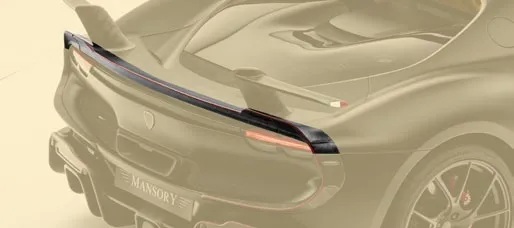
Rear spoiler Mansory for Ferrari 296 GTB


Rear Spoiler Mansory for Ferrari 296 GTB
Where a full rear wing demands a committed aero stance, the Mansory Rear Spoiler offers a more restrained downforce signature — a low-profile ducktail that integrates into the 296 GTB's tea-tray rear deck with minimal visual disruption while generating meaningful incremental rear axle load at road and open-track speeds. Positioned as the subtler of the two rear-lift management options in the Mansory Carbon Fiber Body kit set for Ferrari 296 GTB, the spoiler rises just enough above the rear deck surface to intercept the boundary layer that would otherwise separate cleanly off the deck edge and produce a low-pressure region above the rear bodywork — a region that, if unmanaged, creates turbulent rear-lift and reduces high-speed stability for the 296 GTB's rear-weight-biased PHEV platform. The 296's 830 hp total output from the twin-turbo V6 and axial-flux electric motor, combined with the rear-biased mass from the 7.45 kWh battery pack and transverse-mid engine mounting, demands rear axle aerodynamic control: even a modest spoiler at the deck edge shifts the car's balance toward understeer at speed, improving driver confidence in high-speed cornering without requiring the full downforce and drag commitment of the wing options. The spoiler's low silhouette also preserves rearward visibility from inside the cockpit — a quality-of-life benefit that matters on a daily-driven 296 GTB used on public roads.
Construction & Materials
The spoiler is a single-piece monocoque carbon shell, vacuum-infused over a precision master mandrel and autoclave post-cured at 120 °C under 6 bar. The spoiler profile is a symmetric aerofoil section in cross-section — neither a simple flat-plate nor a complex multi-element assembly — generating downforce through a combination of flow deflection at the leading undersurface and attached Coandă-type flow over the upper surface that remains adhered over the shallow camber angle. The laminate builds to 3.5 mm at the root attachment zone, thinning to 2.2 mm along the main chord and 1.4 mm at the trailing edge, which is ground post-cure to a consistent 0.8 mm radius for a clean boundary-layer separation line without knife-edge fragility. Weight of the complete spoiler assembly including mounting hardware is approximately 1.2 kg.
- Weave: 3K twill pre-preg, visual A-face on upper (visible) surface
- Cure: full autoclave 120 °C / 6 bar, 4 h dwell
- Root thickness: 3.5 mm; mid-chord: 2.2 mm; trailing edge: 1.4 mm, ground to 0.8 mm radius
- Assembly weight: ≈ 1.2 kg including mounting hardware
- Mounting: 4 × M6 stainless bolts through OEM deck lid mounting bosses; no new holes drilled
- Finish: UV-stable gloss lacquer, 2-coat, 80 µm DFT; satin available on request
- Chord length: approximately 85 mm at midspan
- Span: full rear deck width, approximately 1080 mm
Design & Visual Function
The rear deck of the 296 GTB is one of Ferrari's most carefully resolved exterior surfaces — a tight radius transition from the roof arc to the near-horizontal deck, terminating in the wide, short tail that gives the car its characteristic compact fastback silhouette. The Mansory spoiler is sized and profiled to honour this geometry: its chord is shallow enough that, viewed from inside the car, it reads only as a slim carbon accent at the deck edge; viewed from outside at the three-quarter rear angle, it presents as a confident graphic statement that the car carries aerodynamic intent without theatrical excess. The spoiler's underside, visible when the boot is opened, shows the same A-face 3K twill finish as the upper surface — a detail that signals build quality to anyone who inspects the installation closely.
Aerodynamically, the spoiler operates as a boundary-layer trip device that converts the kinetic energy of the rear deck airstream into a controlled separated shear layer at the trailing edge, preventing the uncontrolled flow separation further upstream that would reduce rear-deck pressure recovery and generate rear lift. At speeds above 120 km/h, the incremental rear downforce contribution is perceptible in steering feel — the car's trailing-throttle yaw behaviour becomes more neutral because the rear axle has been slightly loaded by the spoiler's suction effect. At full hybrid performance — 830 hp launching to 200 km/h in approximately 8 seconds — the aerodynamic input is modest compared to mechanical tyre load, but every incremental Newton of rear downforce reduces the probability of aerodynamically induced rear instability at the exit of fast bends.
The 3K twill weave's 45° diagonal orientation runs perpendicular to the car's centreline across the spoiler span, producing a herringbone pattern that reads as a deliberate graphic element when the car is viewed from directly behind. Under direct sunlight the weave catches light at multiple angles simultaneously, animating the surface in a way that flat painted or matte panels cannot replicate. Combined with the high-build gloss lacquer, the result is a surface that appears to have depth — as though the carbon structure is visible beneath a glass skin — rather than sitting flat on the surface.
Compatibility & Fitment
The Rear Spoiler is designed for the Ferrari 296 GTB coupé (2022+) and 296 Assetto Fiorano specification. The 296 GTS spider features a different rear deck geometry due to its retractable roof mechanism; confirm fitment for the GTS at order stage. The spoiler mounts through the OEM deck lid mounting bosses — no drilling of the deck skin is required. The OEM deck lid spoiler (where fitted on Assetto Fiorano spec) is removed before installation; the base Mansory spoiler fits the same mounting pattern. No interaction with the OEM rear camera system — the camera sits below the spoiler plane and is unobstructed. LHD and RHD configurations use the same spoiler. The spoiler does not interact with the PDK wing-deployment logic of the base 296 GTB (which uses a different actuator zone) — it is a static aero device.
Installation & Reversibility
Remove the OEM deck lid spoiler if fitted (4 × M6 mounting bolts). Clean the deck surface thoroughly. Offer the Mansory spoiler dry to confirm full-width span alignment and uniform gap to the deck skin before final assembly. Torque the 4 × M6 mounting bolts to 10 Nm. Apply a bead of clear trim sealant along the spoiler root perimeter to prevent water ingress between the spoiler base and the deck paint surface. Total installation time is approximately 45–60 minutes. The installation is fully reversible — remove the sealant bead with a plastic scraper and trim adhesive remover, unbolt the 4 × M6 fasteners, and the OEM configuration is restored in 30 minutes. A bodyshop is not required; competent DIY installation is straightforward.
Pairing within the Mansory 296 GTB programme
The rear spoiler's conservative downforce signature is most effective when combined with the Rear Diffuser with Brake Light Mansory for Ferrari 296 GTB, which manages underbody extraction at the rear — the two parts together create a balanced aero package that avoids the drag penalty of a full rear wing while providing meaningful stability improvement. For owners who want to step up the aero level, the Rear Spoiler with Air Splitter Mansory for Ferrari 296 GTB adds an active splitter element to the same base spoiler geometry, increasing downforce at the cost of a slightly more visible profile. To complete the rear-corner programme, the Rear Wing Mansory for Ferrari 296 GTB represents the full aero commitment for track-focused builds.
Maintenance & Durability
The spoiler's upper horizontal surface accumulates airborne contamination — road film, insect strikes, and tree-sap deposits — at a higher rate than vertical body panels due to its near-horizontal orientation. Clean regularly with a pH-neutral automotive shampoo and a soft microfibre cloth; avoid using stiff brushes on the weave surface as bristle drag can abrade the lacquer topcoat at the weave peaks. Apply a SiO₂ ceramic coating to the upper face at installation and refresh every 6–8 months on road-use vehicles. The trailing edge is the most exposed point for stone impact from overtaking vehicles; apply a clear trailing-edge protective film immediately after installation. The sealant bead at the spoiler root should be inspected annually — if the bead has shrunk or cracked, clean and reapply to prevent water pooling between the carbon base and the deck paint surface, which can cause paint lifting at the adhesion boundary. Expect the lacquer finish to remain in excellent condition for 5–7 years with correct care; an SiO₂-coated panel under a garage-kept programme will last significantly longer.
Lead Time & Warranty
Rear spoilers carry a lead time of 3–4 weeks from order confirmation. The 12-month manufacturer's warranty covers delamination, lacquer voids, trailing-edge finish defects, and dimensional fitment failures at the OEM mounting boss positions. Impact damage from road debris, trailing-edge chips, and lacquer degradation from incorrect cleaning products are outside the warranty scope. Contact Hodoor with your order reference and clear photographs of any defect to initiate a warranty review.
FAQ
Q: How does the low-profile Rear Spoiler compare to the Rear Wing in downforce terms?
A: The spoiler generates incremental rear downforce at road speeds through boundary-layer management at the deck edge — the effect is meaningful but modest compared to the higher-mounted Rear Wing, which operates above the boundary layer and produces substantially greater downforce at the cost of additional aerodynamic drag. The spoiler is the preferred choice for owners who prioritise daily usability and visual restraint; the wing is for track-focused builds where peak downforce is the primary objective.
Q: Does the spoiler fit the 296 GTS spider?
A: The 296 GTS has a different rear deck profile due to its retractable hardtop. Confirm compatibility at order stage — the GTS may require a modified mounting solution that Mansory can advise on during the order process.
Q: Is the spoiler a static device or does it have an active deployment mechanism?
A: The Mansory Rear Spoiler is a static device — it does not deploy or retract. It replaces or supplements the OEM deck spoiler at a fixed angle. The 296 GTB's active rear aerodynamics use a different rear-deck actuator system that is unaffected by the static spoiler installation.
Q: Can the spoiler be specified with a matte lacquer finish?
A: Yes — a satin-lacquer alternative is available on request at order stage. This gives a lower-sheen finish that suits cars with matte or satin body paint. Specify at order; finish cannot be changed after manufacture without full refinishing.
To specify the Rear Spoiler as part of your 296 GTB Mansory programme, contact us via WhatsApp +44 7488 818 747 or [email protected].