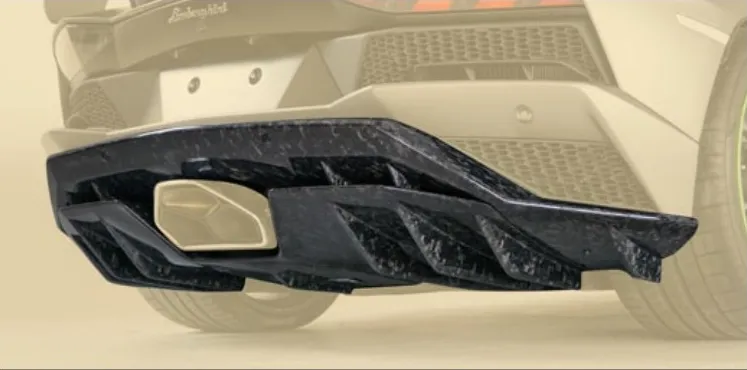
Rear diffuser Mansory Carbon for Lamborghini Aventador S


Mansory Carbon Rear Diffuser for Lamborghini Aventador S
The Mansory carbon rear diffuser is the underbody finale of the Mansory Body Kit for Lamborghini Aventador S — the panel that takes everything the floor has accelerated under the LP740-4 S and lets it leave the car cleanly. It substitutes the factory lower bumper insert on the post-2017 Aventador S coupé and Roadster, swapping a softly profiled OEM tray for a deeper, strake-dense expansion ramp that respects one of the S-generation's defining details: the lower-side exhaust outlets. Where SVJ derivatives funnel a high-mount central twin pipe through a single roof-fed channel, the Aventador S vents from below the corner of the bumper, and the Mansory diffuser is cut, vented and thermally shielded around exactly those cutouts. Owners specify it because the V12 NA exhaust note deserves a rear end that looks as composed at 300 km/h as it sounds at idle, and because the scissor-doored, rear-wheel-steered S earns a tail that finishes the aluminium-CFRP monocoque body with a real aerodynamic surface, not decoration.
Construction & Materials
Mansory builds the diffuser as a single deep-draw moulding with secondary bonded strakes — not a flat plate with stuck-on fences. The main shell is laid up in 3K 2x2 twill carbon over a sacrificial inner ply of 200 g/m² plain weave, with the strake roots and exhaust-cutout flanges reinforced by unidirectional carbon stripes that resist the cyclic thermal load coming off the side pipes. The skin cures in autoclave under pressure and elevated temperature, then receives a UV-stabilised clear lacquer with a matte or gloss option. Forged-composite trim noses for the outermost fences are available as a styling alternative, retaining the same structural carbon underneath.
- Weave: 3K 2x2 twill primary, optional forged-composite accents on outer fences
- Cure cycle: autoclave prepreg, elevated-temperature dwell, ambient demould
- Wall thickness: 2.4–2.8 mm shell, 3.5–4.0 mm at strake roots and exhaust flanges
- Weight: roughly 4.6–5.4 kg as supplied with strakes bonded, depending on finish
- Hardware: stainless threaded inserts at OEM mount points, rivnut perimeter, isolating washers
- Finish: 2K UV clear lacquer (matte / gloss / satin) or raw weave with hydrophobic seal
- Heat shield: aluminised aramid mat bonded around exhaust cutouts, foil-taped seams
- Edge treatment: hand-feathered cloth wraps the leading edge so visual transition to the rear bumper is seamless
Design & Visual Function
The aerodynamic intent of a diffuser on a mid-engine V12 is to recover pressure from the underbody so the rear axle plants under load, and Mansory's reading of that brief on the Aventador S is unusually literal. Five primary carbon strakes run rearward from a tapered leading edge, with the inner pair angled at roughly 7 degrees to the floor centreline and the outer trio progressively splayed outward to follow the wake of the rear tyres. The expansion ratio across the panel is steeper than OEM, which lets the floor decelerate trapped air more aggressively into the wake, building a low-pressure region behind the car that helps the chassis settle without demanding extra rear-wing angle. Crucially, none of those strakes intrude on the lower-side exhaust outlets — the cutout flanges are deliberately set inboard of the pipe exits, with thermal-shield aramid mat bonded to the diffuser's inner skin in those zones to keep the lacquer alive over many heat cycles.
Visually, the panel finishes the rear of the car with a piece of geometry that reads correctly from any angle. The fences cast hard shadows that line up with the hexagonal Lambo cues in the rear bumper bridge above, so the back of the car gains vertical rhythm rather than just a darker patch under the lights. Compared with the OEM tray, the Mansory diffuser sits a touch deeper in the bumper opening, which exaggerates the visual width of the rear track and gives the tail-light bar more authority. Raw weave reads as carbon mass; lacquered satin reads as engineered surface; gloss reads as jewellery — all three suit the S, and all three age well because the substrate underneath is properly cured.
Wake control matters more than peak downforce on a car with rear-wheel steering. The S rotates briskly into a corner, and a clean, symmetrical wake means the rear pressure field stays balanced as the rear axle steers; an untidy diffuser separation would manifest as twitchy throttle behaviour mid-corner. Mansory's strake count and angle were tuned with that in mind, which is why the panel is recommended even on cars not running a larger wing.
Compatibility & Fitment
The diffuser fits the Lamborghini Aventador S (LP740-4 S, 2017–2021) coupé and Roadster, with the pre-SVJ rear bumper geometry and lower-side exhaust outlets. It does not fit SVJ-bodied cars (different bumper, central high-mount exhaust). All OEM parking-sensor pockets and rear fog/reverse light cutouts in the surrounding bumper are preserved; the diffuser itself does not carry sensors but its mounting flanges respect the harness routing under the rear floor. Reverse-camera and rear radar lines clear the upper edge of the panel by design.
Installation & Reversibility
Budget 2.5–4 hours with the car on a four-post lift and the rear bumper either dropped or supported. The OEM lower insert detaches from a combination of plastic clips and threaded fasteners along the perimeter; once it's out, the Mansory unit drops in onto the same mount points, with the supplied stainless inserts giving a more durable thread interface for repeat installs. Two locating pegs at the centre line set the depth so the diffuser sits flush with the bumper splitline before the perimeter screws come up to torque. The methacrylate adhesive used elsewhere on the CFRP monocoque is not required for this panel — it's a fully mechanical fix — but any heat-shield mat that touches body adhesive nearby should be checked for chemistry compatibility before a full cure. Reversibility is complete: the OEM insert refits to factory hardware, no body cuts are made, and the car can be returned to original spec in the same time it took to install.
Pairing within the Mansory Aventador S programme
The diffuser is the keystone of the rear aerodynamic group. It pairs first with the Mansory carbon rear bumper air outtake cover, which evacuates hot air from the engine bay and rear brake zone above the diffuser line — the two parts together form a continuous carbon belt around the back of the car. From above, the panel finishes the visual logic of the Mansory carbon rear spoiler for owners who want the subtler ducktail treatment, or the Mansory carbon rear performance wing for cars chasing more aggressive rear downforce. Structurally, the carbon Mansory rear bridge sits between the tail lights and ties the upper rear surfaces into the same finish family. Specify all four together and the rear of the Aventador S reads as one engineered surface rather than a stack of accessories.
Maintenance & Durability
Carbon diffusers live in the dirtiest zone of the car: tyre spray, brake dust, road salt, exhaust soot. Wash with a pH-neutral shampoo, rinse top-down, and dry with a soft microfibre rather than letting water bead off in the sun (lacquer haze comes from minerals in evaporated water, not from the carbon underneath). Avoid alkaline wheel cleaners migrating onto the panel during a wash — the same chemistry that strips brake dust strips lacquer. A ceramic coating is the right protection here; carnauba is too soft against the thermal load near the side exhaust pipes. The aramid heat-shield matting around the exhaust cutouts is service-life-rated to thousands of heat cycles, and stone-chip damage to the strake leading edges is repairable: a Mansory-trained body shop can scarf in a localised carbon patch and re-lacquer without replacing the whole panel. UV is the long-term enemy; a yearly inspection of the lacquer's gloss retention catches problems before they become visible.
Lead Time & Warranty
Lead time is typically 4–8 weeks from order, reflecting Mansory's bespoke autoclave production and the specific finish chosen. The diffuser carries a 12-month warranty against manufacturing defects covering delamination, cure flaws, hardware failure and lacquer issues unrelated to chemical or impact damage.
FAQ
Q: Will it fit my Aventador S Roadster as well as the coupé?
A: Yes — the rear bumper geometry and lower-side exhaust layout are shared between coupé and Roadster, so the same diffuser fits both.
Q: Does it work on an SVJ?
A: No. SVJ uses a different rear bumper, a high-mount central exhaust, and a more compact diffuser footprint. This panel is shaped for the Aventador S only.
Q: How much does it actually weigh against the OEM lower insert?
A: Net weight saving is modest — roughly 1.5–2.0 kg — because the Mansory unit is structurally heavier per panel area but replaces a denser OEM composite tray.
Q: Can I have raw weave instead of lacquer?
A: Yes. Raw weave with a hydrophobic seal is offered as an alternative to clear lacquer; expect more frequent re-sealing on a car driven year-round.
Q: Does the heat shield need replacing periodically?
A: Under normal road use, no. Track cars with extended high-load running should have the aramid mat inspected annually, especially the strips closest to the exhaust outlets.
Pair the diffuser with the rear bumper air outtake cover and the spoiler or performance wing of choice to finish the rear of the car as one carbon surface. CTA: WhatsApp +44 7488 818 747 or [email protected].