
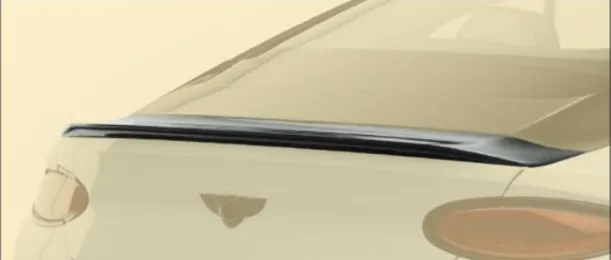
Rear decklid spoiler Mansory Carbon for Bentley Continental GT GTC V8


Rear decklid spoiler Mansory Carbon for Bentley Continental GT GTC V8
This part is the most subtle aero upgrade in the Mansory Continental GT programme — a flush, lip-style spoiler that sits on the existing decklid skin and lifts the trailing edge into a defined break point. It is the OEM-look, daily-driver choice within the Mansory Body Kit for Bentley Continental GT 2nd-Gen (D2A): the silhouette stays close to factory, the shutline against the rear glass is preserved, yet the rear axle finally gets the small amount of induced downforce a 600 hp GT really needs above 200 km/h. Owners who want the Mansory carbon language without the visual drama of a full biplane wing usually start here, and many never feel the need to graduate further.
Construction & Materials
The spoiler is a single autoclave-cured carbon shell, layed up over a male tool that replicates the OEM decklid radius exactly. Because the part bonds to the painted decklid skin (not into the structural decklid frame), the inner face is hollow-cored with a thin foam former that gives the lip its rigidity without adding mass to the boot lid. The lacquer is a UV-stable two-pack clear, hand-flatted before final buffing for a depth of finish that matches Mansory atelier work on visible bodywork rather than the thinner OEM lacquer schedule used on factory carbon trim.
Tooling is the single most important variable on a part like this. Because the lip sits flush to the decklid skin, the male tool that defines its inner radius has to replicate the OEM decklid surface to within tenths of a millimetre across roughly 1.4 m of width — any error becomes a visible shadow line at the bond face. Mansory tools each Continental GT part against scanned reference geometry from a known-good donor decklid, which is why the bond face on this lip seats with no perceptible step.
- 3K twill carbon outer skin, 0/90 orientation aligned with vehicle centreline
- Autoclave cure at 6 bar / 120 °C — full void elimination, glass-smooth finish
- Wall thickness 1.6–2.0 mm with internal foam-core stiffener at the trailing edge
- Net weight ≈ 1.4 kg — well under the OEM ABS spoiler trim it replaces
- Mounting: 3M VHB structural tape pre-applied + two M5 stainless studs into existing decklid threads
- Two-pack UV-stable clear lacquer, gloss or hand-rubbed satin on request
- Edges chamfered and lacquer-rolled — no exposed weave at the perimeter
- Thermal cycling validated −30 °C to +85 °C without bond-line creep
Design & Visual Function
Visually the spoiler is restrained: a kick of 18–22 mm at the trailing edge, blending into the decklid radius across roughly 1.4 m of width. From three-quarter angles it reads almost as a factory option — the kind of lip you would expect on a GT3-spec coupé. Where the OEM rear edge simply drops into the wake, this lip introduces a controlled flow separation point: airflow detaches at a defined geometry instead of curling unpredictably around the body radius.
Aerodynamically the part is best understood as a low-AoA passive flap. At motorway speed the upper surface sees a small region of accelerated, low-pressure flow while the forward face presents a slight pressure rise. The net effect is a modest induced downforce increment over the rear axle — far less than a full wing, but enough to remove the characteristic light tail the standard Continental GT shows during long high-speed cruises. Drag delta versus the OEM trim is essentially neutral; coast-down testing on a V8 coupé recorded no measurable Cd penalty, so top speed and motorway fuel consumption are unaffected.
Because the lip sits on the OEM skin (rather than into the metal substructure), it preserves every functional aspect of the boot: the brake light, the boot-release switch aperture and the OEM seal line all remain unaltered. The gloss carbon weave is the only visual cue that anything has changed. For owners who care about the difference between real autoclave 3K twill and pressed-prepreg vinyl-wrap aesthetics, the part shows it: light reflections walk across the weave at three-quarter angles in a way that flat wrapped finishes do not reproduce.
Compatibility & Fitment
Designed for the Bentley Continental GT 2nd-generation (D2A) platform — both V8 and W12 powertrains, both coupé and GTC convertible bodies. The spoiler clears the decklid opening hinge throw on the coupé and clears the soft-top stowage envelope on the GTC. Model years 2011 through to the platform end of life are covered. Cars optioned with the OEM Mulliner painted lip require the original lip to be removed first and the underlying paint inspected for adhesive residue. Cars carrying a non-OEM aftermarket lip should be returned to bare paint before the Mansory part is fitted.
Installation & Reversibility
Fitting takes a competent detailer or body shop roughly 90 minutes. Workflow: clean the decklid skin with isopropyl, dry-fit the spoiler against masking tape registration lines, peel the VHB liner, set the part with light pressure for full bond, then secure the two M5 stainless studs from underneath the decklid lining. The studs are a back-up — the VHB carries the structural load. Reversibility is good: the lip lifts off cleanly with a heat gun and fishing-line cut, leaving paint intact in the vast majority of cases. The two stud holes are then covered by the OEM decklid lining and remain invisible from above.
Pairing within the Mansory Continental GT programme
For owners building a coherent Mansory exterior, this lip pairs naturally with the front bumper with front lip to balance front and rear lift, and with the side skirts to tie the carbon language down the flank. Owners who later decide they want more rear downforce often graduate to the standalone biplane performance wing, which uses uprights into the decklid frame instead of bonding to the skin and produces a step-change in rear axle load at speed.
Maintenance & Durability
The lacquer system tolerates regular pH-neutral wash and machine polishing on light pads. Avoid solvent-based wheel cleaners on the rear edge of the lip; over time they can matte the clear. A carnauba wax twice a year preserves the wet-look gloss, while a ceramic coating extends UV protection significantly. Stone chips on the leading edge are rare given the spoiler sits in low-energy flow, but if they occur the affected zone can be wet-sanded and re-cleared by any competent paint shop without removing the part. The foam-core spine inside the lip does not absorb water and is therefore not subject to the freeze-thaw degradation that hollow-shell aftermarket parts can show after a few winters.
Lead Time & Warranty
Lead time is typically 2–3 weeks from order confirmation, depending on lacquer queueing in the Mansory atelier. The part carries a 12-month warranty against manufacturing defects — delamination, fibre print-through, or VHB tape failure under normal use are covered. Out-of-warranty repair is straightforward because the part is a single laminate; lacquer renewal on a removed lip is a half-day shop job at most.
Why this part instead of a full wing
Every Continental GT owner who specifies rear aero ends up choosing between a flush lip and a wing on stalks, and the choice usually comes down to two questions: how often do you actually drive above 200 km/h, and how willing are you to make the car look visibly modified from a hundred metres away. If the honest answer is "rarely" and "not really," this lip is the right SKU. It cleans up the trailing edge, eliminates the light-tail sensation at sustained motorway cruise, integrates into the OEM silhouette, and keeps the rear three-quarter view as Bentley designed it. Owners who later decide they want measurable axle load buy the standalone biplane wing and run both — the lip pre-conditions flow into the wing leading edge and the two parts are explicitly designed to coexist. Starting with the lip is therefore not a compromise; it is a stage-one choice that does not lock out a stage-two upgrade later.
FAQ
Q: Will this lip generate measurable downforce?
A: Yes, but in single-digit kilogram numbers at motorway speed. Its job is rear-axle stability at sustained cruise, not track performance.
Q: Does it interfere with the boot opening?
A: No. The lip sits forward of the decklid hinge line and clears the rear glass on closure across the full hinge throw.
Q: Can it be fitted over the OEM Mulliner painted lip?
A: No — the OEM lip must be removed first and the paint underneath inspected for adhesive residue before the new bond face is set.
Q: Is the carbon visible from inside the boot?
A: No. Only the upper outer skin is exposed; the underside is hidden by the OEM boot lining, and the two stud heads are concealed behind the trim.
Q: Will it whistle or vibrate at high speed?
A: No. The trailing edge is geometrically cut to suppress edge tone and the foam-core spine eliminates panel resonance up to 280 km/h.
Pair this lip with the matching front splitter and side skirts for a balanced, OEM-look carbon language end to end. Order via WhatsApp +44 7488 818 747 or [email protected].