
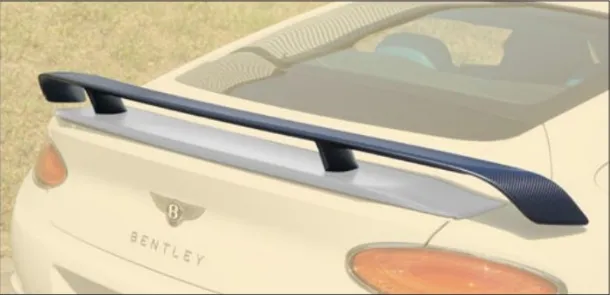
Biplane performance wing Mansory Carbon for Bentley Continental GT GTC V8


Biplane performance wing Mansory Carbon for Bentley Continental GT GTC V8
This is the wing — without the bundled lip, without the trim accessories — for owners who want the Mansory rear-aero hardware but prefer to keep the OEM decklid skin visually intact. Inside the Mansory Body Kit for Bentley Continental GT 2nd-Gen (D2A) the standalone biplane occupies a clean role: it is the highest-downforce rear element in the programme that does not also touch the decklid skin, and it is the part most commonly fitted to V8 coupés that have already been tracked. The OEM decklid trim is preserved; only four discreet upright bolts pass through to the structural decklid frame underneath. Owners who later decide they also want the lip can buy and add it without removing the wing.
Construction & Materials
Each wing element is a closed-section autoclave laminate over a foam former — a continuous airfoil section with no joins between leading and trailing edges. The uprights are forged-carbon, machined post-cure on a five-axis station to receive bonded aluminium inserts that carry the bolt loads. Forged carbon was chosen over woven laminate at the uprights because the chopped-fibre architecture carries shear and point-load forces better than directional weave at the bolt interface — it is the right material for the structural job, not just the aesthetic one.
Element internals matter as much as the visible skin. A wing element that flexes under load loses its angle of attack at exactly the moment downforce matters; Mansory therefore runs a uniaxial carbon-tape tension layer along the chord of each element, embedded inside the laminate, that resists the bending moment introduced by high-speed pressure differential. The upper and lower skins themselves are the visible 3K twill, but the wing keeps its shape under load because of what is buried inside.
- 3K twill outer skin on both elements; uniaxial tape internal tension layer
- Autoclave cure 6 bar / 120 °C; post-cure freestanding bake at 130 °C for tg lift
- Forged-carbon uprights with bonded aluminium torque inserts (M8 grade 12.9)
- Element wall 1.8–2.2 mm; foam former Rohacell-equivalent at 71 kg/m³
- Assembly weight ≈ 5.4 kg complete, including hardware
- Stainless backing plates and thread-lock for decklid frame mount
- Two-pack UV clear lacquer, edges sealed against UV ingress
- Optional satin / matte finish; raw-twill exposed-weave faces optional on uprights
Design & Visual Function
The biplane is engineered around the slot. Two airfoil sections — an upper main plane and a lower flap — are separated by a precisely fixed gap that channels high-energy flow from the windward side over the leeward (upper) surface of the upper element. This jet keeps the boundary layer attached well past the angle of attack at which a single-plane wing of comparable chord would stall. In practical terms, that translates to a higher peak Cl before the wing gives up on its load, and a softer, more predictable break in lift if it is ever pushed past stall. The slot gap is not arbitrary — it is set as a fraction of the upper element chord and tuned through CFD and atelier wind work.
Pressure differential across the elements is what generates the load: at speed, the underside of each element runs at higher pressure than the upper, and the integrated force is downforce on the rear axle. Because the wing sits well above the decklid skin on its uprights, the elements operate in clean, undisturbed air rather than in the recirculating boundary layer along the boot lid. This is the mechanical reason a true wing on stalks generates dramatically more useful load than a decklid-mounted spoiler — the spoiler is stuck working in messy near-body flow; the wing is up in clean air.
Drag delta versus the OEM trim is real but modest — perhaps 6 to 8 counts — and on a 600 hp GT it is not a meaningful top-speed concern. What it is, instead, is a stability tax: the car gives up a little terminal velocity in exchange for an axle that does not feel light at sustained 250 km/h cruise. For most Continental owners that is the right trade. Visually the wing is the Mansory tuning signature — a stacked pair of carbon planes on forged stanchions, weave hand-aligned with the rest of the kit.
Compatibility & Fitment
Continental GT 2nd-gen (D2A) coupé, V8 and W12 powertrains. The standalone wing is specifically the coupé version — it mounts into the coupé's structural decklid frame, which has the section depth to take the upright clamp load. Convertible GTC fitment is not recommended because the soft-top stowage envelope intrudes into the decklid structure; use the dedicated performance wing for GTC on convertibles.
Installation & Reversibility
Installation is a 3–4 hour body-shop job. The decklid trim panel is removed, four pilot holes are drilled into the structural frame using the supplied template, the uprights are torqued in with backing plates and thread-lock, and the trim panel is refitted with the upright apertures sealed against water ingress. Reversal leaves four sealed holes in the decklid frame; the trim panel hides them, and a future repaint is not required to return the car to factory appearance. The OEM decklid skin itself is never touched during installation — that is the whole point of choosing the standalone wing instead of the bundled package.
Pairing within the Mansory Continental GT programme
The standalone biplane is most often combined with the rear bumper with diffuser I to manage the underbody wake the wing creates, and with the side skirts to seal the side-flow path. For owners who want exposed-weave continuity on the upper surfaces, the engine bonnet II is the natural complement.
Maintenance & Durability
The wing surfaces collect bug splatter on the leading edges; treat with a dedicated enzymatic insect remover within a day or two of contact, never overnight. Avoid pressure-washing the slot gap. The forged-carbon uprights are visually stable for life — forged carbon has no preferred fibre direction, so weathering is uniform. Lacquer life under ceramic coating exceeds a decade in temperate climates. If the wing ever comes off the car for paintwork on the decklid, the same upright bolts and backing plates are reused — the part is not consumable on removal.
Lead Time & Warranty
Lead time is 3–4 weeks; forged-carbon uprights occupy a separate tooling lane in the atelier, which sets the floor on turnaround. The 12-month warranty against manufacturing defects covers laminate quality and upright bond strength.
Why the standalone wing instead of the bundle
The standalone biplane is the right choice when the owner specifically does not want the decklid lip — usually because the OEM decklid skin has a bespoke paint or Mulliner finish that should remain untouched, or because the visual taste runs to a wing-on-stalks silhouette without the lower lip filling in the trailing edge. Performance-wise, the standalone wing operates very slightly off its bundled design point because it does not get the pre-conditioned flow the lip provides; the difference is small enough that for almost all road use it is not perceptible, and the trade-off in visual cleanliness usually justifies it. Owners who later change their mind can retrofit the decklid lip at any time without removing the wing — the two parts share no hardware, and the lip bonds to a fresh section of decklid skin entirely forward of the wing footprint.
FAQ
Q: Is this a track wing?
A: No. It is a road-legal, road-tuned biplane. It generates real downforce at autobahn speeds but is not designed to replace a GT3-spec swan-neck wing.
Q: Can the angle of attack be adjusted?
A: No. The wing is set to a single AoA at design; on-car adjustability would compromise upright stiffness and is not a road priority.
Q: Why forged carbon uprights instead of woven?
A: Forged carbon carries shear loads at bolted interfaces better than directional weave; it is the correct material for a structural mounting stalk.
Q: Will the wing whistle at speed?
A: No. The slot gap, leading-edge radius and trailing-edge cut are tuned to suppress edge tones across the full road speed range.
Q: Does it affect the boot opening?
A: No. The wing clears the boot hinge throw and the rear glass on full opening.
Q: How much heavier is the wing than the OEM decklid trim it adds to?
A: About 5.4 kg as installed. The car barely notices — the upright clamp loads are within the structural margin of the decklid frame, and rear-axle weight bias shifts by less than half a percent.
Q: Can the wing be re-lacquered if the gloss eventually dulls?
A: Yes. The wing comes off the car as a complete assembly via the four upright bolts; a refinish shop can flat the existing clear, treat any minor weather marks, and apply a fresh two-pack flow coat. Total turnaround is typically a week.
If you want the OEM decklid skin to remain visually untouched but still want the mechanical load of a real wing — this is the right SKU. Specifications via WhatsApp +44 7488 818 747 or [email protected].