
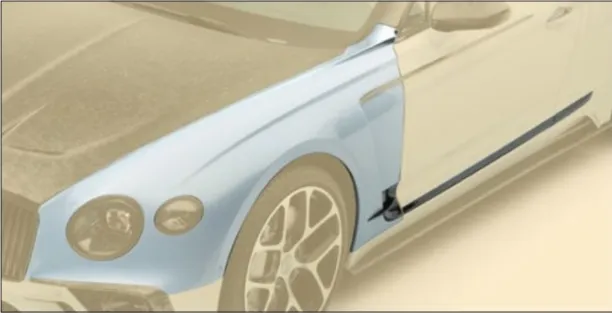
Front fenders with stripe Mansory Carbon for Bentley Continental GT GTC V8


Front fenders with stripe Mansory Carbon for Bentley Continental GT GTC V8
The Mansory front fenders with stripe are a full structural replacement for the OEM aluminium front fenders, not an over-fender appliqué. They widen the front track visually by approximately 18–22 mm per side, integrate an extraction vent on the upper trailing flank, and carry a longitudinal contrast stripe — typically a satin-finish accent over the otherwise glossy 3K twill — that runs from the leading edge of the wheel arch to the door shut-line. The stripe is a Mansory signature, used here to break up an otherwise uninterrupted carbon flank. Programme context: Mansory Body Kit for Bentley Continental GT 2nd-Gen (D2A).
Construction & Materials
The fender is laid up over a precision tooling buck taken from a 3D-scanned OEM fender, with the flare geometry built into the tool rather than added later as a separate piece. That choice matters at the wheel-arch lip — a one-piece flared layup gives a clean reflection along the lip; a two-piece bonded fender does not, no matter how good the bonding line is finished.
- 3K twill visible-carbon outer skin, 2x2 plain backing layer, plus a localised aramid impact ply on the lower arch lip for stone-chip resistance
- Autoclave-cured epoxy, 120 °C / 6 bar, void content under 1.5 %
- Wall thickness 2.0–2.6 mm on the main skin, 3.0 mm at the arch lip, 3.5 mm at the upper extraction-vent throat
- Approx. 4.1 kg per fender (vs. ~5.6 kg for the OEM aluminium fender)
- Stainless steel inner liner mounting bosses bonded to the fender inner face for OEM-pattern fitment
- Functional upper-flank extraction vent, sized to relieve the high-pressure zone behind the front wheel
- Longitudinal contrast stripe: satin lacquer accent over 3K twill, 35–40 mm wide, hand-masked and lacquered
- UV-stable 2K acrylic-urethane lacquer, 60–80 µm; the stripe uses the same lacquer chemistry in a satin gloss-level
Design & Visual Function
Aerodynamically, the upper-flank extraction vent is the functional feature. The high-pressure zone that builds inside the front wheel arch at speed has to escape somewhere; on a stock Continental GT, it bleeds rearward along the underside and partially through the wheel-arch liner gaps. The Mansory fender provides a calibrated upper-trailing extraction route, vented to the lower portion of the door shut-line region, which both reduces front-axle aerodynamic lift and conditions the airflow over the door panel for the side skirt to pick up. The vent is sized for the front-axle aerodynamic loads of the V8 model; the W12 model carries different cooling and arch-pressure characteristics.
Visually, the flared geometry pushes the wheel-arch lip outward by 18–22 mm, which on a Continental GT brings the visible front track into proper proportion with the assertive rear of the Mansory programme. Without flared front fenders, a Continental GT with the wide rear treatment looks pinched at the nose. The flare is integrated with the door shut-line so the body line transitions smoothly rather than stepping. The contrast stripe — a satin band running along the upper flank — does the visual job that a coloured pinstripe does on a classic British sports car: it gives the eye a long horizontal reference and emphasises length.
From the front three-quarter view, the fenders are the part that telegraph "this is a Mansory car" before the eye registers any specific kit element. They sit at exactly the height where the eye lands first.
The stripe deserves its own paragraph. The 35–40 mm satin band is hand-masked, lacquered, then de-masked while the lacquer is still fresh — a wet-edge masking technique that gives a clean transition between gloss and satin without a hard ridge. A printed or vinyl stripe would not survive thermal cycling on the upper fender; this is a true lacquer-on-lacquer finish difference and ages identically across both gloss and satin zones, so the stripe never looks "newer" or "older" than the rest of the fender. The width and the position of the stripe — running from the leading edge into the door shut-line — are calibrated against the OEM door cut so the stripe terminates at a natural body break rather than dying in the middle of a panel.
The fender lip itself is profiled with a slight inward roll at the lower extremity, which catches a thin shadow under the wheel arch and visually drops the fender mass over the wheel. This is a detail Mansory carries across the entire programme — every external panel that meets a wheel arch carries the same lip profile, so the eye reads the car as a coherent set of parts rather than as a kit-of-parts assembly.
Compatibility & Fitment
Built for the Bentley Continental GT 2nd-generation (D2A) V8 4.0L twin-turbo, coupé and GTC convertible. The fender carries the V8 wheel-arch geometry, OEM mirror mount, OEM headlight datum, and the OEM front bumper-to-fender shut-line. W12 cars share most of these but use a different upper grille treatment that influences the leading edge of the fender; W12 fitment requires Mansory confirmation against the specific car.
Installation & Reversibility
Plan 5–6 hours per pair. The OEM aluminium fender removes via the OEM bolt pattern (top mount, A-pillar mount, lower bumper mount, inner liner bolts); the carbon fender bolts back to the same pattern through the bonded stainless mounting bosses. Wing-mirror harness transfers across without modification. Side-marker and side-repeater lamps transfer across. Final shut-line work is the only attention-demanding step — the flared geometry tightens the front bumper-to-fender shut-line slightly, and a 0.5–1.0 mm shim may be needed at the bumper end to chase a flush gap. The job is fully reversible.
Pairing within the Mansory Continental GT programme
The fenders ask for matching width references elsewhere on the car. Common pairings: the Mansory carbon front bumper with front lip to continue the wider front geometry, the cover for OEM fender if the rest of the car runs OEM fender geometry and only an upper highlight is wanted, and the mirror housing II as a continuation of the upper carbon line.
Maintenance & Durability
The arch lip carries a localised aramid impact ply specifically because this is the part of the car that catches stone chips most often. Surface lacquer can still chip; the laminate underneath is more stone-tolerant than aluminium would be. The contrast stripe is a satin-lacquer band — do not polish it with a glossing compound, as this will either burn through or shift it toward gloss locally. Hand-wash routine matches the rest of the kit: pH-neutral shampoo, two-bucket method, hard-shell sealant on the gloss carbon, separate satin-safe sealant on the stripe (a polymer satin sealant rather than a carnauba). Avoid heavy paint-cutting compound on either finish.
Lead Time & Warranty
Lead time is 3–4 weeks; the satin stripe lacquer is a separate masking and shoot, which adds half a working day per fender to the production cycle. A 12-month warranty against manufacturing defects applies — laminate voids, delamination, lacquer adhesion failures including the stripe, mounting hardware. Stone-chip damage is a wear item, not warranty-covered, but is repairable by a competent paint correction shop.
FAQ
Q: Does the stripe come in colour options or only satin black?
A: The default is a satin-lacquer accent against the gloss-lacquer carbon — a finish-level contrast rather than a colour contrast. Pigmented stripe variants (matte black, body-colour, single accent colour) can be specified at order time with a small lead-time addition.
Q: Will the wider arch fit my OEM wheels?
A: Yes. The flare adds visual width, not arch volume — OEM wheels and tyres remain inside the arch with stock offset and tyre size. Wider wheel options are accommodated up to the limits of the arch liner clearance.
Q: Is the upper extraction vent functional or cosmetic?
A: Functional. It provides a calibrated escape route for the high-pressure zone inside the wheel arch, and it conditions the airflow that the side skirt picks up downstream.
Q: Does the fender carry the OEM side-repeater lamp?
A: Yes. Cut-out and gasket positions are designed-in; the OEM repeater transfers across without modification.
Q: Is there a coupé-only or GTC-only version?
A: The front fenders are common across coupé and GTC convertible body styles within the V8 D2A spec; both share the same front structure forward of the A-pillar.
Q: How does the carbon fender compare to the OEM aluminium fender in a low-speed parking ding?
A: Aluminium dents and stays dented; carbon either flexes elastically and recovers or, at higher impact energy, fractures the laminate locally. Recoverable elastic flex is the more common outcome in parking-ding territory. Fractured laminate is repairable; aluminium is also repairable but typically needs a panel-beating shop to dress out a dent.
Pair the fenders with a matching front bumper and skirts to widen the visual track of the car coherently. CTA: WhatsApp +44 7488 818 747 or [email protected].