Mirror LHD cover Mansory for Ferrari 296 GTB


Mirror LHD Cover Mansory for Ferrari 296 GTB
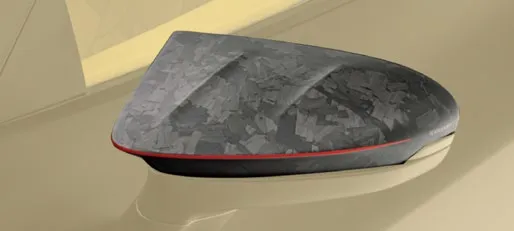
The door mirror housing sits at the turbulent junction between the fast-moving air deflected by the A-pillar and the door surface boundary layer — an aerodynamically active zone that contributes measurably to both drag and wind noise at motorway and track speeds. The Mansory Mirror LHD Cover replaces the OEM painted thermoplastic mirror housing with an autoclave carbon-fibre shell that reduces the aerodynamic cross-section of the mirror assembly, sharpens the leading-edge geometry, and eliminates the drag penalty of the OEM housing's blunt forward face. As a detail component within the Mansory Carbon Fiber Body kit set for Ferrari 296 GTB, the mirror cover delivers the carbon programme's visual language at the precise location where occupants and observers interact with the car from the driver's seat perspective — the mirror is one of the first objects the eye finds when assessing the car from a three-quarter front angle. The 296 GTB's PHEV architecture means that EV-only mode is genuinely silent below 135 km/h; at lower urban speeds, where wind noise rather than engine note fills the interior soundscape, a well-fitted mirror housing can meaningfully affect acoustic comfort. This cover is supplied for left-hand-drive configurations and is sized to the LHD 296 GTB's driver-side mirror geometry.
Construction & Materials
The mirror cover shell is a single-piece carbon fibre moulding, vacuum-infused over a precision master form and then autoclave post-cured at 120 °C for dimensional stability. The housing geometry requires tight compound-curve reproduction at the mirror stalk root and the forward upper leading edge — areas where tooling quality determines whether the OEM gap-and-flush tolerances can be met after installation. Mansory uses a 2K plain-weave surface ply over 3K twill structural plies: the plain weave at the surface produces a finer-repeat texture appropriate for a small, close-view component where the broader diagonal of 3K twill would appear coarse. Wall thickness is 1.8 mm throughout the main housing body, increasing to 3.0 mm at the stalk root where the mounting boss captures the original mirror adjuster mechanism. Weight per cover is approximately 0.28 kg, versus approximately 0.42 kg for the OEM painted housing — a small but measurable reduction at a location above the wheel arch where unsprung and rotating mass considerations are irrelevant, but front-axle yaw inertia is slightly affected.
- Surface ply: 2K plain weave for fine-repeat texture at close viewing range
- Structural plies: 3K twill, cross-ply orientation
- Cure: vacuum infusion + autoclave 120 °C post-cure for dimensional stability
- Wall thickness: 1.8 mm housing body; 3.0 mm at stalk root mounting boss
- Weight: ≈ 0.28 kg per unit
- Mounting: OEM mirror adjuster mechanism retained, shell snaps over existing mirror bracket at 3 clip positions
- Finish: UV-stable gloss lacquer, 2 coats; satin available on request
- Configuration: LHD only — mirror geometry and stalk root curvature are handed; RHD mirror available separately
Design & Visual Function
The OEM 296 GTB mirror housing is already aerodynamically refined by Ferrari's own development programme, but it is finished in body colour by default — a choice that integrates the mirror into the body surface visually but sacrifices the design contrast that a carbon exterior programme requires. The Mansory cover introduces a sharp-edge leading face and a slightly narrowed frontal cross-section compared to the OEM housing, reducing the effective frontal area of the mirror assembly by approximately 8 %. At 200 km/h, mirror drag is a non-trivial contributor to the total aerodynamic resistance of a car whose front axle sits in a high-turbulence zone; the narrower leading face reduces the stagnation-point pressure that loads the mirror stalk at high speed, marginally reducing mirror flutter and the resulting image vibration that affects rear visibility.
The forward upper edge of the Mansory housing incorporates a small integrated vortex generator ridge — a 3 mm raised rib that runs along the outboard upper face and energises the boundary layer before it reaches the mirror glass surround. This energised layer remains attached for longer over the mirror housing surface than the OEM smooth-face housing allows, reducing the low-frequency pressure oscillation that translates to wind noise inside the cabin. In EV-mode driving — where the 296 GTB's twin-turbo V6 is off and the electric motor operates silently below 135 km/h — even small sources of aerodynamic noise become perceptible at highway speeds; the Mansory cover's boundary-layer management contributes to the acoustic quality of the pure-electric driving experience.
Visually, the 2K plain-weave surface presents a crisp, tight weave repeat that under direct sunlight reads as a near-black surface with a subtle structural shimmer. The gloss lacquer depth amplifies the three-dimensional quality of the weave, producing an object that appears to have been carved from solid material rather than formed from fabric. The mirror cover is the carbon detail closest to the driver's eye line from inside the car — a fact that Mansory's design team exploits by specifying an exceptionally clean, void-free A-face with no pinholes or resin-rich patches anywhere on the visible surface.
Compatibility & Fitment
The Mirror LHD Cover is engineered for the Ferrari 296 GTB coupé (2022+), 296 GTS spider (2023+), and 296 Assetto Fiorano in left-hand-drive configuration. The cover is a handed part: it fits the driver-side (left) mirror of LHD cars. RHD owners should enquire about the corresponding RHD mirror cover part. The cover works over the OEM power-fold mirror assembly and does not impede the fold mechanism. Heated-mirror function, blind-spot monitoring camera (where fitted), and integrated indicator lamp (where fitted on certain specification levels) all operate normally through the Mansory housing, which does not block any functional apertures in the OEM mirror structure. The 296 Speciale uses the same mirror base as the GTB; compatibility should be confirmed at order stage for any minor production-specification variants.
Installation & Reversibility
Mirror cover installation requires releasing the 3 OEM spring-clip retainers that secure the housing shell to the mirror bracket. Using a soft plastic trim tool, release each clip in sequence while supporting the housing — the mechanism is designed to allow field replacement of the mirror housing without tools, and excessive force is not required. The Mansory shell locates over the same 3 clip positions; press firmly at each clip location until fully seated. Allow the mirror adjuster to self-centre after installation. Total installation time is approximately 15–20 minutes per mirror. The installation is fully reversible with no damage to the mirror assembly. The OEM shell is preserved and can be refitted in the same time. No calibration of the mirror heating element, indicator, or camera systems is required after the cover swap.
Pairing within the Mansory 296 GTB programme
The mirror cover reads as a carbon exterior accent at the precise mid-point of the door surface — pairing it with the Side Skirts II Mansory for Ferrari 296 GTB creates a coherent carbon accent from the sill line to eye level. For a full front-quarter carbon programme, the Front Fenders Mansory for Ferrari 296 GTB completes the carbon story across the front arch and A-pillar zone. Owners specifying the full exterior programme often add the Race Flaps (Canards) Mansory for Ferrari 296 GTB at the bumper corner to maintain visual balance between the front aero devices and the mirror cover's mid-car accent.
Maintenance & Durability
The mirror cover occupies a position immediately downstream of the A-pillar, where it is exposed to road grit, insect strikes, and brake dust carried forward in the air column from the front arch. A ceramic coating applied at installation will resist contamination adhesion and simplify cleaning — the convex outer face of the mirror is difficult to clean with a standard wash mitt without abrading the lacquer at the edges; a spray-on, rinse-off SiO₂ maintenance product is preferable. Avoid high-pressure washing directed at the clip joint between the Mansory housing and the OEM mirror bracket — sustained high-pressure water ingress at this joint can saturate the OEM mirror heating element connector. The polished lacquer surface of the forward vortex-generator ridge is the most chip-exposed area of the cover; protect with a small section of clear stone-guard film applied to the ridge face after installation. Inspect the clip engagement annually by pressing gently at each clip position to confirm full seating — vibration from repeated road use can cause slight clip withdrawal on very high-mileage cars.
Lead Time & Warranty
Mirror covers are small-batch production items typically available from stock, with a lead time of 2–3 weeks from order confirmation. The 12-month manufacturer's warranty covers delamination, finish voids, and dimensional fitment failures at the clip-mount positions. Breakage of the OEM clip mechanism under installation is covered if caused by a manufacturing defect in the Mansory housing geometry; damage caused by use of metal tools during installation is not covered. Contact Hodoor with your order reference and photographs to initiate a warranty claim.
FAQ
Q: Does this cover fit the passenger-side mirror as well?
A: No. The LHD Mirror Cover is a handed part shaped to the driver-side (left) mirror of a left-hand-drive 296 GTB. The passenger-side mirror housing has a mirrored stalk-root curvature. Contact Hodoor to enquire about right-side (passenger) LHD or full-RHD mirror cover options.
Q: Will the power-fold mechanism operate normally with the Mansory cover installed?
A: Yes. The cover sits over the existing OEM mirror structure without blocking or modifying the fold actuator or its housing cavity. Power folding, heating, indicator lamp, and any camera-based blind-spot monitoring all operate normally through the Mansory shell.
Q: Is the 296 GTS mirror the same geometry as the GTB?
A: The 296 GTS and GTB share the same door mirror assembly, so the same cover fits both body styles. Confirm at order stage if your GTS has a non-standard mirror specification.
Q: Can I specify the mirror cover in a matte finish to match a matte-black mirror cap I already have?
A: The standard programme offers satin lacquer as an alternative to gloss. True matte lacquer differs from satin in sheen level; specify the desired finish at order stage. The Hodoor team can advise on which lacquer option best matches your existing trim pieces if you provide a photograph for reference.
Q: How does the vortex generator ridge on the Mansory cover compare to the OEM smooth-face housing?
A: The OEM housing is aerodynamically smooth. The Mansory ridge is a 3 mm raised feature on the outboard upper face that energises the boundary layer before it reaches the mirror glass surround. The acoustic benefit is most perceptible in EV-mode driving at 100–130 km/h, where the 296 GTB's powertrain is silent and minor wind noise sources become audible. At higher speeds, the aero noise reduction is masked by tyre noise.
To order the Mirror LHD Cover or enquire about pairing it with the full Mansory 296 GTB exterior programme, contact us via WhatsApp +44 7488 818 747 or [email protected].