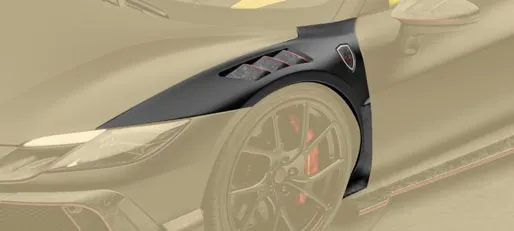
Front fenders Mansory for Ferrari 296 GTB


Front Fenders Mansory for Ferrari 296 GTB
The front wheel arches of the Ferrari 296 GTB carry the full aerodynamic and thermal burden of the front axle — accommodating the swept volume of 245/35 ZR20 front tyres, channelling high-pressure ram air away from the rotating front tyre face, and presenting the first visual impression of the car from a three-quarter front angle. The Mansory Front Fenders replace the OEM aluminium pressing with a full carbon-fibre overfender unit that broadens the front track stance, integrates dedicated vent louvres for front-brake thermal relief, and introduces a forward-swept arch lip that mirrors the silhouette language of the broader Mansory Carbon Fiber Body kit set for Ferrari 296 GTB. The 296 GTB's PHEV powertrain — 830 hp total from the 2.992 L twin-turbo hot-vee V6 and 165 hp electric motor — taxes the front brakes heavily under regenerative braking interruption events at the track, making ventilated front fenders a functional as well as aesthetic upgrade. The hot-vee engine architecture places both turbochargers inside the V directly above the engine bay, driving ambient air temperatures in the forward bulkhead zone that place real demands on radiator intake efficiency — the overfender louvre design contributes to the aerodynamic package that maintains adequate radiator face velocity at all operating conditions.
Construction & Materials
The Mansory front fender is a multi-layer composite structure, primary-face laid in 2K plain-weave pre-preg carbon for a tighter optical texture than the 3K twill used in most flat body panels. Plain weave produces a tighter, more symmetric knit repeat — visually appropriate for a large curved panel where 3K twill's diagonal axis would appear to shift across the compound curves of the front arch. Internal structural ribs are laminated in 3K twill for stiffness, with a 3 mm overall face thickness increasing to 4.5 mm at the arch lip where cantilevered span and stone-impact exposure are greatest. The louvre apertures are cut post-cure by CNC 5-axis routing to maintain dimensional accuracy within ±0.3 mm across the full panel, ensuring that OEM headlamp surround and bonnet-gap tolerances are met after installation. Each panel is resin-infusion assisted under vacuum bag at the perimeter to eliminate void pockets at the flange radii, then full autoclave-cured to consolidate the rib structure. Total weight per pair is approximately 3.2 kg.
- Primary face weave: 2K plain pre-preg, tighter optical texture suited to large compound surfaces
- Internal ribs: 3K twill for structural stiffness — not visible on finished exterior face
- Face thickness: 3.0 mm standard face; 4.5 mm arch lip and louvre frame
- Cure: vacuum-bag peripheral infusion + full autoclave at 120 °C / 6 bar, 4 h dwell
- Louvre apertures: 5-axis CNC post-cure, ±0.3 mm dimensional tolerance
- Weight per pair: ≈ 3.2 kg (saving ≈ 2.4 kg vs. OEM aluminium panel)
- Mounting: OEM bodywork mounting flange geometry retained, M6 bolt-through at 8 positions per side
- Finish: UV-stable gloss lacquer, 2 coats, 80 µm DFT; satin on request
Design & Visual Function
The overfender design extends the outer arch line by approximately 18 mm at maximum width, accommodating wider track widths for competition-oriented builds while maintaining legal road-use arch-to-tyre coverage on standard-width wheel packages. The broadened front stance aligns the car's visual width at the front axle with the rear haunches — on the standard 296 GTB, the rear arches are already wide and aggressively flared; the front fenders in OEM form appear narrower by comparison, creating a slight front-narrow, rear-wide appearance that the Mansory overfender corrects. The forward-swept arch lip integrates a pronounced outboard ridge that channels turbulent wheel-wake air away from the door mirror zone, reducing the turbulent boundary layer that otherwise increases wind noise and drag on the mirror stalk. This ridge geometry is directly analogous to front fender vortex generators used in factory GT3 and GT racing programmes — a functional solution presented as a styling detail.
The integrated louvre pack, positioned behind the front wheel arch at the upper trailing edge of the fender panel, provides a direct evacuation path for the hot boundary air trapped between the rotating front tyre and the arch liner. On a track-driven 296 GTB, carbon ceramic front brakes operating at 700–900 °C generate a heat dome inside the front arch — hot air that would otherwise stall against the arch liner and reduce braking-zone cooling effectiveness. The louvres create a low-pressure extraction slot that draws this hot air out through the upper fender face, driven by the favourable pressure gradient between the high-pressure front-arch interior and the lower-pressure fender exterior. This mechanism is the same thermal reasoning that led Ferrari to specify similar louvres on the 296's own SF90-derived front undertray, applied here to the exterior body surface where it can be enhanced without modifying factory underbody structure.
Compatibility & Fitment
Engineered for the Ferrari 296 GTB coupé (2022+), 296 GTS spider (2023+), and 296 Assetto Fiorano specification. The 296 GTB and GTS share identical front bodywork mounting points; the Assetto Fiorano specification does not alter front fender mounting geometry. The overfender adds 18 mm to the outer arch — confirm with your tyre supplier that this clearance accommodates any wheel-spacer fitment you plan to run. The front wheel arch does not carry any active sensors in the standard 296 GTB programme; no sensor recalibration is required. The OEM front parking distance sensors sit in the bumper, not the fender, and are unaffected. The 296 Speciale shares the GTB's front arch geometry; Speciale owners should confirm at order stage as minor production variations may apply.
Installation & Reversibility
Front fender replacement requires disconnecting the OEM fender from 8 M6 mounting bolts and the wiring loom for the side repeater lamp integrated in the forward section of the panel. Removal time for the OEM panel is approximately 45 minutes per side; offer the Mansory panel dry to confirm headlamp gap, bonnet gap, and bumper junction alignment before final torquing. The side repeater lamp or puddle-lamp bracket transfers directly to the Mansory panel, which retains the OEM mounting boss position. Final installation time per side is approximately 90 minutes; both sides can be completed in a single day's shop work. The installation is fully reversible — the OEM panel and all original fasteners are preserved, and re-installation to OEM specification takes 45 minutes per side. A Ferrari-certified bodyshop is recommended for precision gap setting, particularly at the bonnet-to-fender joint, which is visible and critical to the finished quality of the installation.
Pairing within the Mansory 296 GTB programme
The front fenders' louvre vents and broadened arch lip are visually most cohesive when paired with the Front Splitter Mansory for Ferrari 296 GTB, which establishes the aerodynamic stagnation point at the front bumper lower edge — the two parts together define the front axle's aero philosophy. The overfender's arch-exit air management dovetails with the Race Flaps (Canards) Mansory for Ferrari 296 GTB, whose vortex generators on the front bumper corner direct the flow that the fender louvres then extract. For owners also addressing the exterior mirror zone, the Mirror LHD Cover Mansory for Ferrari 296 GTB completes the carbon trim at the transition between fender and door.
Maintenance & Durability
The 2K plain-weave face of the Mansory front fenders requires the same lacquer protection protocol as all exposed carbon panels in the programme. Apply a UV-stable SiO₂ ceramic coating immediately after installation and maintain a 6-month reapplication schedule for track-driven cars. The louvre apertures should be cleared of debris — insects, road grit, and leaf fragments — after each track session using a soft detailing brush and compressed air from the inboard side; blockage reduces the thermal extraction function that the louvres are engineered to provide. For the arch lip, which receives the highest stone-impact exposure of any exterior carbon surface, apply a sacrificial clear stone-film to the lower 80 mm of the arch underside — this film can be replaced when damaged without requiring lacquer refinishing. Inspect the louvre frame edges annually for crack initiation at the CNC-cut aperture corners; these high-stress concentration points are the most likely failure mode under repeated thermal cycling between cold ambient and hot brake-zone temperatures. Any crack detected at the louvre frame should be arrested immediately with a tack weld of the same two-part laminating resin used in the original layup.
Inspect annually for any signs of delamination or VHB bond degradation.Lead Time & Warranty
Front fenders are a complex multi-radius panel with CNC post-machining; lead time is 4–5 weeks from order confirmation to despatch. Each pair is supplied with a 12-month manufacturer's warranty against delamination, finish voids, louvre dimensional tolerance failures, and mounting flange fitment issues. Warranty does not cover impact or abrasion damage, stone chips on the arch lip, or lacquer degradation caused by non-approved cleaning chemistry. Contact Hodoor with photographic evidence and your order reference to initiate any warranty claim.
FAQ
Q: Do the front fenders fit the 296 GTS spider in addition to the GTB coupé?
A: Yes — the 296 GTS shares the GTB's front bodywork architecture, including fender mounting points and headlamp surround geometry. The same panel fits both variants.
Q: Does the 18 mm overfender extension require a wheel spacer to fill the arch correctly?
A: The overfender broadens arch clearance for wider track builds; it does not require a spacer on the standard wheel and tyre combination. Owners running wider wheels or tyre profiles should calculate clearance with the 18 mm additional arch width factored in.
Q: How effective are the louvre vents in practice on a track day?
A: Brake duct efficiency depends on the full ducting path, not solely the louvre extraction slot. The Mansory fender louvre is an extraction vent, not a direct duct intake; it works by creating a low-pressure extraction zone at the arch exit. Track drivers who require maximum brake cooling should complement the fender louvres with a dedicated front-brake duct kit that introduces cold air at the disc hat.
Q: Can the side repeater lamp from the OEM fender be transferred to the Mansory panel?
A: Yes. The Mansory fender retains the OEM side-repeater mounting boss position, and the lamp transfers directly using the original clip retainer. No wiring modification is required.
Q: Is the 2K plain weave finish visually lighter or darker than the 3K twill used elsewhere in the kit?
A: Plain weave produces a tighter, more evenly distributed reflection pattern — it tends to appear slightly lighter and more uniform than 3K twill in daylight, and the weave repeat is finer. At normal viewing distances both weaves read as the same dark carbon, but the textural difference is appreciable at close range or under raking light.
Discuss front fender specification, louvre configuration, or pairing with other programme elements via WhatsApp +44 7488 818 747 or [email protected].