
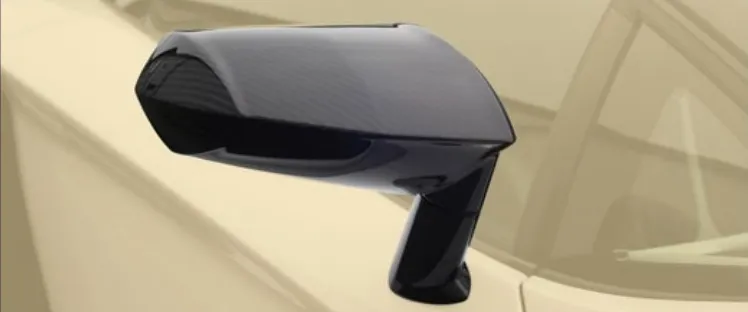
Mirror housing Mansory Carbon for Lamborghini Aventador S


Mansory Carbon Mirror Housing for Lamborghini Aventador S
The Mansory carbon mirror housing for the Lamborghini Aventador S is supplied as a paired left and right shell that bonds over the existing wing-mirror frame, transforming the OEM bulb-shaped pod into a thinner, blade-profile silhouette aligned with the rest of the carbon programme on the Mansory Body Kit for Lamborghini Aventador S. The mirror sits exactly where the scissor-door cut meets the front fender shoulder, so it is one of the first details an onlooker registers when the door swings up. Crucially, the housing keeps the OEM motorised adjuster, the OEM glass, the indicator lens and the blind-spot wiring loom — nothing is rerouted, nothing is sacrificed — while shaving visible mass off a part of the LP740-4 S that designers themselves admit was a downstream casualty of pedestrian-impact regulation rather than a styling choice.
Construction & Materials
Each shell starts as a hand-laid 3K twill prepreg layup over a male tool that mirrors the OEM mounting frame to within a tenth of a millimetre. The lay-up is bagged and cured in a 6-bar autoclave at 125 °C, producing a void content under one per cent and a uniform weave pitch that holds its diagonal across the curved cheek of the housing. After demoulding, the parts are wet-flatted, primed with a 2K epoxy isolator, then finished with two coats of UV-stable clear lacquer cut and polished to a piano gloss. A satin-finish option is available where the final clear is sprayed and left flat.
Because the housing wraps a complex compound curve, weave alignment is treated as a styling element in its own right — every shell is laid so that the twill diagonal runs at 45° to the leading edge, which keeps the optical pattern continuous with the carbon door card and the air intake on the side window if those parts are also fitted.
- Layup: 3K twill prepreg, four plies, woven balanced
- Cure: autoclave, 125 °C, 6 bar, 90-minute hold
- Wall thickness: 1.6–1.9 mm at the shell, 2.2 mm at mounting flange
- Pair weight: ~720 g (vs ~1.05 kg painted OEM pair) — saving ~330 g
- Hardware: stainless M5 inserts at OEM bond points, butyl gasket strip on the inner perimeter
- Finish: UV-stable 2K clear, gloss as standard, satin on request
- Surface: weave diagonal aligned to leading edge at 45°
- Cut-outs: indicator lens window, blind-spot sensor port, drain slot at trailing edge
Design & Visual Function
Approached from the front three-quarter angle, the OEM housing reads as a soft bulb attached to a black plastic stem; the Mansory shell turns it into an aerodynamic blade with a chiselled leading edge and a tapered trailing fin that sits flush with the door glass. The shoulder line of the blade picks up the hexagonal cue from the front bonnet vents and carries it rearward, so the eye reads a single horizontal cut from headlamp through mirror to side intake without the OEM bump breaking the rhythm.
On a lacquered shell the diagonal weave catches light differently along its length: the front face reflects sky, the upper surface reflects the door glass, and the underside picks up a softer ambient bounce off the side skirt. That play of reflections is what separates a properly aligned carbon mirror from a reskinned plastic one — the weave does the work the paint cannot. On a satin shell the same geometry reads more matt-graphite, which suits cars finished in muted bronze or anthracite where a piano-gloss mirror would scream too loudly.
The indicator lens cut-out is shaped to receive the OEM amber unit without trimming, and the blade leading edge is profiled to redirect rain bead-off down the door rather than onto the side glass at speed — a small functional benefit that owners only notice when they drive a wet motorway and realise the mirror glass is staying clean.
Compatibility & Fitment
Designed for the Lamborghini Aventador S (LP740-4 S) coupé and Roadster, model years 2017 through 2021, with the pre-SVJ wing-mirror frame. The shell is geometry-locked to the OEM mirror motor housing, so the OEM glass plate, heating element, motorised tilt mechanism, indicator lens and any factory-fitted blind-spot sensor module all transplant directly. No wiring is cut, no harness is rerouted, and the mirror retains its full power-fold, heat and tilt functionality. Lamborghini parking sensors are unaffected — the mirror housing carries no sensor itself. Owners with the optional carbon-look OEM mirror upgrade should remove that trim before bonding, as the Mansory shell replaces it entirely.
Installation & Reversibility
Total time for the pair is around 60–90 minutes per side in a body shop, including substrate prep and bonding cure. The OEM mirror is detached from the door at the wiring plug, the existing painted shell is unclipped from the frame, and the Mansory blade is offered up over the bare motor housing. Bonding is via 3M structural acrylic adhesive on the mounting flange and a butyl perimeter gasket against the frame; the adhesive choice respects the methacrylate chemistry used elsewhere on the Aventador's CFRP monocoque so cross-contamination is not a concern. After the adhesive flashes off, the indicator lens, glass and motor are reinstated.
Reversibility is straightforward: the bond line breaks cleanly with a thin nylon wire, the OEM frame is undamaged, and the original painted shell can be refitted if the car is ever returned to factory specification. For owners installing themselves, the job is well within DIY reach provided a torque value of 4 Nm on the mirror-base bolts is respected. Recommended installer for owners who would rather not handle the door card: any Lamborghini-certified body shop or Mansory-trained partner.
Pairing within the Mansory Aventador S programme
The mirror housing is a small part with outsized visual reach, and it benefits from being specified alongside its natural neighbours on the door and front-of-cabin zone. The closest visual partner is the carbon windshield wipers cover, which extends the same lacquered-weave language across the cowl and ties the front cabin together when the doors are open. Owners who want the entire shoulder line in carbon then add the air intake — side window, so the eye travels from wiper cowl through mirror blade into the side intake without a single painted break. For a lighter touch, the carbon panels (general body trim) set provides smaller accent pieces that echo the mirror's weave diagonal across the cabin and exterior trim.
Maintenance & Durability
Lacquered carbon hates two things: alkaline cleaners and abrasive sponges. A pH-neutral shampoo, a fresh microfibre and a two-bucket method are all the housing needs week to week. UV is the slow killer — a lacquered shell left under direct sun without protection will yellow at the clear-coat over five to seven years. A ceramic coating reset every 18 to 24 months, or a carnauba wax applied quarterly, keeps the gloss reading dark and dimensional rather than greying out.
Stone chips on the leading edge can be filled with a clear-resin pen and re-polished without disturbing the weave; deeper damage that breaches the layup is repairable by a competent carbon specialist who can scarf in a matching twill patch and re-clear the panel. The mirror sits clear of the V12 hot zone, so engine-bay heat is not a maintenance variable here — though the same care discipline applies to every other carbon piece on the car, particularly anything within a metre of the rear deck.
Lead Time & Warranty
Production runs through Mansory's bespoke schedule with a typical lead time of four to eight weeks depending on finish choice, paint-break specification and current order book. A 12-month manufacturer warranty covers laminate defects, delamination and clear-coat failure under normal use; impact damage and chemical etching from incorrect cleaners fall outside warranty cover.
FAQ
Q: Will the OEM motor and power-fold still work after fitting?
A: Yes — the housing bonds over the existing motor frame, so power-fold, heat, electric tilt and any optional blind-spot module continue to function on their original wiring.
Q: Does the indicator lens need to be replaced?
A: No. The shell is cut to receive the OEM amber indicator unit unmodified, and the lens transfers across at install.
Q: How much weight does the pair save versus painted OEM mirrors?
A: Roughly 330 g across the pair — modest in absolute terms, useful in unsprung-adjacent terms because it sits high on the door, where mass affects perceived nimbleness more than the kerb-weight figure suggests.
Q: Can I fit one side at a time if a stone smashes a single mirror?
A: Yes. The shells are sold as a pair but each side is independent at the mounting interface, so a single replacement can be ordered and bonded without touching the surviving side.
Q: Raw-weave or lacquered — what holds up better long term?
A: Lacquered. Raw 2K weave looks superb on day one but will UV-bleach within two seasons of unprotected outdoor use; a 2K clear adds the buffer the resin needs to keep its depth.
Q: Will the housing clear the door glass at full power-fold?
A: Yes — the inner profile is geometry-checked against full-fold travel, and the trailing edge sits flush with the glass without rubbing through the fold cycle.
Pair the carbon mirror housing with the wiper cowl and the side-window air intake to lock the entire shoulder line into a single woven graphic. Order via WhatsApp +44 7488 818 747 or [email protected].