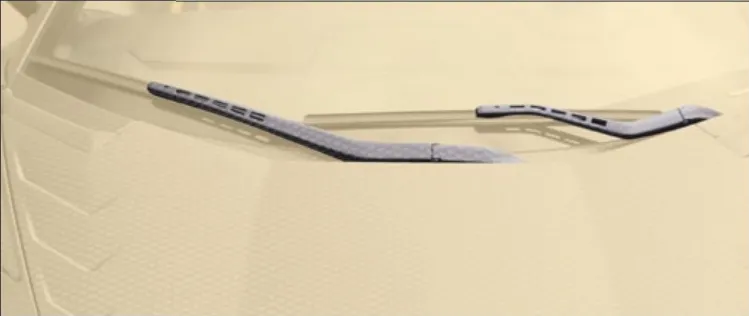
Carbon windshield wipers cover Mansory for Lamborghini Aventador S


Mansory Carbon Windshield Wipers Cover for Lamborghini Aventador S
This Mansory carbon wiper cowl is a small but visually disciplined trim panel that closes off the wiper-arm storage well at the base of the windscreen on the Lamborghini Aventador S. On the OEM car this region is a black plastic cowl moulding sitting between the front bonnet trailing edge and the windshield-frame transition; Mansory replaces that moulding with a like-for-like carbon shell that picks up the same fasteners, the same drain channel openings and the same wiper-arm clearance pockets. Within the wider Mansory Body Kit for Lamborghini Aventador S programme it is the part that finishes the upper-front sightline — once the front bonnet, mirror caps and roof are in lacquered weave, the OEM black plastic cowl is the last piece that breaks the carbon continuity, and this cover closes that gap. LP740-4 S, naturally aspirated 6.5 V12, scissor-doors, rear-wheel-steering, aluminium-CFRP monocoque. Coupé and Roadster covered by the same shell.
Construction & Materials
The cowl panel is laid as a thin-wall carbon skin over a lightweight stiffening grid. Because the part sits in a low-load zone — it carries no aero pressure, no body-stiffness duty, only its own weight plus rain runoff — the laminate is optimised for surface quality and dimensional stability rather than structural strength. The wiper-arm pockets are kept dimensionally identical to OEM so that arm sweep, parked-rest height and washer-jet ducting remain unchanged. Edge geometry along the windshield-frame transition is trimmed against the OEM gasket profile so the rubber seal still beds flat across the panel lip.
Surface treatment is the same lacquered programme that runs across every Mansory Aventador S exterior part: pigmented basecoat, two clear flow coats, then a final UV clear that protects the resin matrix from solar yellowing.
- Weave: 3K twill, lacquered finish standard; 2x2 plain-weave option; forged-look cosmetic option for inserts
- Cure: prepreg / vacuum-bag cycle, post-cured for dimensional stability against bonnet shut-line
- Wall thickness: ~1.4 mm carbon shell, locally ribbed underneath to resist hand-pressure flex during cleaning
- Weight: ~0.5 kg complete (versus ~0.8 kg for the OEM black plastic cowl)
- Mounting hardware: clip-on retainers re-using OEM cowl fastener bosses; supplementary hidden push-fit pegs
- Drain channels moulded into the underside, geometry matched to OEM rainfall path into the bulkhead drain
- Wiper-arm clearance pockets dimensionally identical to OEM — no re-indexing of arm rest position
- Finish options: high-gloss UV clear, satin matte, or paint-matched body colour with weave fadeout into the bonnet trailing edge
Design & Visual Function
The wiper cowl sits in a sightline that the driver sees every time they walk up to the car — directly between the bonnet shut-line and the bottom edge of the windscreen. On OEM Aventador S the contrast is harsh: lacquered body or carbon bonnet flowing into a flat black textured plastic panel, then back into glass. Replacing that plastic moulding with a lacquered carbon twin restores visual continuity, so the upper front of the car reads as one carbon-and-glass surface from the front bumper lip back to the roof.
Weave alignment is the detail that separates a serious build from a parts-bin one. Mansory orient the twill so the diagonal flows toward the windshield rake — the same rake angle that runs through the front bonnet and the A-pillar. From the driver's seat looking forward through the glass, the cowl weave reads as a continuation of the bonnet weave rather than a stand-alone panel. Light treatment is also part of the design intent: the lacquered surface picks up the hexagonal Lambo cues reflected in the windshield, and on the gloss clear option the panel functions almost as a soft mirror for the wiper-arm steel, framing the arms when parked.
For owners running a paint-break build (body colour on the bonnet, raw weave on the cowl), the panel can be specified in matte raw weave, which also softens windshield glare reflection on the dashboard during low-sun driving. For full-carbon builds, the gloss lacquer ties into the front bonnet, the mirror caps and the roof.
Compatibility & Fitment
Lamborghini Aventador S (LP740-4 S, 2017-2021), coupé and Roadster, both standard wiper hardware and any factory option packs. Pre-SVJ bonnet shut-line geometry, lower-side exhaust outlets — irrelevant to this part but flagged for build planning. The cover retains OEM rain-sensor wiring, washer-jet feed lines, wiper-motor service access, drain channels into the bulkhead and the rubber gasket profile against the windshield frame. No bonnet-cable re-routing, no wiper-arm re-indexing, no sensor recalibration. The Roadster fitment is identical — the cowl region is forward of the soft-top stowage zone, so targa-top operation, cabrio roof folding and stowage clearance are not affected.
Installation & Reversibility
This is the most DIY-friendly part in the entire Aventador S Mansory carbon programme. Tool list: Torx T20 and T25 drivers, a plastic trim-removal wedge, microfibre cloths and isopropyl wipes for prepping the gasket land. Time on the bench: 30 to 45 minutes including a slow careful unclip of the OEM cowl, and a deliberate seat of the carbon replacement so the wiper-arm pockets index cleanly over the parked arms. No paint or primer work is required if the panel is specified in factory lacquer. No adhesive is used on the cowl itself — fitment is mechanical, via the OEM fastener bosses and the supplementary push-fit pegs Mansory mould into the underside.
Reversibility is total. The OEM cowl unclips, the carbon cowl clips in, and either part can be re-fitted in either direction without trace. This makes the windshield wipers cover an excellent first-step build: an owner who wants to test a Mansory carbon look on their Aventador S before committing to bonnet, roof or bumper-lip parts can install the cowl in an afternoon and see how lacquered weave reads in their actual lighting and paint setting. If the build later expands, the cowl simply joins the rest of the carbon programme; if the owner sells, the OEM cowl returns in 30 minutes. Note on the wider Aventador S monocoque: methacrylate adhesive bonds are used on some structural panels of the CFRP tub, which is why Mansory keeps adhesive-bonded fitment off the cowl entirely — DIY owners do not touch substrate chemistry, only fasteners.
Pairing within the Mansory Aventador S programme
The cowl is the visual hinge between the front bonnet and the roof, so the two natural partner parts are immediately above and immediately ahead of it. The most common pairing path in our build sheets:
- Front bonnet (Mansory carbon) — lands directly forward of the cowl. Weave continuity between bonnet trailing edge and cowl front edge is the single biggest visual gain of fitting the cowl.
- Roof cover (coupé) — closes the upper sightline. Bonnet, cowl, A-pillar, roof in matched lacquered weave reads as a single carbon canopy.
- Mirror housing — flanks the cowl in peripheral vision when the driver looks forward. The three together (bonnet, cowl, mirrors) form the most visible carbon trio from the driver's seat.
For Roadster builds, swap the coupé roof cover reference for the cabrio-specific roof cover so soft-top stowage clearance is preserved.
Maintenance & Durability
The cowl lives in a high-debris zone — leaf litter, pollen, road grit and rainwater all funnel across it on their way into the bulkhead drains. UV exposure is moderate (the windshield rake shades part of the panel for half the day) but the trailing edge and the wiper-arm pockets see direct sun. Care routine: rinse first to lift grit, then wash with a pH-neutral car shampoo and a clean lambswool mitt; never use alkaline degreasers, ammonia-based glass cleaners drifting down from the windshield, or abrasive sponges — alkaline chemistry attacks the UV clear and abrasives cut micro-scratches into lacquered weave that no polish recovers. A ceramic coating applied once a year is the recommended protection layer; carnauba is acceptable but burns off faster in this zone because of windshield-channel heat soak. For chip repair, the laminate accepts standard automotive UV clear with isolated weave rebuilds — a good detailer can erase a stone chip on the cowl invisibly. Lifespan with disciplined care matches the rest of the Mansory exterior carbon programme: a decade of show-condition appearance with annual ceramic refresh.
Lead Time & Warranty
Production runs four to eight weeks from confirmed specification. Mansory build the cowl in the same lacquering line as the bonnet and roof, so when those parts are specified together the run is sequenced as one batch and arrives finish-matched. Twelve-month warranty against manufacturing defects: laminate voids, lacquer adhesion failure, weave misalignment outside spec, fastener-boss fracture. The warranty does not cover stone-chip damage, abrasive-sponge swirl, ammonia bleach from glass cleaners, or impact damage from a wiper-arm catch on a frozen windshield.
FAQ
Q: Does this fit both Aventador S coupé and Roadster?
A: Yes. The cowl region is forward of the soft-top mechanism, so the same panel covers both body styles without modification.
Q: How much weight does it save versus the OEM plastic cowl?
A: Around 0.3 kg. Negligible on lap times, but real for the cumulative weight bookkeeping owners run on full carbon builds.
Q: Can I install this myself?
A: Yes. It is the most DIY-friendly part in the Aventador S Mansory programme — Torx T20/T25, a plastic trim wedge, 30 to 45 minutes on the bench. No adhesive, no paint prep, no recalibration.
Q: Will the wipers still park in the same place?
A: Yes. The wiper-arm pockets are dimensionally identical to OEM, so parked-rest height and arm sweep stay factory.
Q: What finish should I pick if my bonnet is body-coloured?
A: Matte raw weave is the cleanest paint-break choice — it softens windshield glare on the dashboard and avoids competing with the painted bonnet. For full-carbon builds, gloss lacquer is the default.
Q: Does it interfere with the rain sensor or washer jets?
A: No. Sensor wiring and washer-jet feed lines route through the same paths as on the OEM cowl. No recalibration is required.
Pair the cowl with the front bonnet and the roof cover for the cleanest upper-canopy carbon read on the Aventador S. Talk to us on WhatsApp +44 7488 818 747 or email [email protected] and we will sequence the cowl with whatever else is on your build sheet.