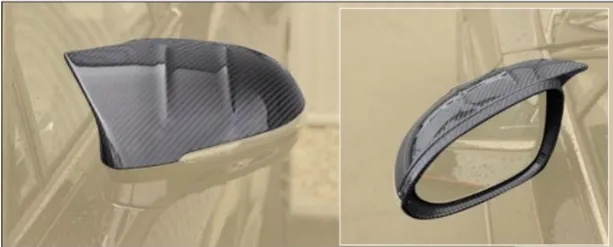
Mirror housing II Mansory Carbon for Bentley Continental GT GTC V8


Mirror housing II Mansory Carbon for Bentley Continental GT GTC V8
The Mirror housing II is the wider, aero-evolved sibling of the original Mansory carbon housing for the Bentley Continental GT 2nd-generation (D2A). Where the standard shell is a like-for-like cosmetic replacement, the II revision adds turning vanes along the inboard edge and a marginally enlarged footprint that pulls the mirror's wake further from the front-quarter window — a small detail that matters at speed. As part of the wider Mansory Body Kit for Bentley Continental GT 2nd-Gen (D2A), this housing pair lifts the side profile from "standard W12 GT" into the unmistakable Mansory silhouette. Sold as a left/right pair, hand-laminated, lacquer-finished, and ready to drop onto the OEM mirror base without trimming. The II revision exists because owners running the full Mansory carbon programme often wanted a mirror shell that visually echoed the wider, more architectural shoulder language of the bumpers and fenders rather than disappearing into the OEM silhouette.
Construction & Materials
Each shell is laminated as a one-piece monocoque over a CNC-milled tooling buck taken from a digitised OEM mirror scan. The outer ply is 3K twill carbon laid at a deliberate 0/90-degree weave alignment so that the diagonal pattern flows continuously from the leading edge through the turning-vane shoulder. Underneath sit two cross-plies and a structural core that gives the shell enough rigidity to resist micro-flex at autobahn speeds — flex that, on cheaper aftermarket housings, eventually cracks the lacquer. The lay-up sequence is hand-walked: each ply is consolidated against the previous one using soft squeegees specifically because mirror housings have aggressive compound curvature where machine consolidation can either bridge the corners or stretch the weave into visible distortion.
Resin selection is a high-Tg aerospace-grade epoxy with a glass transition temperature comfortably above the worst-case panel surface temperature a mirror housing will ever see, which on a dark-coloured Continental GT parked in summer sun is in the 80 to 90 C range. A correctly cured high-Tg laminate will not soften or shift dimensionally inside that envelope. The clear-coat sits at a similarly conservative thermal rating to prevent the dreaded summer-bonnet-haze effect that lower-grade lacquer chemistries produce after a few seasons.
- Outer skin: 3K 2x2 twill prepreg, 200 gsm, oriented for visual continuity
- Sub-laminate: two cross-plies of 200 gsm twill at +/-45 degrees
- Cure cycle: autoclave, 6 bar, 125 C dwell, slow ramp to suppress pinholes
- Wall thickness: 1.6–1.9 mm at panel face, 2.4 mm at vane root
- Mass per shell: approximately 320 g lacquered (vs OEM painted shell ~410 g)
- Mounting: factory clip pattern retained; no adhesive required
- Finish: 2K automotive clear, UV inhibitor, hand flat-sanded to 2000 grit then machine polished
- Optional matte finish on request, same lacquer chemistry, satin top-coat
Design & Visual Function
The geometric difference between Housing I and Housing II lives mostly on the inboard face. Housing II carries a pair of subtle turning vanes that rake rearward by roughly 12 degrees, plus a marginally wider trailing edge that pushes the shed vortex outboard of the A-pillar. On a Continental GT 2nd-gen, the OEM mirror sits in dirty air coming off the front fender shoulder, and the standard housing simply shrouds the pivot. The II revision is shaped to accept that incoming flow rather than fight it: the vane geometry breaks the inboard vortex into smaller, higher-frequency structures that disperse before reaching the side glass. In practical terms, owners report fewer water beads tracking diagonally across the front side glass in heavy rain at speed — a tertiary benefit but a real one.
Visually, the wider shoulder is the easiest tell. Viewed from the front three-quarter the housing has a deeper, more architectural shoulder line, and the twill weave wraps cleanly from the leading edge, around the vane, to the trailing lip without a single seam break. Mansory's house style here is restrained — there is no gloss-black accent strip, no brand stencil, no LED pod. The carbon is the design.
Light behaviour matters more than buyers expect. The 0/90 weave alignment makes the housing read as a single continuous panel under low-angle light, instead of fragmenting into the diagonal "checkerboard" effect that off-axis weaves produce on curved surfaces. At dusk, when most photographs are taken, the shell holds tone with the bonnet and front fender carbon parts of the kit. In direct overhead sun the polished clear gives a wet-look reflection that honours the OEM Bentley paint depth rather than reading as a flatter, lower-grade aftermarket part.
The vane root is shaped with a small radius rather than a sharp internal corner, both to prevent stress concentration in the laminate and to let the weave wrap continuously into the inboard face without local fibre distortion. Sharp internal corners are where bad housings either fracture under thermal cycling or show resin-rich patches in the carbon pattern. The radius hides neither geometry from the eye.
Compatibility & Fitment
Engineered for Bentley Continental GT 2nd-generation chassis (D2A, Volkswagen MSB platform), V8 and W12 variants, model years 2011 through 2017 facelift inclusive. Both coupé and GTC convertible body styles share the same mirror module on this generation, so the housing fits either body. Power-fold, heated, memory and side-camera mirror modules are all retained — the housing replaces only the cosmetic shell, not the electromechanical pivot or glass. Vehicles with retrofitted blind-spot LED mirrors should confirm shell internal geometry before fitting; OEM blind-spot modules clear without modification. The housing has been fitted on cars with Bentley OEM body-coloured caps, gloss black caps, and Mulliner-spec painted caps with no additional adjustments needed — the underlying mirror base is the same across those trim levels.
Installation & Reversibility
Installation is a 25–35 minute job per side for an experienced detailer or body specialist. The OEM shell is released by gentle hand-pressure on its three internal clips, lifted clear of the mirror base, and the carbon shell pressed into the same clip locations until the perimeter sits flush. No drilling, no cutting, no adhesive. Glass and motor are not touched. Fully reversible — the OEM shells are usually retained intact and can be refitted in minutes if the vehicle is returned to factory specification for resale or warranty work. We recommend torque-free hand-fitting only; power tools are unnecessary and risk cracking the clip ribs. If the original clips have been previously broken or fatigued — common on cars over 100k km that have had mirror cap painting work — replace the clip carriers before fitting the carbon shells, otherwise the housing will work loose at speed.
Pairing within the Mansory Continental GT programme
The Mirror housing II most often ships alongside Front fenders with stripe and Side skirts when buyers commit to the full side-profile carbon treatment. A common upper-body completion adds the Engine bonnet II for matching weave continuity from cowl to A-pillar. Matching weave runs along the visible flank of the car so that a side-elevation photograph reads as a single carbon language rather than three disconnected panels.
Maintenance & Durability
The autoclave-cured laminate is dimensionally stable across the full thermal envelope a road car experiences, and the 2K UV-inhibited lacquer is rated against carbon-clear yellowing for the typical seven to ten year window before a refresh might be considered. Wash with pH-neutral shampoo, no abrasive sponges, and avoid alkaline wheel cleaners migrating onto the housing during a rinse pass. A ceramic coating or high-grade synthetic wax twice a year will keep the depth of clear visibly intact. Light kerb-rash or stone chips on the leading edge can be locally repaired by a carbon specialist — the lacquer flat-sands and re-clears cleanly. Avoid automated wash brushes that whip across the housing at angle; the leading edge is the highest-risk area for micro-scratches because brushes catch the proud shell shoulder.
Lead Time & Warranty
Production lead time is 2 to 3 weeks from order confirmation to dispatch-ready, depending on autoclave queue and finish option. The matte finish schedule typically extends to 3 to 4 weeks because the satin top-coat needs an additional drying and inspection pass. Twelve-month warranty against manufacturing defects in laminate, bonding, and lacquer adhesion. Damage from impact, kerb strike, or aftermarket modification is excluded. We retain QC photographs of every housing pair before dispatch and will share them on request — a useful reference if any visual discrepancy appears after long-term ownership.
FAQ
Q: How does Housing II differ from the standard Mirror housing?
A: Housing II adds inboard turning vanes and a marginally wider trailing footprint. The standard housing is a direct cosmetic replacement; Housing II carries small aero geometry on top of that. Visually the II reads as a more architectural shoulder; functionally it manages the inboard vortex slightly better at sustained speed.
Q: Does the housing keep power-fold and heating function?
A: Yes. Only the outer cosmetic shell changes. Motor, glass, heater element, and any side-camera or blind-spot module remain on the OEM mirror base untouched. Wiring is not interrupted because no wiring runs through the cosmetic shell.
Q: Will the carbon match my bonnet exactly?
A: When ordered in the same batch as other Mansory Continental GT carbon parts, weave alignment and lacquer chemistry match closely. Standalone reorders against a pre-existing aged bonnet may show a marginal tonal difference because clear yellows slightly with age. Owners pursuing perfect match on existing aged carbon often re-clear the bonnet at the same time.
Q: Is matte finish available?
A: Yes, on request, with the same UV-inhibitor base and a satin top-coat. Matte typically extends lead time by a few days. Matte finish ages more gracefully on a daily-driven car because hairline swirl marks are diffused.
Q: Can I refit the OEM shells later?
A: Yes, the housing change is fully reversible. Keep the OEM shells; they clip back onto the same mounts in minutes. This is one reason the Mirror housing is a popular first-stage carbon swap — zero risk to resale value.
Pair the Mirror housing II with the wider Mansory Continental GT carbon programme for a single visual language across bonnet, fenders, and mirrors. WhatsApp +44 7488 818 747 or [email protected].