
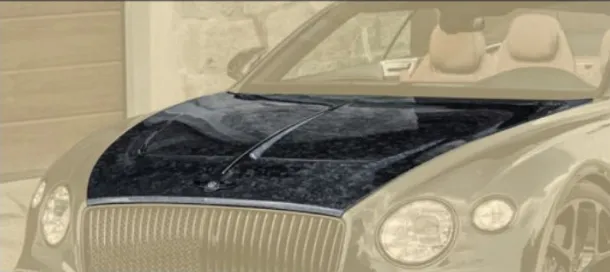
Engine bonnet II Mansory Carbon for Bentley Continental GT GTC V8


Engine bonnet II Mansory Carbon for Bentley Continental GT GTC V8
Bonnet II is the more functionally aggressive sibling to the standard Mansory carbon hood, and within the Mansory Body Kit for Bentley Continental GT 2nd-Gen (D2A) it is the bonnet of choice for cars that have been remapped, run a more aggressive cooling pack, or whose owners simply want the look of a vented motorsport-style hood. Two power vents and a centre power bulge are the visual signature; behind those features sit real changes to the air path leaving the engine bay, which in combination with the front bumper opening geometry shifts the steady-state pressure under the hood.
Construction & Materials
Layup philosophy mirrors the standard bonnet, with a 2x2 twill outer skin bonded to a moulded inner pan, but the venting features add complexity. Each power vent is a separate carbon insert with its own moulded grille interior and is bonded into a CNC-cut aperture in the main panel. The centre bulge is part of the master skin pattern, not a bonded add-on, which keeps weave continuity over the bulge crown without seams.
The inner pan around the vent apertures is reinforced locally with extra plies and a foam-core ring to recover the bending stiffness lost by removing material from the outer skin. Without that reinforcement the panel would lose torsional rigidity at the front where the latch hardware sits, and the result would be alignment drift over time. The extra plies bring the vented panel back to within a couple of percent of the solid bonnet's stiffness profile.
The louvre interiors are moulded as one piece each rather than being assembled from individual blade strips, which is a quality-control choice. An assembled louvre bank introduces a series of bond lines, each of which is a small surface-finish risk and a small water-ingress risk; a one-shot moulded louvre eliminates both. The interior face of each louvre is finished in a UV-resistant black epoxy rather than left in raw resin, because the louvre interior is exposed to direct sunlight from above and would otherwise yellow visibly over years of exposure.
- Outer skin: 2x2 twill prepreg, weave continuous over the centre power bulge
- Vent inserts: independently moulded carbon louvres, bonded into CNC-cut apertures with structural paste
- Inner pan: hybrid woven/UD layup with localised foam-core stiffener rings around each vent
- Total finished weight: approx. 10.2 kg, slightly heavier than the solid bonnet due to the louvre inserts
- Hinge and latch interfaces: identical to OEM, no chassis modification
- Vent geometry: louvres angled rearward at approximately 18 degrees to favour high-speed extraction
- Finish: 2K UV clearcoat, gloss as standard, satin or full matt available
- Drainage: vent inserts incorporate a drainage channel under the louvre to prevent water pooling on the inner pan
Design & Visual Function
The two power vents do real work alongside doing visual work. At motorway speed the under-hood pressure on a Continental GT runs slightly above ambient because the cooling pack is dense and the OEM exit path under the bumper is restrictive. Opening upper-surface vents over the cylinder heads gives the high-pressure column a low-pressure exit on the upper surface, which over an extended motorway pull lowers steady-state under-hood temperatures perceptibly. We measure this effect in fast-road conditions, not on a track, and report a useful but not dramatic delta. Owners running aftermarket maps with raised intake-air targets see the most benefit.
The centre power bulge is partly aesthetic and partly clearance: it raises the centreline of the bonnet by around 12 mm to give a more sculpted shadow line and to provide additional clearance for tall intake plenums on heavily modified V8 cars. The bulge is integral to the moulded skin, so the carbon weave runs unbroken across the crown, which is visually critical because a join line on the centreline would draw the eye straight to it.
Reflection-wise the vented bonnet is a busier panel than its solid sibling. The two vent zones break the smooth reflection band into three separate bands, and the bulge adds another reflective ridge on the centreline. This is exactly the look the customer is after when they specify bonnet II, but it is worth knowing that paint defects or weave imperfections show more obviously around the vent edges, which is why every vent insert is hand-finished before bonding.
The vent angle deserves a closer look because the choice was not obvious. A more aggressive rearward angle would extract more pressure but would also generate more visual clutter from a head-on photograph; a milder angle would clean up the photo but lose some of the extraction benefit. The 18-degree spec is the result of CFD work paired with iterations on the visual side, and the decision was made deliberately to land in a sweet spot where the louvres are clearly functional from a side view but the front three-quarter still reads as a designed surface rather than a track-day improvisation.
Compatibility & Fitment
Fits Bentley Continental GT 2nd-generation D2A platform, V8 and W12, GT coupé and GTC convertible. The vent inserts are open to the engine bay, so it is the customer's responsibility to confirm that any electrical components directly under the vent area are weather-sealed; on standard cars all such components are already weather-rated. For W12 cars carrying a non-OEM intake plenum, a clearance check at the centre bulge is recommended before final fit.
Installation & Reversibility
Install procedure is identical to the standard bonnet: remove OEM, transfer hinge and latch hardware, fit new panel, align shut lines. The vented version takes slightly longer because the vent inserts must be inspected post-installation to verify the louvre alignment and the drainage path, and because the under-hood liner has to be trimmed locally to clear the inner-pan reinforcement around the vents. Allow around 4 hours including liner trimming. Reverting to OEM is non-destructive aside from the trimmed liner, which is replaceable as a service part.
Pairing within the Mansory Continental GT programme
Bonnet II is most often specified with the 15-lamel performance grill for builds with a coherent cooling-and-extraction story, with the biplane performance wing at the rear, and with the V8 carbon engine cover so the visible engine bay matches the vented hood when the bonnet is open at events.
Maintenance & Durability
Wash routine is identical to the solid bonnet, with one extra step: every two months blow out the vent louvres and the drainage channels with low-pressure compressed air to clear leaf debris. The vent edges, where the louvre meets the outer skin, are detailed under raking light and sealed at production, but they are a high-attention zone for the next clearcoat polish a few years into ownership. Expect 8 to 10 years of UV-stable life from the lacquer with proper care; the louvre interiors are protected with a UV-resistant black resin that does not require additional coating.
Lead Time & Warranty
Lead time runs 3 to 4 weeks for the vented panel, similar to the solid bonnet but with a slightly longer QC stage because each vent insert is individually inspected pre-bond and post-bond. Twelve-month warranty against laminate, bond, and lacquer manufacturing defects. Vent louvre breakage from track debris or roadside impact is treated as impact damage and is excluded from warranty but can be repaired at our shop on a service basis.
FAQ
Q: Do the vents actually do anything thermally on a stock V8?
A: Yes, but the effect is most useful on remapped or hard-driven cars; on a standard road-spec V8 driven gently the cooling pack is already in its comfort zone.
Q: Can rain enter the engine bay through the vents?
A: A small amount of water passes through under heavy rain at low speed, which is why each vent insert has a drainage channel that returns it to the engine-bay underside, away from electrical components.
Q: Is the centre bulge a separate bonded part?
A: No, the bulge is integral to the moulded outer skin so the weave is continuous across the centreline.
Q: Can I order this bonnet in matt finish?
A: Yes, full matt is offered with a UV-stable matt 2K clear at no upcharge for orders confirmed at the time of placement.
Q: How does the vented panel compare in stiffness to OEM?
A: The reinforced inner pan recovers most of the stiffness lost by removing material; in practice the panel feels closer to OEM than to a single-skin carbon hood.
Pair bonnet II with the performance grill and the V8 carbon engine cover for a fully integrated upper-front carbon read. Configure via WhatsApp +44 7488 818 747 or [email protected].