
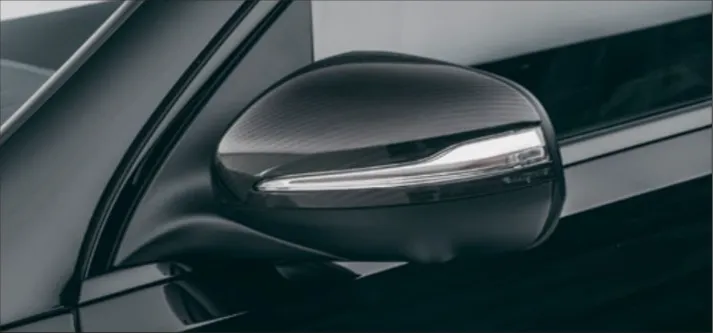
Mirror housing I Mansory Carbon for Mercedes GLS X167


Mirror Housing I Mansory Carbon for Mercedes GLS X167
The Mirror Housing I is the founding chapter of Mansory's mirror story for the Mercedes-Benz GLS X167 — the original, classically proportioned full-cap that the atelier introduced when the X167 first joined the carbon programme. It is a complete replacement of the OEM mirror shell rather than a cover bonded over the factory plastic, and its silhouette deliberately stays a touch closer to the production door line than the later, more sculptural Housing II. Specified by owners who want the Mansory wordmark and full carbon weave on the door corner without breaking the upright Mercedes architecture, it sits naturally on GLS 450, GLS 580 and the AMG GLS 63 alike, and complements the rest of the programme described in Mansory Body Kit for Mercedes GLS X167. AIRMATIC self-levelling, Panamericana presence, four-exhaust theatre on AMG, 9G-TRONIC composure — none of that changes; only the side profile gets its first dose of bespoke carbon coachwork.
Construction & Materials
Housing I is laid up as a load-bearing carbon shell from the inside out. The Mansory atelier in Brand starts with a CNC-milled positive that mirrors OEM hard points one-to-one, then builds the cap as a structural part rather than a cosmetic skin — it has to take the door slam, the high-speed buffeting, the car-wash brushes and the occasional shopping-trolley brush in a school car park, all without flexing the fold mechanism behind it.
- 3K twill-weave carbon outer ply with a 2x2 pattern aligned along the mirror's longitudinal axis so the diagonals echo the GLS shoulder line
- Multi-axial inner plies and a closed-cell core in the high-load zones around the fold-motor pivot
- Autoclave cure with prepreg epoxy, oven-controlled ramp, post-cure for dimensional stability under heat-soak from a black GLS roof on a summer afternoon
- Average wall thickness 2.0–2.4 mm, locally thicker at the fixture bosses
- Mansory deep-gloss UV-stable lacquer (default), or exposed-weave matt UV clear, or body-colour over carbon, or the Mansory two-tone painted shoulder with weave belly
- Stainless A2 hardware, OEM mirror-glass carrier and motor mounts retained, gasket interfaces re-cut to OEM tolerances
- Per-pair weight ~340–390 g (approximately equal to the OEM plastic shell — Housing I is about presence and material, not gram-count)
- Tamper-evident serial plate and Mansory certificate so the part is documented for resale and any future restoration
Design & Visual Function
Housing I and Housing II are both full-cap replacements, but they belong to two different studio moods. Where Housing II refines the geometry — sharper shoulder break, slightly wider cheek, a more confident outboard taper — Housing I keeps to the original Mansory script: a softer shoulder, a longer flush meeting with the door skin, and a cheek that sits a fraction tighter against the GLS upper door panel. From three quarters in front it reads as a discreet upgrade; the carbon weave catches the light, the Mansory signature is there for those who know where to look, but the silhouette still belongs to a Mercedes flagship rather than to a show car.
The three-way mirror matrix on the X167 is worth spelling out, because owners who specify the GLS programme almost always ask. Housing I — the part on this page — is the classical, original full-cap replacement. It transforms the entire mirror shell, the weave wraps the whole exterior surface, and the geometry is the most restrained of the three. Housing II is the later, more sculptural full-cap replacement: same construction philosophy, same OEM electronics retention, but a more aggressive shoulder and a touch more theatre. Mirror Cover I is a different proposition entirely — a bonded cover that sits over the OEM plastic rather than replacing it, the easiest and most cost-effective route to a carbon outer face but the least dimensional change because OEM geometry stays underneath. Specifiers who want the cleanest carbon transformation with a discreet voice choose Housing I; those who want a bolder, more carved silhouette go for Housing II; those who want a fast, fully reversible badge of carbon without disassembling the mirror choose Cover I.
Visually Housing I rewards close inspection. The weave runs continuously around the outboard cheek without a paint break, the lacquer pools deep on the shoulder, and the LED blind-spot lens sits in its OEM position so the warning amber still throws onto the door glass exactly where the driver expects it. The door-mounted surround camera (where fitted on AMG GLS 63 with the 360-degree system) keeps its aperture and clears the door skin without distortion, and the heated mirror-glass element warms the carrier in the same time as factory.
Compatibility & Fitment
Engineered for the Mercedes-Benz GLS X167 from MY2020 production onwards, including the MY2024 facelift, in left- and right-hand-drive form. Compatible with GLS 450 (3.0 inline-six with EQ Boost mild-hybrid), GLS 580 (4.0 V8 BiTurbo with EQ Boost) and the AMG GLS 63 (4.0 V8 BiTurbo, ~603 hp, Panamericana grille and four central-mounted tailpipes). Power-fold, auto-dim, heating, blind-spot LED, memory positions and the door-mounted camera feed for 360-degree surround view are all preserved by the OEM electronics package; Housing I only changes the outer shell, never the carrier, motor or sensor cluster. AIRMATIC ride-height changes, the panoramic roof drainage path along the upper door seal and the third-row visibility geometry are all unaffected.
Installation & Reversibility
Plan around three to four hours per pair at a Mercedes-certified body shop or a Mansory-trained installer. The mirror is removed at the door, the inner trim cap and glass carrier are detached, the OEM shell is parted from the carrier sub-frame, and Housing I is mated to that same sub-frame with the original screw pattern and the supplied stainless hardware. The fold mechanism is reattached, the gasket dressed, the heater and blind-spot connectors clipped back in, and the assembly torqued to OEM values before the door card goes back on. Because Housing I uses the factory mounting points without modification, the installation is fully reversible — the OEM shells can be reinstalled at any time, with no drilled holes, no cut harness and no marks on the door skin.
Pairing within the Mansory GLS X167 programme
The natural first cross-reference, especially for owners who are still choosing between the original and the refined geometry, is the later Mirror Housing II — same build philosophy, more sculptural shoulder, the alternative full-cap mood. The other end of the matrix is the Mirror Cover I, the bonded over-cover that swaps in carbon without disassembling the mirror — fastest path, lowest cost, smallest geometric change. For owners who want the side profile to read as a coherent carbon statement rather than a mirror upgrade in isolation, pair Housing I with the Fender extensions so the wheel arches and the door corners share the same weave language, or with the Front fender panel to bring the carbon further along the body side toward the bonnet shut line.
Maintenance & Durability
Treat Housing I exactly as a lacquered carbon body panel. A pH-neutral shampoo, a soft mitt, a soft drying towel and a quarterly carnauba or twice-yearly ceramic top-up are enough to keep the weave looking deep and the lacquer free of swirl. Stay away from alkaline wheel cleaners, ammonia, abrasive scotch pads and traffic-film removers used neat — they will dull the lacquer over time and they bleach exposed weave. The GLS lives a school-run-plus-long-haul life, which means the door corners see more rock-chip and trolley contact than a coupé's mirrors ever will, so a layer of self-healing PPF over the outboard cheek is a sensible specification, especially in a high-mileage household. Lacquered carbon is also fully repairable — a Mansory-trained refinisher can sand back, re-clear and re-cure a chipped section, and a heavily damaged housing can be sent back to the atelier for a re-shell rather than a full replacement.
Lead Time & Warranty
Bespoke production runs four to eight weeks from order, with the final week reserved for QC and matched-batch packaging if a wider Mansory specification is travelling on the same crate. The supplied 12-month warranty covers manufacturing defects in the carbon lay-up, lacquer adhesion and hardware; cosmetic damage from impact, abrasion, alkaline cleaning agents or installation outside Mansory's published torque values is excluded.
FAQ
Q: How is Housing I different from Housing II — when should I pick this one?
A: Both are full-cap replacements with identical build standards and the same OEM electronics retention. Housing I is the original, classical Mansory geometry: softer shoulder, more flush with the OEM door line, more discreet voice. Housing II is the later, more sculptural geometry: sharper shoulder, slightly wider cheek, more theatre. Pick Housing I if you want the cleanest carbon transformation that still reads as restrained Mercedes flagship; pick Housing II if you want the side profile to be louder.
Q: And how does Housing I compare with Mirror Cover I?
A: Cover I is bonded over the OEM plastic rather than replacing it, so it is the fastest, cheapest and most reversible route to carbon on the mirror — but the OEM geometry stays underneath, so the silhouette barely changes. Housing I replaces the whole shell, so the carbon weave wraps the entire visible cheek and the part feels like coachwork rather than trim. If budget and time are tight and you simply want a carbon face on the mirror, Cover I. If you want the part to feel bespoke and material-true, Housing I.
Q: Does it fit AMG GLS 63 with the 360-degree surround camera and the Panamericana grille car?
A: Yes. The door-mounted camera aperture, blind-spot LED, heated glass, power-fold motor and memory module all stay OEM. Panamericana versus upright louvre grille is a front-end distinction; the mirror geometry on the door is shared across the X167 range, so Housing I fits GLS 450, GLS 580 and AMG GLS 63 from the same part number per side.
Q: How much weight do I save?
A: Effectively none — Housing I is roughly the same mass per shell as the OEM plastic. The Mansory atelier prioritises rigidity, dimensional stability and material presentation over gram-count on a 2.49-tonne luxury SUV. The point of the part is the carbon coachwork and the Mansory signature, not the lap time.
Q: If a stone chips it, am I scrapping the whole housing?
A: No. Lacquered carbon is locally repairable by any refinisher who has worked on Mansory or factory carbon parts — sand the area, re-clear, re-cure, polish. Severely damaged shells can be returned to the atelier for re-lacquer or re-shell rather than full replacement. Lead time on remanufacture sits inside the same 4–8 week bespoke window.
Pair Housing I with the rest of your GLS X167 carbon specification and we will sequence production so everything lands in the same crate. Concierge orders, fitment questions and bespoke finishes — Mansory two-tone, body-colour-over-carbon, exposed weave matt — all run through WhatsApp +44 7488 818 747 or [email protected].