
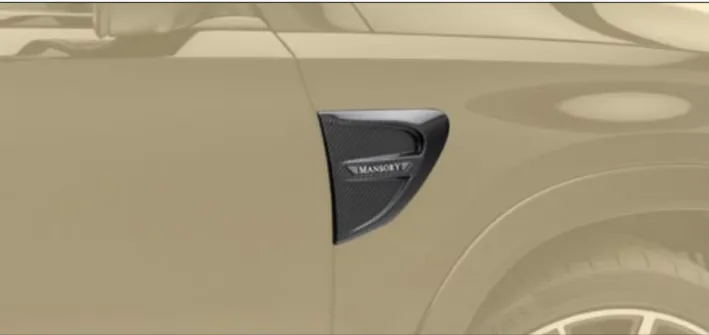
Front fender panel Mansory Carbon for Mercedes GLS X167


Front Fender Panel — Mansory Carbon for Mercedes GLS X167
The front fender panel is the vertical carbon piece that sits above the front wheel arch and behind the wheel itself, resolving the visual run between the fender extension below and the air-outtake trim that punctures the upper shoulder. Within the broader Mansory Body Kit for Mercedes GLS X167, this panel is the part that converts the OEM body-coloured shoulder into a bespoke carbon plane, locking together flare, vent and door-shut into one coachbuilt surface. On a 5.21-metre, ~2.49-tonne luxury SUV — whether GLS 450 inline-6 mild-hybrid, GLS 580 V8 BiTurbo or AMG GLS 63 with its M177 4.0-litre and four central exhausts — the upright shoulder line is the dominant graphic of the side view; resurfacing it in twill carbon is exactly how Mansory tells you a GLS has been through their workshops.
Construction & Materials
The fender panel is laid as a single bespoke part with weave continuity across the full vertical face — there is no splice, no joint visible from any walk-around angle. Mansory's preference on this generation of programme is autoclave-cured prepreg with a deep-gloss UV-stable lacquer; an exposed-weave matte option is available on request for owners pairing the part with PPF.
- Weave: 3K twill 2x2 standard; 2K plain or forged-look on bespoke order.
- Cure: autoclave prepreg, vacuum-bagged, ~120 °C cycle for full resin advancement.
- Wall thickness: ~1.6–1.9 mm across the panel, locally thicker around the upper return where it meets the bonnet shut.
- Weight per side: ~0.9 kg vs OEM stamped-steel section the carbon visually overlays.
- Mounting: factory-shape carrier with 3M VHB structural adhesive plus mechanical screw points to the existing fender flange.
- Finish: Mansory deep-gloss two-pack clear with UV inhibitor; matte-clear and full satin lacquer available.
- OEM cut-outs: side-marker / repeater aperture and front-quarter camera (where fitted) preserved with factory-tolerance edges.
- Sealing: closed-cell EPDM gasket along the inner return to keep wash-water and road spray out of the carrier cavity.
Design & Visual Function
The GLS X167 has a deliberately upright shoulder. Mercedes draws a long, almost rectangular volume from the A-pillar back toward the C-pillar with a single shut line stepping over the wheel arch. Mansory's front fender panel respects that geometry — it does not try to sculpt downforce onto an SUV that has no need of it — but it lays a carbon plane over the most rock-chipped, most often-photographed quarter of the car. Twill direction runs vertically with a 45-degree lay so the weave reads as a quiet pinstripe along the shoulder rather than a busy chequer.
Where it really earns its place is the joinery. Below it sits the fender extension, flaring the arch outward; above and behind it sits the air-outtake-cover and air-outtake-splitter that vent the front-wheel-well pressure on the AMG GLS 63 and high-trim 580. Without the carbon fender panel between them, you have OEM body colour sandwiched between two carbon parts — which immediately reads as an aftermarket clip-on. With the panel in place, the entire shoulder becomes one surface and the eye stops looking for the joint. That is the Mansory move, and it is why this part is rarely specified alone.
For owners not running carbon roof or carbon mirror caps, the fender panel can be ordered with a paint-break finish — the panel is sprayed in body colour and only the bottom edge runs in clear-coat carbon, giving a more reserved look that still upgrades the rock-chip surface and the joint with the fender extension.
Compatibility & Fitment
The part is engineered for the Mercedes-Benz GLS X167 from MY2020 (2019 build onward) including post-MY2024 facelift cars, across GLS 450 (inline-6 EQ Boost mild-hybrid), GLS 580 (4.0-litre V8 BiTurbo with EQ Boost) and AMG GLS 63 (M177 4.0-litre V8 BiTurbo, ~603 hp). Side-marker / repeater aperture is retained at OEM dimension; front-quarter camera, where specified, keeps full field of view; AIRMATIC self-levelling and active body control are not affected because no suspension component is touched. Owners running the Manufaktur or AMG Night Package — gloss-black trim where chrome would normally be — should specify lacquered carbon to keep the shoulder cohesive; chrome-spec cars usually look better with the paint-break variant.
Installation & Reversibility
Bench time is 3–5 hours per side for a body-shop technician with the fender liner dropped. The flow is straightforward: jack the car onto stands with AIRMATIC switched to transport mode, remove the front wheel, drop the inner liner, degrease the OEM fender face, primer-prep the bonding zones, lay 3M VHB 5952 strips along the carrier ribs, locate the panel on its alignment pins, and torque the discreet screw mounts that capture the upper return into the fender flange. Body shop is recommended for the alignment pass — getting the panel parallel to both the bonnet shut and the door shut is what separates a clean install from one that always looks slightly off. Reversibility is high: the carrier and adhesive lift cleanly with heat, and OEM bodywork is not modified beyond pre-existing flange holes.
Pairing within the Mansory GLS X167 programme
The fender panel is the connective tissue of the front shoulder. Three pairings make particular sense: with the Mansory carbon fender extensions below, which flare the arch outward and pick up the same weave at the bottom edge of the panel; with the Mansory carbon air-outtake cover immediately rearward, which closes the fender into the door shut on the AMG GLS 63 and the high-spec 580; and with the Mansory carbon mirror housing I, which lifts the carbon vocabulary from the shoulder up onto the door and into the driver's eye-line. Specified together, the three parts plus the fender extension form a continuous carbon ribbon along the side of the car — which is what the programme is really designed to deliver.
Maintenance & Durability
The leading edge of any front fender panel sees more rock-chips than almost any other body surface — a GLS does motorway miles, school-run miles and the occasional gravel-drive country house, and the front of the front arch catches everything the front wheels throw up. Two long-term-care moves matter here. First, specify clear paint-protection film over the leading 8–10 cm of the panel; PPF on lacquered carbon is invisible at conversational distance and keeps stone chips from cracking the clear-coat. Second, never let an alkaline wheel cleaner overspray onto the panel — alkaline chemistry attacks two-pack clear far faster than carbon. A pH-neutral shampoo, two-bucket wash, and an annual re-application of a SiO2-based ceramic topper will keep the gloss measurably high for years. If a chip ever does breach the lacquer, the repair workflow is the same as for a painted panel — sand local, fill, re-clear, polish-blend — and any Mercedes-certified body shop with carbon experience can do it.
Lead Time & Warranty
Lead time is 4–8 weeks from order confirmation. Each fender panel is laid, cured and finished to the customer's specification — weave choice, lacquer level, paint-break or full carbon — and inspected before release. The part carries a 12-month manufacturing-defect warranty covering delamination, lacquer failure under normal use, and dimensional drift; impact damage and chemical attack from incorrect detailing products are not covered, which is the same boundary every coachbuilt carbon part operates within.
FAQ
Q: Does the same panel fit the GLS 450, GLS 580 and AMG GLS 63?
A: Yes. The bodyshell of the GLS X167 is shared across the range and the panel is engineered to that shell. The visual story differs because the surrounding parts differ — AMG cars more often pair it with the carbon air-outtake cover and splitter — but the panel itself is one part number across all three.
Q: My car has a stone chip in the existing fender. Can I just bolt the carbon panel over it?
A: Not recommended. The carbon panel is a finished surface that needs a sound substrate underneath. We always advise correcting the OEM stone chip first — touch-up paint or a localised respray — before the carbon panel is laid down, because a rust seed left under VHB will eventually telegraph through.
Q: What finishes are available?
A: Three: full lacquered 3K twill (the default and most popular), satin / matte-clear over the same weave (more reserved, hides micro-marring better) and the paint-break option where the panel is sprayed in body colour with a carbon strip along the bottom edge that ties into the fender extension.
Q: Will it sit cleanly against the carbon fender extension below?
A: Yes — the two parts are dimensioned together. The bottom edge of the fender panel and the top edge of the fender extension are designed to share a common shut, with weave continuity across both parts when the same lay-up is specified.
Q: How long is lead time and how long is warranty?
A: 4–8 weeks for production, then bench install. Warranty is 12 months on manufacturing defects from the date of fitment.
The fender panel is a quiet but defining part of the GLS X167 Mansory programme — the piece that lets the shoulder read as one continuous carbon surface rather than a kit of discrete add-ons. Specify it alongside the fender extensions and the air-outtake cover and the side view of the car finally settles. To configure colours, weaves and pairings, contact a programme advisor on WhatsApp +44 7488 818 747 or by email at [email protected].