
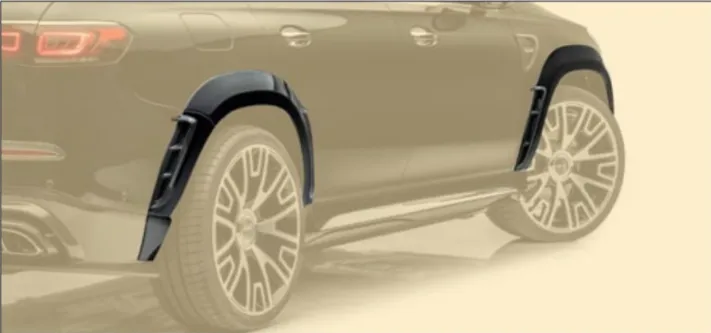
Fenders extension Mansory Carbon for Mercedes GLS X167


Fender Extensions — Mansory Carbon for GLS X167
The Mansory carbon fender extension set for the Mercedes-Benz GLS X167 is the part that does the most for stance with the least amount of bumper surgery. Four wheel-arch flares — two fronts, two rears — extend the OEM fender lips outboard so a wider track and bolder wheel offset look intentional rather than stretched. On a GLS 580 V8 BiTurbo it broadens the upright Mercedes silhouette without breaking the seven-seat luxury proportions; on the AMG GLS 63 with Panamericana grille and four central exhausts it amplifies the already-subtle factory widening into proper Mansory theatre. The flares sit within the Mansory Body Kit for Mercedes GLS X167 programme — a coachbuilt carbon catalogue that treats the X167 as a canvas for bespoke presence rather than a tuning donor. AIRMATIC travel, 4MATIC track, parking-sensor cones and 9G-TRONIC behaviour are all preserved.
Construction & Materials
Each flare is laid up as a carbon-fibre composite shell with localised reinforcement at the bolt/bond zones. Mansory's house grade for visible exterior carbon is 3K twill — a tight, deep weave that reads as woven cloth at arm's length and dissolves into a near-black mirror under deep-gloss lacquer. Edges are radiused and post-cured so they sit flush against the OEM fender steel without any perceptible step.
The flares are produced in matched left/right pairs per axle — fronts and rears are not interchangeable. Mounting is a hybrid: structural urethane bonding along the fender-lip seam plus stainless mechanical fasteners hidden behind the wheel-arch liner, so the visible carbon face is unmarked by hardware.
- Weave: 3K twill carbon, factory option for 2K plain or forged-look chopped-tow on request
- Cure: prepreg autoclave at 120 C with vacuum debulk between plies for void-free skins
- Wall thickness: 1.6–2.0 mm at the flare face, stepped to 2.5–3.0 mm at the mounting flange
- Combined set weight: ~3.4 kg for all four flares (front + rear)
- Mounting: marine-grade structural urethane bond + concealed stainless M5 fasteners through OEM liner mount points
- Finish: deep-gloss UV-stable lacquer as standard; satin clear or raw-weave matte to order
- Edge treatment: radiused and sealed; inner lip flocked to suppress arch noise
- Optional: gloss-black painted face for owners who want widening without visible weave
Design & Visual Function
The visual job of a fender extension on a vehicle this large is restraint. The GLS X167 is 5.21 m of upright luxury SUV — over-flare it and the car looks like a cosplay of itself. Mansory's geometry adds roughly 18–24 mm of outboard width per side, tapered into the existing OEM lip with a long lead-in so the eye reads the car as one continuous body, just wider at the corners. The crown of each flare is sculpted to follow the GLS shoulder line and the rising rear-arch crease, which means the carbon weave grain runs in the direction the eye already wants to travel.
On AMG GLS 63 — where the Panamericana grille, four central-mounted exhausts and standard wider-track AMG hardware already imply purpose — the flares sit as the missing link between the front-bumper aggression and the AMG quad-tip stance at the rear. On standard / 580 trims with the upright louvre grille and dual exhausts, the same flares pull the visual weight of the car outward and lower its perceived centre of gravity, so the SUV reads as planted rather than tall.
Where the flare meets the door cut and the rear-quarter shut-line, Mansory's CAD has been driven by laser-scanned X167 bodies rather than nominal CAD, so the gap to the door edge is consistent within ~0.5 mm along the full sweep. The arch lip is rolled inboard so the carbon never catches a tyre under full AIRMATIC compression, and the lower trailing edge of each rear flare clears the rear-camera washer aperture and the parking-sensor cones at full lock.
Compatibility & Fitment
Mercedes-Benz GLS X167 (2019–onwards), all variants — GLS 450 (3.0 inline-6 + EQ Boost), GLS 580 (4.0 V8 BiTurbo), AMG GLS 63 (4.0 V8 BiTurbo, ~603 hp). The flares are dimensioned for OEM fender geometry and are compatible with both pre-facelift and post-MY2024 facelift bodies. AIRMATIC and E-ACTIVE BODY CONTROL self-levelling is preserved — flares are bonded to the OEM fender lip, which itself moves with the body, so suspension travel is unaffected. Parking-sensor cones in the rear bumper and any factory blind-spot radar emitters are not obstructed. Panoramic-roof drainage, third-row seat folding and rear-tailgate sweep are unaffected — the flares live entirely on the fender, not on the door or tailgate.
Installation & Reversibility
Plan on a 4–6 hour bench job for an experienced body-shop fitter, longer if paint-matching the painted-face option to a body-colour spec. Wheel-arch liners must be dropped to access the inner mount points, the OEM fender lip is cleaned and lightly keyed for the urethane, then each flare is offered up dry and shimmed against the door shut-line before any bond is set. Once bonded, the concealed M5 fasteners pull the flange to the liner mount points and the bond cures over 24 hours.
Reversibility: the urethane bond can be cut with a fishing-line debond tool, and the OEM fender lip remains intact underneath. Expect light keying scuffs that need a thin re-prime — a competent shop reverses a set in a half-day. Recommended installer is a Mercedes-certified body shop or a Mansory-trained installer; this is not a driveway DIY part. Owners doing emblems, mirror covers and other clip-on parts themselves should still hand the flares to a professional bay.
Pairing within the Mansory GLS X167 programme
The fender-extension set anchors the visual widening package and rewards being specified with the right neighbours. The front fender panel in Mansory carbon sits forward of the flare and carries the weave from the front wheel-arch up the body side, so the eye reads a continuous carbon corner rather than a flare bolted onto a painted panel. The front splitter closes the front aperture below the bumper and balances the widened front track visually, so the car doesn't look hip-heavy. For owners who specify the air-management programme, the air-outtake cover ties the carbon language from fender corner up into the front-fender vent — three pieces, one carbon vocabulary.
Maintenance & Durability
Lacquered carbon on a 2.49-tonne family SUV that does the school run, motorway miles and the occasional gravel driveway sees more rock-chip exposure than a coupé would. The flares are the closest carbon part on the car to the tyres, which means stone-chip risk is real. We strongly recommend self-healing PPF over the flare faces, particularly on the front pair, and a ceramic top coat over the PPF. Wash with pH-neutral shampoo and two-bucket method; avoid alkaline traffic-film removers, ammonia-based glass cleaners that overspray onto the carbon, and abrasive sponges. UV exposure is mitigated by the UV-stable lacquer Mansory uses but is not eliminated — garage where possible.
If a flare chips through to the weave, the repair is local: scuff, fill the chip with clear-coat-compatible resin, sand flush, re-lacquer the affected zone, polish back. A full panel re-lacquer is rarely needed. Edge-flocking inside the arch wears slowly; expect 5–7 seasons before a refresh is sensible.
Lead Time & Warranty
Lead time is 4–8 weeks from order to dispatch — Mansory production is bespoke and matched to your build slot. The set ships fully cured, lacquered and quality-inspected, with bonding consumables and concealed fasteners included. Warranty: 12 months against manufacturing defects (delamination, weave inclusions, lacquer failure under normal use). Stone-chip and impact damage are not covered — this is why we recommend PPF.
FAQ
Q: Will these fit my GLS 450, or are they AMG GLS 63 only?
A: They fit all X167 variants — GLS 450, GLS 580 and AMG GLS 63. The AMG is already a fraction wider in track from factory, but the same flare geometry works because it's bonded to the fender lip rather than referencing the bumper.
Q: How much wider does the car actually look?
A: ~18–24 mm per side at the widest point of each flare. Visually it reads as a meaningful step rather than a subtle one — without crossing into caricature territory.
Q: Do I need wider wheels or a different offset?
A: Not strictly. The flares cover the OEM track, but they unlock the visual and clearance budget for a wider wheel/lower offset if you choose to specify one. Many owners run them with OEM wheels for the look alone.
Q: Will AIRMATIC and the air-suspension lift mode still work?
A: Yes. The flares bond to the fender lip, which moves with the body. Full suspension travel and lift mode are unaffected, and arch clearance is engineered around full compression at maximum steering lock.
Q: Can I have them in raw matte weave instead of gloss lacquer?
A: Yes — matte clear or satin lacquer over raw weave is a factory option, and a full painted body-colour face is available for owners who want widening without visible carbon.
Q: How long does fitment take and can I keep the car driveable in between?
A: Plan for a 4–6 hour shop visit plus 24 hours of urethane cure before the car returns to wet-weather use. Most owners drop the car in the morning and collect it the next day.
Pair the flares with a front fender panel and a front splitter to lock the carbon language across the entire front quarter, then add a roof spoiler and diffuser to balance the silhouette front-to-rear. Order or specify your build via WhatsApp +44 7488 818 747 or [email protected].