
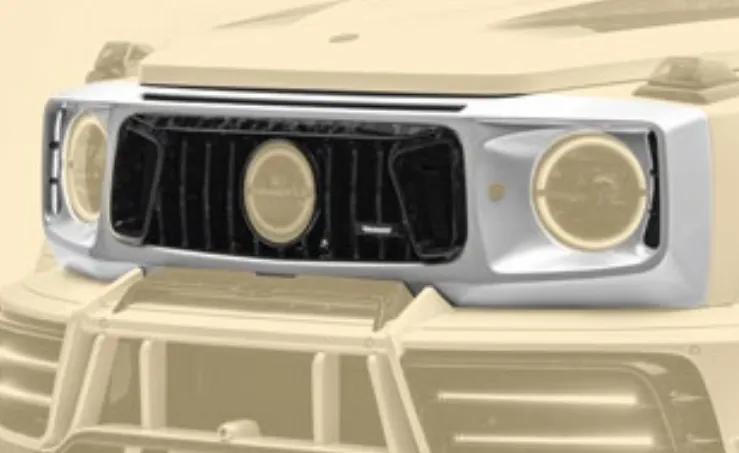
Wide front mask with air side intakes - primed with performance vertical grill


Mansory Wide Front Mask with Air Side Intakes — Primed, Vertical Performance Grill for the Mercedes-Benz G-Class W465 Gronos
The W465 G-Class arrived with a tighter, more electronics-dense front end than its W463A predecessor: revised radar geometry, repositioned camera, reworked headlight-washer plumbing. The factory mask is conservative by design — it has to satisfy global homologation. Mansory's Wide Front Mask with vertical performance grill rebuilds that fascia from the studio floor up: a wider opening, sculpted side intakes feeding cooling and brake ducts, and a vertical-bar grill that reads as engineered rather than decorative. Delivered primed, ready for your bodyshop to lay a finish that matches the rest of the Gronos build.
Visual identity: a deliberately wider track
The mask extends past the OEM grille frame on each side, integrating with the wider Gronos fender flare line. The eye sees three things at once: a stretched horizontal stance, the recess of the side intakes, and the vertical bars of the grill insert. Together they pull the truck visually lower and broader without changing ride height. From three-quarter views the mask is what tells onlookers this is a Gronos rather than a stock G63. The widened track is not a styling exercise alone — it gives the front bumper room to breathe air around the wheel arches and into the brake-cooling ducts that sit behind the lower portion of the mask.
Air intake aerodynamics: cooling, not just looks
The two flanking air-side intakes are functional channels, not blanked-off cosmetic shells. Each intake is shaped to capture high-pressure flow at the front of the truck and route it to a specific consumer:
- Brake cooling ducts: the lower portions of the side intakes feed flexible ducts that direct cool air to the front rotors during sustained high-speed driving — meaningful on a 2.5-ton SUV with 295 mm rotors that can otherwise heat-soak under repeated braking.
- Intercooler & oil cooler feed: the upper inboard portion of each intake routes flow toward the M177 V8's intercooler and engine-oil cooler stack, helping stabilize charge-air temperatures and oil temperatures during long high-load runs.
- Pressure-balanced opening: the mask's main grille area and the two side intakes are sized to balance pressure across the radiator core, eliminating the dead zones that develop behind narrow OEM grilles at speed.
The geometry was developed against the W465's specific underhood layout. Channel cross-sections taper to the consumer rather than dumping into open engine bay, which is what separates a designed intake from a hole in plastic.
Primed finish vs. visible carbon: a deliberate trade-off
This variant ships primed. That choice is not cost-driven — it is a finish strategy. A primed mask gets painted in your body color, allowing the front end to read as a single sculpted piece rather than a contrasting carbon panel bolted onto a coloured truck. Reasons owners pick primed over visible carbon:
- Color cohesion: a single body color across mask, hood, fenders and bumper produces a tighter, more architectural front end. Visible carbon, by contrast, fragments the front face into texture zones.
- Designo / bespoke paint matching: if your truck wears a Designo, Magno, or custom-mixed shade, only paint can match it. Carbon weave cannot.
- UV durability: a properly painted and clear-coated mask resists UV chalking better over a decade than visible carbon under a single clear layer.
- Repair flexibility: stone chips on a painted panel are blended invisibly. Stone chips on a clear-coated weave are far harder to repair without re-laying clear over the entire surface.
If you want the carbon-weave statement, the same mask geometry exists in visible-carbon variants elsewhere in the Gronos catalogue — but this listing is specifically the paint-ready route.
Vertical vs. diagonal grill: aesthetics and airflow
The W465 Gronos wide mask is offered with two grill insert geometries: vertical-bar (this listing) and diagonal-bar (its sibling variant — front mask with diagonal performance grill). The choice changes both the visual register and the airflow signature:
- Vertical bars: read as classical, technical, AMG-adjacent. Eyes track the bars top-to-bottom, reinforcing the truck's tall stance. Airflow behind the bars is largely uninterrupted on the horizontal axis, with mild turbulence shed off the trailing edges of each bar — well-suited to radiator-core feed where you want even pressure distribution.
- Diagonal bars: read as modern, motorsport, dynamic. Eyes track diagonally, adding implied motion to a stationary truck. Airflow is biased toward the sides as it deflects off the bars, which can favor end-tank cooling at the radiator extremes.
Functionally both feed the radiator adequately; this is primarily an aesthetic decision. Owners who already run vertical-bar grilles on their Mercedes daily drivers tend to pick this variant for visual continuity. Those who came from S63 or AMG GT projects more often pick diagonal.
ACC radar, sensors and OEM compatibility
The W465 carries adaptive cruise-control radar, parking sensors, and a forward-facing camera positioned on or behind the front mask. Mansory's mask preserves all of that:
- ACC radar pass-through: the mask's central panel is engineered with a low-attenuation radar window in the correct position for W465 long-range radar. Cruise control, distance-keeping and emergency-brake features remain operational.
- Parking sensor cutouts: all OEM ultrasonic sensors transfer to factory-spec cutouts in the mask. No drilling or repositioning is required.
- Headlight washer jets: the lower edge of the mask routes washer-jet pass-throughs for the factory telescoping washer nozzles where fitted.
- Forward camera: the mounting boss for the central forward-facing camera is preserved; lane-keep and traffic-sign recognition continue to function.
Engineering this without compromising radar transparency is the part most aftermarket masks get wrong. The Mansory part keeps it within OEM tolerance.
Material and structural engineering
- Composite layup: reinforced GFRP / SMC core selected specifically because it bonds and accepts paint better than carbon over large painted surfaces. Glass fiber gives the panel impact tolerance against road debris that carbon would handle more brittly.
- Reinforcement zones: additional fiber stacking around the mounting points and around the radar window keeps panel deflection within tolerance under highway loads, where a flat front face sees significant pressure.
- Bonded crash-relief sections: the mask incorporates designed crash-relief zones bonded into the core composite so the front end behaves predictably in low-speed impacts and so the mask itself does not transmit unintended loads into the bumper structure.
- Mounting: uses the OEM front-mask bolt pattern plus supplementary bonded mounts. Stainless hardware with vibration-damping isolators. Torque sheet supplied with the part.
Paint preparation: from primed to finished
Primed delivery is the start of the finish process, not the end. A correct paint preparation goes:
- Inspection: verify panel alignment dry-fitted on the truck before any sanding. Identify gap targets at top, bottom, left, right edges (3–5 mm typical).
- Sanding: wet-sand the factory primer with P400, then P600, then P800. Edges and channel transitions are the trouble spots; work them with hand pads, not orbital, to avoid breakthrough.
- Filler primer (if needed): any minor texture variation in the SMC core gets a thin coat of high-build filler primer, then re-sanded to P800. On panels delivered well, this step is skipped.
- Base coat: 2–3 coats of base in your color, with proper flash time between coats. Body shops experienced with composite panels know to check temperature and humidity carefully — composites move slightly with temperature and you don't want a coat going down at the wrong substrate temperature.
- Clear coat: 2–3 coats of automotive 2K clear, polished after full cure. The mask's prominence in the front view means any clear-coat orange-peel will be visible — this is not the panel to cut corners on.
Total bodyshop time including paint and cure: typically 2–3 working days when scheduled into an existing booth slot.
Comparison with the diagonal-grill twin
The closest sibling to this part is the diagonal-grill version of the same wide front mask. Both share the identical mask body, identical side-intake geometry, identical radar pass-through, identical mounting and identical paint preparation. The difference is only in the grill insert: this variant uses vertical bars, that one uses diagonal bars. If you are choosing between them, decide on aesthetic register first — neither is meaningfully different in cooling performance for a road-driven Gronos. Some owners commission both inserts and swap them seasonally; the inserts share mounting points, so a swap is a 20-minute job once the mask itself is installed and painted.
Pairing inside the Gronos build
This mask is designed to integrate with the rest of the front-end Gronos catalogue. The most common pairings:
- The performance engine bonnet sits directly above the mask; their lines are designed to align so the hood's intake sculpting reads continuous with the mask's grill plane.
- The Mansory logo emblem for the grill is the standard center-grille logo for owners who want explicit Mansory branding on the front face.
- The ambient illumination kit for the wide front mask adds backlit detailing to the side intakes and grill periphery for night-time presence.
This part is part of the broader Mansory Gronos body kit for the W465 G-Class; full catalogue available at the Mansory collection.
FAQ
Q: Why primed instead of finished in body color from the factory?
A: Mansory delivers primed because each truck's body color must be matched at the bodyshop. Designo, Magno and custom paints cannot be reliably reproduced at the supplier — sending primed panels guarantees the final color matches your truck precisely.
Q: Will adaptive cruise control still work after installing this mask?
A: Yes. The mask is engineered with a radar-transparent window in the OEM W465 radar position. ACC, distance assist and emergency-brake systems continue to operate within factory tolerance. No recalibration is normally required, though a quick scan-tool verification is good practice after install.
Q: Can the vertical-grill insert be swapped for the diagonal-grill insert later?
A: Yes. The mask body is identical between vertical and diagonal variants; only the insert changes. Owners sometimes commission both inserts to swap seasonally. The swap is straightforward and does not require repainting the mask.
Q: How long does paint preparation and finishing typically take?
A: Most experienced bodyshops complete sanding, base coat, clear and cure in 2–3 working days when scheduled into a booth. Allow longer if you want flake or candy paint over the base, which adds coats and cure time.
Q: Does this fit AMG-Line W465 trucks as well as the AMG G63?
A: The mask is engineered around the AMG-style front bumper geometry that the Gronos kit assumes. AMG-Line non-G63 trucks share that bumper, so the mask fits. Earlier W463A or pre-2024 trucks do not share the W465's radar and washer geometry — those need the W463A version of the mask.
Order this front mask
WhatsApp +44 7488 818 747 — fitment confirmation, paint-shop coordination, lead-time scheduling.
[email protected] — written quotation, shipping arrangements, ACC/sensor verification.
Lead time 10–14 weeks from order; price quoted in EUR; made-to-order; ships worldwide. Photographic acceptance after layup, before primer, available on request.