Rear light protection cover w465


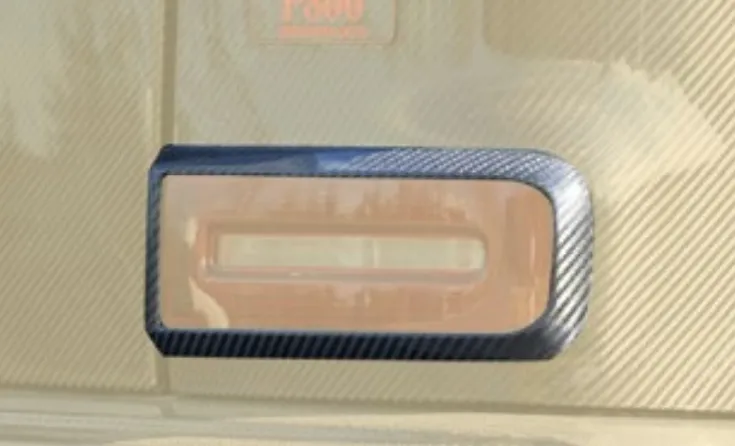
Mansory Carbon Rear Light Protection Cover for Mercedes-Benz G-Class W465 Gronos
Tail-lights on a G-Class take more punishment than most owners think. The rear cluster sits at the corner of the body, well above bumper height but well within the trajectory of stones flicked up by the rear tyres on a gravel track, and it sits exactly where a careless reverse manoeuvre meets a tree branch, a kerb or a low concrete bollard. The OEM lens is glass-clear, optically tuned for the LED matrix behind it, and built to a price - it is not built to absorb a 12-millimetre flint at 60 kilometres per hour or a hard contact with stationary masonry. The Mansory Rear Light Protection Cover for the W465 Gronos is the part that catches the hit instead of the lamp.
This page covers the rear stone-strike risk profile of the W465, the ECE rear-lighting minimum-intensity rules that any cover layered over a stop or turn lamp has to respect, the polycarbonate-and-hardcoat sandwich that lets the cover hit ≥85 percent transmission, and the mounting and UV stability work that keeps the cover sitting flush and clear over the life of the truck. The cover ships as part of a complete Mansory Body Kit for Mercedes Benz G-class W465 Gronos build or as a standalone retrofit on an existing W465.
Why the rear of a G-Class is a stone-strike zone
The rear axle of the W465 sits roughly two metres behind the front of the spare wheel, and the all-terrain tyres specified on the Gronos throw a substantial amount of debris on loose surfaces. On a dry gravel forestry road at touring speed the rear tyres lift small stones, sand and grit at angles that send the heavier projectiles directly into the rear corners of the body. The lower rear bumper takes most of that load, but the upper trajectories - the ones thrown by tread blocks at the eight and four o'clock position on the tyre rotation - carry up past the bumper line and into the tail-light apertures at the corners of the rear quarter panels. Anyone who has driven a G-Class on a gravel road for more than fifty kilometres has seen the small star-pattern impacts that build up across the rear lens over time.
The second risk is reverse manoeuvres. The W465 is a wide vehicle with a short rear overhang and a substantial spare wheel sitting proud of the rear door. Reverse parking against a kerb, against a stack of firewood at a chalet, against a tree branch on a forest track - any of these can put a tail-light corner against a hard object before the parking sensors have time to scream. A direct contact at low speed will almost always crack an unprotected lens. Replacement of an OEM W465 LED matrix lens, with diagnostics and recoding, is a four-figure invoice in any serious market. The cover is the part that absorbs the contact and keeps the lamp behind it intact.
The ECE rear-lighting compliance constraint
Any aftermarket layer placed in front of a rear stop, tail or turn signal lamp on a road-registered vehicle has to respect the same ECE photometric rules that the lamp itself was approved against. ECE Regulation 7 governs front and rear position, stop and end-outline marker lamps; ECE Regulation 6 governs direction-indicator lamps. Both regulations specify minimum luminous intensity in candela across a defined angular field, measured at the lamp output - which means measured through any protective cover that is fitted in front of the lens. A cover that drops transmission below the threshold required to keep the assembly in spec is not a legal road part.
The Mansory rear light protection cover is engineered to ≥85 percent total transmission across the visible spectrum. That figure is not a marketing target - it is a design floor chosen so that the worst case ECE intensity reduction (red stop signal at maximum operating temperature, with the cover at end-of-life UV exposure) still leaves the lamp comfortably above the regulation minimum. The clear polycarbonate substrate is hardcoated on both surfaces with an abrasion-resistant siloxane coating that is itself optically clear, and the bonded carbon surround is positioned outside the lamp aperture so it does not mask any of the active light-emitting area. In practice, the cover-on-lamp assembly photometers within a few percent of the lamp alone, and stays within ECE specification across the full operating temperature range.
Polycarbonate substrate, transmission ratio and hardcoat
The protective layer itself is 2.5 millimetres of optical-grade polycarbonate, the same material family used for motorcycle visors and aircraft cabin glazing. Polycarbonate is roughly two hundred and fifty times more impact-resistant than acrylic and around thirty times more impact-resistant than glass, which is why it is the default choice anywhere a transparent panel needs to take a hit and stay intact. A 2.5-millimetre polycarbonate sheet will absorb a 12-millimetre steel ball at well above motorway speed without cracking - the equivalent acrylic or glass sheet shatters.
The downside of bare polycarbonate is that it scratches easily and yellows under prolonged UV exposure. Both problems are solved with a hardcoat. Mansory specifies a UV-stable siloxane hardcoat applied to both faces of the substrate. The hardcoat raises the surface hardness from soft polymer toward glass territory, which means the cover survives years of bug splatter, wash mitts and brush passes without etching, and it blocks the UV wavelengths that drive polycarbonate yellowing. Total transmission of the hardcoated substrate measures at 89 to 91 percent in the laboratory, and the design floor of ≥85 percent transmission carries an engineering margin against gradual hardcoat ageing across a ten-year service life.
The polycarbonate panel is supplied either fully clear, for owners who want the OEM red signal colour to read as it does at the factory, or in a 12 percent grey tint that drops only a few points of transmission while taking the visible red of the lamp toward a slightly deeper, more cohesive look on dark body paints. The tinted option still meets the ≥85 percent transmission floor; anything darker is offered for show vehicles only and is not a road-registered part.
Carbon surround and visual integration
The clear polycarbonate insert is bonded into a hand-laid 2x2 twill carbon frame that wraps the lamp aperture and ties the cover into the visual language of the rest of the W465 Gronos kit. The carbon surround is the same weave architecture used on the bonnet, the wide front mask, the carbon mirror housings, the front flasher protection cover at the opposite corner of the truck, and the rear door panel that the lamp cover sits adjacent to. Cured in autoclave at the same 130 degrees Celsius as the rest of the visible-carbon range, finished in either raw weave clear-coat or body-matched paint, the surround reads as part of the family rather than as an aftermarket add-on.
The frame profile is shaped around the W465 rear lamp aperture geometry - which is where the part diverges from anything offered on the older W463A platform. The W465 rear cluster is wider and taller than the W463A unit, the LED matrix layout is different, and the housing draft angle is different. A W463A rear light cover does not fit the W465 lamp and a W465 cover does not fit the W463A; they are not interchangeable. Customers cross-shopping covers between platforms should confirm chassis code before ordering.
IP67 mounting tape and seal integrity
The cover is bonded to the painted body around the lamp aperture using 3M VHB acrylic foam tape with an IP67 rating across the bond line. IP67 here means the bonded interface is dust-tight and survives short immersion in water - the cover will not leak around its perimeter under heavy rain, jet-wash impingement or a forded river crossing within rated wading depth. The tape is pre-applied at the factory in a controlled-temperature clean room and protected with a peel-off carrier; on the body it bonds at temperatures above 10 degrees Celsius with light hand pressure for 30 seconds.
The bond line carries the cover for the life of the vehicle. If the lamp behind needs to come out for service, the cover lifts off cleanly using a heat gun and a plastic wedge, the residual tape strip peels away without paint damage, and a fresh tape strip is bonded back in place at refit. Tape kits are supplied with the cover and are stocked separately for service.
UV stability is the other half of the long-term durability story. The two failure modes that aftermarket transparent covers suffer most in real service are surface hazing and yellowing of the substrate, and both are UV problems. The Mansory cover blocks them at two points. The hardcoat itself contains UV stabilisers that absorb in the 290 to 380 nanometre band, which is the wavelength range that drives polycarbonate yellowing. The carbon surround uses the same UV-stable clear-coat as the rest of the body kit, which prevents weave yellowing and resin chalking on the visible carbon faces. In practical terms, a vehicle parked outdoors in southern European or Middle Eastern sun for ten years should still see a cover that reads clear, with measurable transmission within a few percent of the new-condition value. There is no published service interval - the cover is intended to last the rest of the service life of the vehicle from the date of fitment.
How the rear light cover ties into the rest of the rear and corner spec
The cover is one of a small group of corner-protection parts on the W465 Gronos that do real work rather than purely cosmetic work. At the front of the truck, the front flasher protection cover performs the same role for the front turn-signal lamp; together the two parts protect the four signalling lamps the W465 needs to keep on the road in any jurisdiction. Above the rear bumper line, the rear door panel rebuilds the largest vertical surface on the back of the truck in carbon and integrates the spare-wheel mount; the rear light covers sit immediately outboard of that panel, finishing the rear quarter view in matched weave. Move down the door and the spare wheel cover closes the centre of the rear elevation. Specified together, the four parts turn the rear of the W465 into a coherent carbon composition rather than a series of separately-finished panels.
Specified on its own, the rear light cover is the cheapest insurance available against a four-figure tail-light replacement bill on a truck that is going to see gravel, salt and tight reverse manoeuvres for the next ten years. Browse the rest of the W465 Gronos catalogue and the wider Mansory collection to see what else can go on the build at the same time.
Specification at a glance
Substrate: 2.5 mm optical-grade polycarbonate, hardcoated both faces. Total transmission: ≥85 percent (laboratory measurement 89 to 91 percent on new parts). Surround: hand-laid 2x2 twill carbon, autoclave-cured at 130 degrees Celsius, UV-stable clear-coated or body-matched paint. Mounting: 3M VHB acrylic foam tape, IP67 rated, factory pre-applied. Tint options: clear or 12 percent grey. Compatibility: Mercedes-Benz G-Class W465 only - not compatible with W463A. ECE compliance: cover-on-lamp assembly stays within Regulation 7 (stop and tail) and Regulation 6 (turn signal) photometric minima across operating temperature range.
How to order
Send the VIN, the chosen tint (clear or 12 percent grey), and the chosen surround finish (raw weave clear-coat gloss or matte, or a body paint code). We come back with a confirmed quote in EUR ex-works our European hub, a build slot, and a render of the rear corner in the chosen finish for sign-off. Lead time is 10 to 14 weeks from deposit, made-to-order in carbon, with worldwide shipping handled by our logistics partners.
Reach a build advisor on WhatsApp or write to [email protected]. Pair the rear light covers with the matching front flasher protection cover at the opposite corner of the truck and the four signalling lamps on the W465 are all protected together.
FAQ
Q: Will the cover keep the rear lamp ECE-compliant for stop, tail and turn signals?
Yes. The cover is engineered to ≥85 percent total transmission, with laboratory measurements landing at 89 to 91 percent on new parts. The cover-on-lamp assembly stays within ECE Regulation 7 (stop and tail) and ECE Regulation 6 (turn signal) photometric minima across the full operating temperature range, with margin against gradual hardcoat ageing.
Q: Is this the same part as the W463A rear light cover?
No. W465 rear lamp aperture geometry, LED matrix layout and housing draft angle differ from the W463A. A W463A cover will not fit a W465 lamp and the reverse is also true. Confirm chassis code before ordering - this part fits the W465 only.
Q: What does the polycarbonate substrate actually protect against?
2.5 mm optical-grade polycarbonate absorbs gravel-sized stone strikes well above motorway speed without cracking, and it absorbs hard low-speed contacts of the kind a careless reverse manoeuvre produces. Polycarbonate is around 250 times more impact-resistant than acrylic and around 30 times more impact-resistant than glass at equal thickness, which is why it is the default choice for motorcycle visors and aircraft glazing.
Q: How is the cover bonded to the body and can it be removed for service?
The cover bonds with 3M VHB acrylic foam tape at IP67. The bond is intended to last the service life of the vehicle, but if the lamp behind needs to come out the cover lifts off with a heat gun and a plastic wedge, the residual tape strip peels away without paint damage, and a fresh tape strip is bonded back in at refit. Service tape kits are stocked separately.
Q: Does the tinted option still meet the transmission floor?
Yes. The 12 percent grey tint drops only a few points off total transmission and still clears the ≥85 percent floor. Anything darker is offered for show-vehicle use only and is not a road-registered part.