
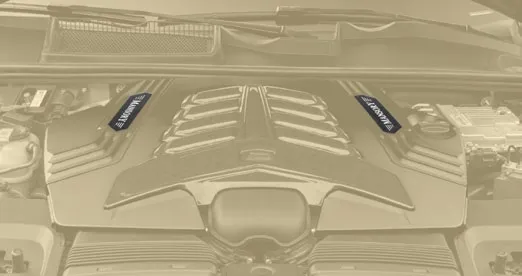
Logo emblems for engine cover Mansory for Lamborghini Urus Venatus


Logo Emblems for Engine Cover — Mansory for Lamborghini Urus Venatus
The Mansory logo emblems for the engine cover are the smallest, most theatrical pieces in the Mansory Body Kit for Lamborghini Urus Venatus S programme — a pair of carbon plaques carrying the lacquered Mansory wordmark, mounted directly onto the engine cover of the 4.0-litre twin-turbocharged V8. They are the punchline of the engine bay: when the bonnet pops on a Venatus-spec Urus, the eye catches the deep-gloss black plaques with their crisply masked Mansory script glinting back at the daylight. Owners specify them because the Urus is a super-SUV that gets opened — at hotel forecourts, at Cars & Coffee, at the school drop-off when a curious passenger asks what is under the bonnet. Behind the Y-shaped LED DRL face and hexagonal Lambo bodywork sits the engine bay theatre, and these emblems are its closing act. They retrofit across the Urus / Urus S / Urus Performante line.
Construction & Materials
Despite their compact footprint these are not stamped or printed badges — they are full carbon-fibre composite plaques produced in the same Mansory atelier that builds the larger panels of the Venatus programme. Each emblem is a miniature wet-laid carbon laminate with the wordmark applied as a UV-stable two-pack masked paint, then encased in a heat-resistant clearcoat designed for engine-bay temperature cycling rather than exterior bodywork.
- Substrate — 3K twill carbon-fibre laminate, ~1.0–1.2 mm wall thickness, hand-laid and vacuum-cured to keep the weave perfectly aligned with the wordmark axis.
- Mass — each plaque weighs roughly 10–25 g depending on size variant; the pair adds essentially nothing to engine-cover load and does not affect carbon-cover resonance or heat dissipation.
- Wordmark — masked-and-sprayed lacquered Mansory script in deep-gloss finish; the lettering sits flush within the clearcoat envelope rather than as an applied vinyl, so it cannot peel at edges or lift after a hot-cold cycle.
- Mount — pre-applied 3M VHB acrylic foam tape on the back face, automotive-grade, rated for sustained engine-bay temperature exposure; alcohol prep of the host surface is the only preparation needed.
- Low-profile geometry — the back face is contoured to follow the curvature of the Mansory carbon engine cover; on the OEM plastic cover the contact patch sits flat with no visible gap.
- Heat-resistant lacquer — automotive engine-bay rating; the clearcoat does not yellow, blush, or chemically attack the carbon laminate beneath under sustained twin-turbo V8 heat-soak after a Corsa-mode session.
- Fuel-resistant gasket where the part is supplied for installations adjacent to the fuel-rail cosmetic shroud — included on Performante-spec sets that mount further forward.
- Quality control — each plaque is inspected for weave alignment, lettering edge crispness, and clearcoat clarity before it leaves the atelier; rejected pieces are scrapped rather than reworked.
Design & Visual Function
Open the bonnet on a stock Urus and the bay reads anonymously — black acoustic shrouds, OEM Lamborghini script, the characteristic V8 plenum. Open the bonnet on a Venatus-spec car already wearing the Mansory carbon engine cover and the bay shifts register: the carbon weave catches the light, hexagonal cover lines echo the hexagons in the front mask, and the geometry feels intentional. The logo emblems are the punctuation — they sit at the cover’s visual focal points and replace the implied “Lamborghini twin-turbo V8” reading with an explicit “Mansory Venatus” one.
The plaques harmonise with the rest of the Venatus wordmark presence: the carbon tank cap carries the Mansory script at the rear quarter, the front-fender emblems (original and revised) carry it at the leading fender edge, and the rear-hatch panel — silver or illuminated — carries it across the tailgate. The engine-cover emblems extend that presence into the bay, so when the car is being shown — bonnet up at a meet, or passed to a hotel valet — the Mansory branding reads consistently in every direction.
The theatre-of-the-bay element matters more than it sounds. The Urus is one of very few super-SUVs that is regularly opened in front of guests, who ask about the twin-turbo V8, the 4.0 TFSI lineage shared with the RS Q8 and Bentayga Speed, the 641–666 hp output. Every time the bonnet rises, the cover and its emblems answer the question — the cover alone reads as “a carbon part”, while the emblems read as “a Mansory build”.
Compatibility & Fitment
The emblems fit the full Lamborghini Urus production run — pre-facelift Urus (2018–2022), Urus S (2022 facelift onward), and Urus Performante. The slug uses the generic -for-lamborghini-urus-venatus naming because Mansory’s Venatus programme is evolutionary rather than year-locked, and these branding pieces retrofit cleanly across the line. Two host surfaces are supported: the Mansory carbon engine cover, where the contoured back face matches the cover curvature exactly; and the OEM plastic engine cover, where the plaques sit flat with no visible gap and no requirement to swap covers first. They do not interfere with the cover’s acoustic insulation, do not affect cover resonance, and do not sit over service points (oil filler, dipstick, charge-air ducting). The lacquer is rated for sustained twin-turbo V8 operation including Corsa-mode runs and post-shutdown heat-soak.
Installation & Reversibility
Installation is the simplest in the Venatus catalogue and genuinely DIY. Total time is roughly 10 minutes per pair; the only tools required are a microfibre cloth and a bottle of isopropyl alcohol (90%+).
Workflow: open the bonnet and let the engine cool fully (VHB tape needs ambient temperature for full initial bond). Identify the mounting points — Mansory supplies a placement template if requested. Wipe the host surface twice with isopropyl alcohol. Peel the protective film from the 3M VHB backing. Press each plaque into position firmly for 30 seconds, working from centre outward to expel air. Close the bonnet. The VHB reaches roughly 50% bond strength within an hour and full strength within 72 hours, with the first heat-cycle accelerating cure.
The mount is fully reversible: if the cover is ever removed for service or the plaques are repositioned, the VHB releases cleanly with a fishing-line slice and the residue wipes off with isopropyl alcohol. There is no drilling, no fastening, no electrical splice, no permanent modification.
Pairing within the Mansory Urus Venatus programme
The logo emblems are the lightest piece in the Venatus catalogue and the easiest to pair, because they are explicitly designed to complete other parts rather than to stand alone. The natural duo is the engine cover — the carbon panel that the emblems mount onto. Specifying both together is the standard Venatus engine-bay configuration; specifying only the cover leaves the bay reading as anonymous carbon, while specifying only the emblems leaves the wordmark sitting on OEM plastic. The pair is the minimum coherent statement.
From there the wordmark programme extends outward across the car. The carbon tank cap with logo echoes the same lacquered Mansory script at the rear quarter — the next surface a passenger will notice when refuelling. The front fenders emblem with logo (or the revised new front fenders emblem) carries the wordmark forward to the leading edge of the front fenders, completing the four-corner branding statement. Together with the rear-hatch-panel script, the full-car Mansory wordmark presence reads consistently from any angle — bonnet up, fuel door open, walking past the front fender, or following the car at a traffic light.
Maintenance & Durability
The engine-bay environment is harder on lacquered carbon than exterior bodywork in some respects and gentler in others. Harder: sustained heat-soak after a Corsa-mode run can hit 80–90 °C at the engine-cover surface, and chemical exposure is broader (oil mist, fuel vapour, brake-cleaner overspray during service). Gentler: no UV degradation, no rock chips, no road salt, and the bay sees a small fraction of the wash cycles the exterior does. The heat-resistant lacquer is specified precisely for this profile and does not yellow or blush after repeated heat cycles.
Wash precautions are simple: keep the bay closed during exterior washes (the plaques are not water-rated for direct hose pressure), and during periodic engine-bay detailing use only pH-neutral degreasers — never alkaline cleaners, ammonia-based solutions, or solvent wipes. A microfibre and a quick mist of pH-neutral detail spray will keep the gloss looking fresh between services. If a plaque ever chips at an edge from a tool strike during service, a single replacement piece is sourced in days rather than weeks; the VHB releases with a fishing-line slice, the host surface wipes clean, and the new piece installs in 5 minutes.
Lead Time & Warranty
Lead time is 4–8 weeks for production through the Mansory atelier — these plaques are made in batches alongside the larger Venatus carbon programme rather than held as off-the-shelf stock, which is why the wordmark masking, weave alignment, and clearcoat thickness match the rest of a Venatus build piece-for-piece. Warranty is 12 months against manufacturing defects (laminate delamination, lacquer blush under specified operating conditions, wordmark edge lift). Heat-related yellowing of the clearcoat is covered within warranty; chemical attack from non-recommended cleaners (alkaline products, ammonia, solvent) is excluded.
FAQ
Q: Can I install these myself or do I need a body shop?
A: DIY entirely. Total time is around 10 minutes, and the only tools needed are isopropyl alcohol and a microfibre cloth. There is no drilling, no fastening, and no electrical work — these are 3M VHB-mounted plaques. A body shop visit is unnecessary; this is a coffee-and-bonnet-up afternoon job.
Q: Will the lacquer survive engine-bay heat over the long term?
A: Yes. The clearcoat is automotive engine-bay rated and is designed for sustained twin-turbo V8 heat-soak including post-Corsa-run temperatures. It does not yellow, blush, or chemically attack the carbon laminate. Heat-related yellowing is explicitly covered by the 12-month warranty.
Q: Do they fit the pre-facelift Urus, Urus S, and Performante?
A: Yes — all three. The Venatus slug naming is generic across the production run because the engine-cover geometry is shared. They retrofit equally onto the Mansory carbon engine cover and onto the OEM plastic cover.
Q: Should I get just the emblems, or the carbon engine cover and emblems together?
A: The pair is strongly recommended as the minimum coherent statement. Emblems alone sit on OEM plastic and read as a small wordmark on a stock surface; the cover alone reads as anonymous carbon to a curious eye. The duo is what produces the full Mansory engine-bay theatre.
Q: Is the install reversible if I sell the car?
A: Fully. The 3M VHB releases cleanly with a fishing-line slice, and the adhesive residue wipes off with isopropyl alcohol, leaving no mark on the cover beneath. There is no permanent modification to the engine cover.
Pair with the carbon engine cover for the standard Venatus bay configuration, and extend the wordmark programme via the carbon tank cap and front-fender emblems. WhatsApp +44 7488 818 747 or [email protected].