
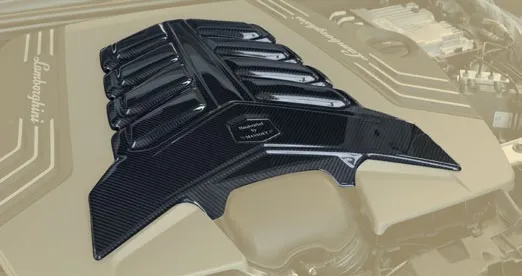
Engine cover Mansory for Lamborghini Urus Venatus


Mansory Carbon Engine Cover for Lamborghini Urus Venatus
The Mansory carbon engine cover turns a routine bonnet-pop into a piece of theatre. Out of the box, the Lamborghini Urus arrives with a moulded grey plastic shroud sitting on top of its 4.0-litre twin-turbo V8 — functional, anonymous, at odds with a car that wears Y-shaped LED DRLs, hexagonal Lambo geometry, eight-speed ZF, six driving modes and rear-wheel steering. This part replaces that shroud with autoclave-cured 3K twill carbon in Mansory deep-gloss lacquer, so the bay reads as a continuation of the bodywork. It sits at the heart of the wider Mansory Body Kit for Lamborghini Urus Venatus S programme, alongside the bonnet, race-flaps, mirror housings and rear-hatch panels.
Construction & Materials
An engine-bay panel is engineered around a different brief than exterior trim. It does not see UV or rock chips, but it sits centimetres above the cylinder banks of a turbo V8, with temperatures that climb after a hard run and stay high during heat-soak. Mansory builds the cover to that spec, not as a generic overlay.
- 3K twill weave, autoclave-cured. Even, symmetrical pattern across the cover with the weave clocked along the engine's longitudinal axis so the twill diagonals frame the V8 valley.
- Heat-resistant resin system. The matrix is rated for sustained engine-bay temperatures and the post-shutdown heat-soak window — no softening, no resin bloom, no cosmetic blistering above the cylinder heads.
- Thermal lacquer top-coat. Mansory's deep-gloss clear is reformulated for under-bonnet duty: stable against heat cycling, resistant to oil mist and the slight chemistry of brake-fluid or coolant overspill during routine top-ups.
- Wall thickness 1.6–2.0 mm. Stiff enough to hold geometry across the full cover length without bowing under its own weight, thin enough to keep the part feeling like a panel and not a slab.
- Approximately 1–2 kg lighter than the OEM plastic shroud. Modest in absolute terms, but consistent with the Mansory approach of trimming grams everywhere — every panel on a Venatus carbon car contributes a little.
- OEM mounting clips retained. The cover is moulded around the factory clip pattern; the same pop-in geometry the Lamborghini service centre uses to release the OEM shroud holds this one.
- Cut-outs for oil filler, dipstick and washer reservoir. Each access point on the OEM cover is mirrored — owners can top up oil, check the dipstick or refill the screen-wash without removing the panel.
- Edges rolled and sealed. No raw weave on the perimeter; the lacquer wraps the edge so heat soak does not lift the clear at the cut line.
Design & Visual Function
An engine cover is, strictly, an interior panel — but on a super-SUV that is shown at every petrol station, valet stand and hotel forecourt, the bonnet gets opened more often than people admit. The transformation is binary: lift the bonnet on a stock Urus and you see a grey textured plastic with embossed logos; lift it on a Venatus-specified car and the entire valley between the cylinder banks is deep-gloss carbon, with the Mansory lacquer catching the daylight in the same way the bonnet vents and front bumper do above. The cover is the visual centre of the bay, and it reframes everything around it — the brushed-metal coolant reservoirs read as deliberate accents, the strut brace looks intentional, the engine itself looks like the centrepiece of a coachbuilt object rather than an Audi-architecture V8 hidden under a moulded shell.
Within the Mansory programme, this cover is the anchor of a small branding triplet. It pairs naturally with the logo emblems for engine cover — small machined Mansory badges that mount directly onto this panel and finish the centrepiece — and with the carbon tank cap with logo, which sits behind the fuel flap and gives a second moment of owner-engagement carbon every time the car is refuelled. Together those three parts cover the two surfaces an owner physically opens — the bonnet and the fuel flap — and turn each into a moment of the car's identity.
The third design consideration is purely thermal. A 4.0 V8 BiTurbo runs hot — twin turbos, a charge-air cooler stack, hot-V exhaust manifolds — and the air around the cover spends time well above ambient. A standard cosmetic carbon cover with off-the-shelf resin and furniture lacquer will not survive that duty cycle: the clear goes milky, lifts at the edges, the weave shows resin starvation. Heat-resistant lacquer chemistry is non-negotiable on this part.
Compatibility & Fitment
The cover fits Lamborghini Urus, Urus S and Urus Performante (2018–present). All variants share the same Audi 4.0 TFSI twin-turbo V8 architecture, the same engine-bay packaging and the same OEM cover footprint — the carbon panel drops into all three without re-tooling. OEM mounting clips, the oil filler cap, the dipstick handle, the washer-fluid reservoir cap and the engine-bay junction-box covers are all retained: the cover is designed around them rather than over them, so service intervals and routine fluid checks behave exactly as they did with the factory shroud. Adaptive air-suspension self-levelling, six driving-mode behaviour, rear-wheel steering geometry and active anti-roll all live elsewhere in the car and are not affected by an under-bonnet panel swap. Note that this part is described under the generic Venatus naming — Mansory's Venatus / Venatus S / Venatus EVO programmes share the engine-bay envelope, and the cover retrofits across the line.
Installation & Reversibility
This is among the easiest parts in the entire Mansory Venatus catalogue to fit. The OEM plastic shroud is held on by integrated clips that pop free when lifted vertically with moderate force; the carbon cover uses the same clip geometry, so installation is a literal swap. Allow 20–40 minutes total: lift the bonnet, lift the OEM cover off its clips (do this slowly and evenly, supporting both ends), lift the Mansory carbon cover into position, line up the clip locations visually, press down at each clip until you feel and hear it engage. No tools are required for the cover itself; if the optional logo emblems are being added at the same time, allow another 15–20 minutes for cleaning the badge sites with isopropyl alcohol and curing the 3M VHB tape. The change is fully reversible — keep the OEM shroud, and the car can be restored to factory engine-bay appearance in another 20–40 minutes if a future owner ever asks for it. No wiring, no ECU work, no calibration; the panel is mechanical and cosmetic only.
Pairing within the Mansory Urus Venatus programme
The engine cover is one corner of a tight visual package. The first and most important pairing is the logo emblems for engine cover: small machined Mansory badges that bond directly to this carbon panel. The cover is the canvas, the emblems are the signature — owners who specify one without the other tend to come back for the second piece within a few months. The second natural pairing is the carbon tank cap with logo, which extends the same deep-gloss carbon and Mansory branding to the fuel flap — the two parts together cover both owner-engagement openings on the car and give the bonnet-pop and the fuel-stop the same visual signature. For owners who want the branding theme to continue forward onto the wings, the front fenders emblem logo or the revised new front fenders emblem logo bring the Mansory wordmark out of the engine bay and onto the exterior — a coherent four-piece small-detail package that complements any of the larger body panels in the wider Venatus carbon kit.
Maintenance & Durability
Carbon under a bonnet ages differently to carbon on the bodywork. The good news: no UV exposure means no fade and no microcracking from sun cycles, and no rock-chip exposure means no PPF requirement. The bad news: heat soak is unforgiving on poorly engineered lacquers, and the engine bay sees chemistry that an exterior panel never encounters — oil mist, brake-fluid splashes, coolant overspill, occasionally a smear of grease from a careless service. Wash precautions are simple but worth following. After any drive, let the engine bay cool fully — at least a couple of hours — before wiping the cover. Use a microfibre cloth and a pH-neutral interior detail spray; avoid alkaline degreasers, ammonia-based glass cleaners and abrasive sponges, all of which will eventually haze the lacquer. If oil or coolant lands on the panel during a service, blot it (don't smear) and clean the area with a dedicated carbon-safe cleaner. Long-term, the heat-resistant lacquer holds up well to a normal Urus duty cycle — daily use, occasional track days, the odd road trip — and a small chip can be flatted and recoated locally. Avoid pressure-washing the bay; a high-pressure stream around the edges will eventually find its way under the lacquer.
Lead Time & Warranty
Production lead time is typically 4–8 weeks. Each engine cover is laid up to order in Mansory's atelier, autoclave-cured, finished and lacquered against a specific VIN, then quality-checked by Mansory's bespoke division before despatch. The cover ships in protective foam in a fitted crate and includes a clip-engagement check sheet. Warranty is 12 months against manufacturing defects — delamination, lacquer failure, dimensional drift on the clip footprint. Cosmetic damage caused by spilled fluids, abrasive cleaning chemistry or pressure-washing is not covered, in line with Mansory's standard carbon-care guidance for engine-bay parts.
FAQ
Q: Will the lacquer survive engine-bay heat?
A: Yes — Mansory specifies a heat-resistant resin system and a thermal-grade lacquer for this part. Standard cosmetic carbon clears will not survive a turbo-V8 heat-soak cycle; this lacquer is reformulated for it. The cover is engineered around the actual under-bonnet thermal envelope of the Urus, not adapted from an exterior panel.
Q: Does it fit my Urus / Urus S / Performante?
A: All three. The 4.0 TFSI twin-turbo V8 packaging is shared across the Urus line, and the OEM cover footprint is identical, so the carbon cover is a direct replacement on every variant from 2018 to current.
Q: How much weight does it save?
A: Approximately 1–2 kg versus the OEM moulded plastic shroud. Modest on a 2.2-tonne SUV, but consistent with the Mansory carbon programme's overall approach — every panel contributes a small amount.
Q: What is the lead time?
A: 4–8 weeks from order. Build-to-order, VIN-noted, quality-checked, then crated.
Q: Can I still check oil and washer fluid without removing the cover?
A: Yes. The cut-outs for the oil filler cap, dipstick handle and washer-fluid reservoir cap are mirrored from the OEM cover, so all routine fluid checks happen exactly as they do with the factory shroud — no part removal needed.
Pair with the logo emblems for engine cover and the carbon tank cap with logo for the full Mansory bay-and-flap branding triplet. To configure: WhatsApp +44 7488 818 747 or [email protected].