
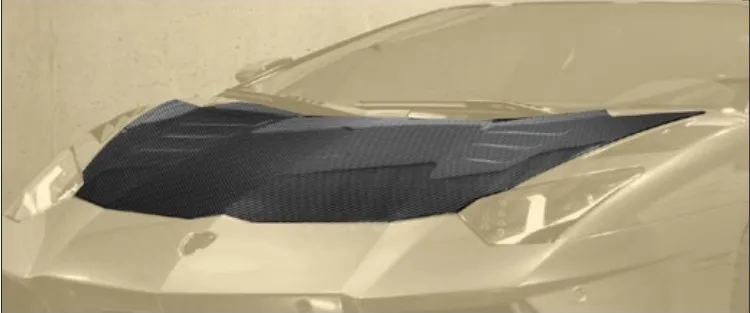
Front bonnet Mansory Carbon for Lamborghini Aventador


Front Bonnet Mansory Carbon for Lamborghini Aventador
Spanning the widest horizontal surface a viewer sees when the Aventador is stationary, the front bonnet is simultaneously the car's most prominent styling canvas and a structural panel that must tolerate thermal cycling, road-wash ingestion, and the occasional stone strike at motorway pace. Mansory's carbon replacement, part of the Mansory Carbon Fiber Body kit set for Lamborghini Aventador, addresses all three demands in a single monocoque-grade layup — delivering a panel that is measurably stiffer at the hinge and latch points than the factory carbon clamshell, while shaving meaningful mass from the highest point of the mid-engine Aventador's weight distribution. For owners who want a dramatic first impression before a door is opened, the carbon bonnet sets the tone for the entire build.
Construction & Materials
The bonnet is laid up from pre-impregnated 3K twill-weave carbon prepreg, with the visible outer skin oriented at 45 ° to the car's centreline — the classic diagonal diamond pattern that Mansory uses across its high-visibility panels. The inner structural skin uses a 2K plain weave for out-of-plane stiffness, with a lightweight Nomex honeycomb core sandwiched between the two skins over the central section where resistance to bonnet oscillation at speed matters most. The finished panel is autoclave-cured at 120 °C under controlled pressure, then CNC-trimmed to final geometry on the same fixture used to verify OEM Lamborghini panel tolerances.
| Attribute | Specification |
|---|---|
| Outer weave | 3K twill, 45 °/135 ° orientation |
| Inner skin | 2K plain, biaxial for stiffness |
| Core | Nomex honeycomb, 10 mm, central section |
| Cure | Autoclave 120 °C / 6 bar |
| Finish | High-gloss UV polyurethane lacquer (matte on request) |
| Weight | approx. 9 kg (vs factory clamshell ~16 kg) |
| Hinge / latch mounts | OEM-spec aluminium inserts co-cured into laminate |
The aluminium inserts at the hinge and latch points are co-cured into the carbon stack — not bonded after the fact — which eliminates the risk of insert pull-through that occasionally affects panels where metalwork is adhered to a cured shell. This detail matters especially on the Aventador, where the clamshell bonnet lifts on a parallelogram linkage that concentrates peel load at the hinge root on every cycle.
Design & Visual Function
The Aventador's front bonnet is the longest unbroken horizontal surface on the car. Mansory exploits this by aligning the twill weave so every row of carbon fibre converges at a vanishing point behind the windscreen — pulling the eye forward and reinforcing the car's forward-leaning aggression. At close range the weave texture has an almost architectural quality: precisely spaced carbon ribbons catching light at opposing angles, creating a moiré depth that no painted surface can replicate.
Beyond aesthetics, the mass reduction — approximately 7 kg against the factory clamshell — lowers the car's polar moment of inertia. On a mid-engine supercar whose weight distribution is already optimised, reducing unsprung and rotating mass at the extremities improves transient steering response and reduces the Aventador's characteristic heavy-nose understeer when pushing into tight hairpins. Owners running track days will notice the benefit even if the numbers sound modest in isolation.
The bonnet integrates flush with Mansory's optional bonnet air outtake, which is pre-cut into the panel at the trailing edge: the louvred carbon outtake evacuates underbonnet heat pressure that would otherwise build against the flat inner surface at motorway cruise speeds, benefiting both intake air temperature and brake cooling ducts that draw from the bonnet cavity on the base Aventador.
Compatibility & Fitment
Engineered for the Lamborghini Aventador LP 700-4 (2011–2016) and LP 720-4 50° Anniversario coupé. The coupé bonnet shares geometry with the Roadster front clamshell, so this panel fits both body styles at the front. For engine bay access at the rear of a Roadster, the dedicated engine bonnet cabrio is the correct item. Aventador S (MY2017+) uses a re-contoured clamshell — the Mansory S-specific programme covers that model.
Installation & Reversibility
Front bonnet replacement is a straightforward two-person task for a body shop with Lamborghini experience, typically requiring 3–4 hours including hinge-torque verification and gap adjustment. The OEM hinges and latch are retained; only the bonnet skin changes. Because the Mansory panel uses the same hinge-mount geometry as the factory item, no shimming or bracket modification is required on a standard LP 700-4. The factory bonnet can be reinstated in equivalent time — full reversibility is preserved as long as the original clamshell is stored rather than discarded.
Pairing within the Mansory Aventador programme
The front bonnet pairs naturally with the bonnet air outtake — supplied as an integrated cut-out or as a retrofit louvre depending on the installation sequence. Add the front add-on lip to continue the carbon theme from the bonnet's leading edge down through the front fascia. For owners building a complete front-end carbon statement, the front splitter cover closes the visual loop between the bonnet, the bumper, and the ground plane.
Maintenance & Durability
The bonnet's large horizontal surface is the panel most exposed to UV radiation, bird deposits, tree sap, and motorway stone strikes. A paint-protection film (PPF) overlay on the leading edge of the bonnet — the first 150 mm behind the bumper line — is strongly recommended; the film is invisible on clear-lacquered carbon and preserves the lacquer from chip accumulation that would otherwise require touch-in within the first high-mileage season. For ongoing care, a ceramic coating applied at installation provides a hydrophobic surface that sheds water and prevents ionic contamination (water-spot etching) from bonding to the lacquer. Avoid washing in direct sunlight — the panel temperature under summer sun can exceed 60 °C, causing water-spot minerals to bake into the lacquer surface in under a minute.
Lead Time & Warranty
The front bonnet is a single large panel requiring careful layup sequencing to maintain weave registration across the full surface area. Lead time is 3–5 weeks from order confirmation. Mansory covers the panel with a 12-month warranty against delamination, resin voids, and fitment defects attributable to manufacturing. Road chip damage to the clear coat is a maintenance item, not a warranty claim, but is readily addressed with a urethane touch-up pen matched to the lacquer batch.
FAQ
Q: Is the front bonnet supplied with the air outtake louvre pre-cut?
A: The bonnet is available with or without the outtake aperture. If ordering alongside the bonnet air outtake, specify at checkout to receive the pre-cut panel; the louvre is then installed flush into the aperture. If ordered separately, the outtake can be retrofitted by a body shop.
Q: What is the actual weight of the Mansory bonnet versus the factory clamshell?
A: The Mansory bonnet weighs approximately 9 kg. The factory LP 700-4 carbon-fibre-reinforced clamshell weighs approximately 16 kg. The saving of roughly 7 kg reduces the Aventador's nose-heavy polar moment noticeably at high cornering loads.
Q: Can the bonnet be wrapped rather than left in natural carbon?
A: Yes. Applying a vinyl wrap over the clear-lacquered carbon is non-destructive and fully reversible. Some owners wrap the centre section and leave the outer edges in visible carbon for a two-tone effect. Paint adhesion over the lacquer is also achievable but requires a light key-sand of the lacquer, which reduces reversibility.
Q: Does the Mansory bonnet fit the Aventador Roadster front end?
A: Yes — the Roadster and coupé share identical front clamshell geometry. The dedicated cabrio items cover the engine-bay lid at the rear of the car only.
Reach the Mansory Aventador team via WhatsApp +44 7488 818 747 or [email protected] to confirm fitment for your specific build.