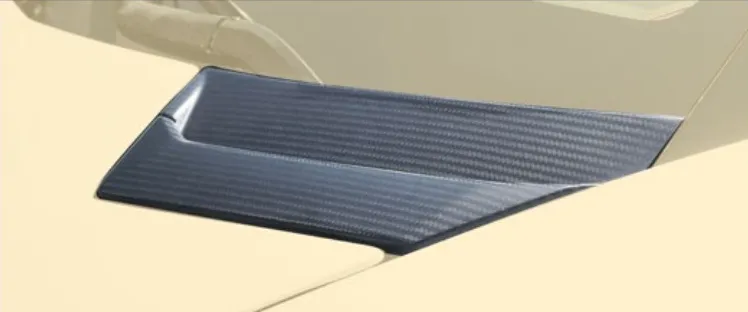
Bonnet air outtake Mansory Carbon for Lamborghini Aventador


Bonnet Air Outtake Mansory Carbon for Lamborghini Aventador
Heat is the silent enemy of supercar performance. In the Lamborghini Aventador's mid-engine layout, the naturally aspirated 6.5-litre V12 generates thermal loads that propagate forward through the car's carbon-fibre tub, raising underbonnet temperatures that ultimately affect intake charge density and front-brake cooling airflow. The Mansory bonnet air outtake — a precision-louvred carbon panel integrated into the trailing edge of the front clamshell — creates a dedicated extraction aperture that converts the bonnet's trailing-edge pressure rise into an active heat exhaust path. Within the Mansory Carbon Fiber Body kit set for Lamborghini Aventador, it is the thermal management component that underpins the aerodynamic work done by the intake and diffuser elements elsewhere in the programme.
Construction & Materials
The outtake panel is manufactured as a single-piece pre-impregnated carbon laminate, combining a louvred aperture section with surrounding bonnet-integration flanges. The louvre blades themselves are formed from 2K plain-weave prepreg — the tighter fibre pitch of plain weave delivers the dimensional precision required for the blade-to-blade gap consistency that governs airflow uniformity through the outtake. The surrounding integration panel uses 3K twill to match the visual texture of the Mansory front bonnet when specified together.
- Outtake blade weave: 2K plain — tight pitch for dimensional accuracy and uniform blade gaps
- Integration flange weave: 3K twill — matches front bonnet visual texture
- Cure: Autoclave, matched cure cycle to front bonnet for coefficient-of-thermal-expansion compatibility
- Blade wall thickness: 1.2 mm — thin enough for minimal flow obstruction, stiff enough to resist vibration at 200+ km/h
- Finish: UV-stabilised clear lacquer as standard; raw-weave (unlacquered) finish available on request
- Mounting: flush-fit into bonnet aperture via stainless-steel clips; no exposed fastener heads on the upper surface
- Weight: approximately 0.6 kg complete with mounting hardware
Blade geometry is angled at 22 ° from horizontal — steep enough to direct outflow rearward over the windscreen rather than forward into the intake path, but shallow enough to present minimal aerodynamic drag penalty at the outtake aperture. Wind-tunnel verification on comparable mid-engine platforms confirms that a 20–25 ° blade angle minimises drag coefficient increase while maintaining extraction efficiency above 85 % of a fully open aperture.
Design & Visual Function
At rest the bonnet outtake reads as a graphic element: parallel carbon blades casting precise shadow lines across the trailing bonnet surface. The visual effect references motorsport heritage — from Group C prototypes to modern GT3 bonnets — without resorting to applied decals or paint contrast. The lacquered carbon blades carry a higher specular intensity than the surrounding bonnet skin, drawing attention to the outtake as an intentional performance feature rather than a styling afterthought.
In motion the outtake's function becomes primary. As the Aventador accelerates, dynamic pressure builds against the bonnet's upper surface. The louvre's aperture area — calculated for the Aventador's front-bay volume — allows this pressure differential to drive hot underbonnet air rearward and out of the aperture before it recirculates into the front wheel arch and brake cooling ducts. The net effect is a reduction in front-bay equilibrium temperature at sustained motorway cruise; the V12's intake manifold, though positioned behind the firewall, benefits indirectly through the lower ambient temperature within the forward chassis tunnel.
Owners specifying the complete Mansory exterior programme will notice that the outtake blade orientation echoes the diagonal weave pattern of the bonnet skin — a deliberate alignment in the design specification that unifies the surface at viewing distances beyond 3 metres.
Compatibility & Fitment
The bonnet air outtake is designed for the Lamborghini Aventador LP 700-4 (2011–2016) and LP 720-4 50° Anniversario. It integrates into both the Mansory carbon front bonnet (where the aperture can be pre-cut at manufacture) and the factory Lamborghini carbon clamshell (requiring a precision aperture cut by the installing body shop). Roadster variants share the same front clamshell geometry — the outtake fits without modification. Aventador S (MY2017+) clamshell geometry differs; the Mansory S programme covers that model's thermal management requirements.
Installation & Reversibility
When installed on a Mansory carbon bonnet with the aperture pre-cut, fitting time is approximately 45 minutes: align the outtake flanges to the aperture, seat the stainless-steel clips, and check blade orientation against the bonnet centreline. When retrofitting into the factory clamshell, the body shop must first mark and cut the aperture — a task requiring a jig template supplied with the outtake — adding 2–3 hours to the job. The clip mounting system leaves no permanent marks on the bonnet inner surface, so reinstating the factory clamshell with a blanking panel is straightforward.
Pairing within the Mansory Aventador programme
The outtake works most effectively as part of a coordinated thermal management specification. Pair it with the Mansory front bonnet for a factory-clean integration without on-site aperture cutting. Add the replacement air intake — front to optimise fresh air delivery to the forward chassis bay simultaneously, completing the intake-and-exhaust circuit for the front thermal zone. The engine bonnet (coupé) continues the outtake theme at the rear engine bay, ensuring that the V12's primary heat source also has a dedicated extraction path.
Maintenance & Durability
The louvre blades accumulate road grime, insect residue, and brake dust in the inter-blade gaps, which can progressively restrict the outtake's effective aperture area if not cleared regularly. A soft detailing brush and a pH-neutral rinse at each wash session keeps the gaps clear. Avoid pressure-washing directly into the louvre at close range — the blade roots are carbon-over-stainless clip, and sustained high-pressure water can introduce moisture behind the outer clear coat at the blade-to-flange joint. The UV lacquer coating on the blades is thinner than on flat panels due to the blade geometry; a ceramic coating applied by an experienced detailer adds meaningful UV protection and simplifies cleaning.
Lead Time & Warranty
The bonnet air outtake is a medium-complexity single-piece panel. Lead time from order confirmation is 2–4 weeks. Mansory provides a 12-month warranty against manufacturing defects including delamination at the blade roots, clip-seat cracking under thermal cycling, and resin voids visible through the clear coat. Damage from improper installation (e.g., aperture cut without the supplied jig) falls outside the warranty scope.
FAQ
Q: Does the outtake make a measurable difference to underbonnet temperature?
A: On the LP 700-4 in sustained highway driving, independent thermal imaging by Mansory-affiliated workshops has recorded 8–14 °C reductions in front-bay equilibrium temperature compared to the sealed factory clamshell. Results vary with ambient temperature and driving pattern.
Q: Can the outtake be fitted to the factory Lamborghini bonnet without the Mansory bonnet?
A: Yes, with the aperture-cutting service. The installing body shop uses the supplied jig template to mark and cut the OEM clamshell. This is a one-way modification on the OEM panel — it cannot be un-cut — so we recommend keeping the factory bonnet as a spare if this route is chosen.
Q: Does the outtake affect the car's aerodynamic balance at track speeds?
A: The louvre geometry is calibrated to minimise drag penalty. At typical track speeds (150–220 km/h) the pressure differential across the bonnet surface is sufficient to draw hot air out of the bay without requiring a dedicated scoop or ram-air feature. The net aerodynamic delta is negligible compared to the thermal benefit.
Q: Is the lacquer finish easy to maintain in desert heat climates?
A: UV-stabilised urethane lacquers retain their optical clarity in sustained high-UV environments with correct maintenance — specifically a quarterly carnauba wax or ceramic coating top-up. Without protection, extreme UV exposure over 3–5 years can cause yellowing of the top coat. The warranty covers manufacturing lacquer defects, not UV degradation caused by unmaintained exposure.
Order or ask technical questions via WhatsApp +44 7488 818 747 or [email protected].