Engine bonnet Mansory Carbon for Audi RS Q8


Engine bonnet Mansory Carbon for Audi RS Q8
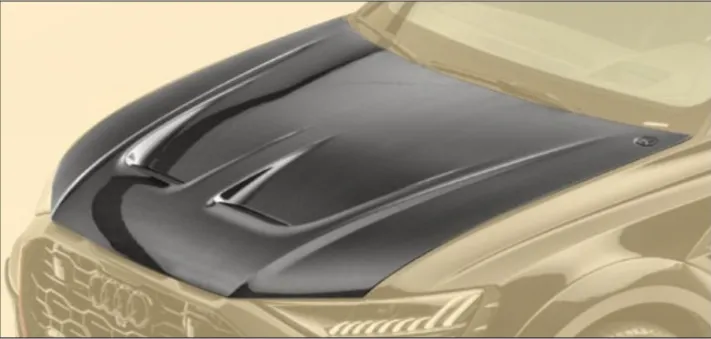
The Mansory carbon engine bonnet is a full one-piece replacement panel for the Audi RS Q8 (4M chassis), swapping out the OEM aluminium hood for an autoclave-cured prepreg carbon shell with a sculpted central air-outtake recess. It belongs to the wider Mansory Carbon Fiber Body kit set for Audi RS Q8 programme and is one of the few parts that delivers visible aggression and a measurable thermal benefit at the same time. Owners who run the 4.0 TFSI biturbo V8 hard — track days, long Autobahn pulls, towing, or simply living with a 2,315 kg performance SUV in summer heat — choose this panel because it pulls hot air out of the engine bay before it has time to cook the intake charge, the plenum, the engine cover trim, the wiring looms and the painted underside of an aluminium OEM hood.
Construction & Materials
The shell is a Mansory factory part, laid in their European production cell from prepreg twill carbon and cured in an autoclave under pressure and heat. The result is a glass-smooth A-side with no print-through, a structurally honest B-side, and a panel that holds dimension across the full hood length without the wave that you see on cheaper wet-laid hoods when summer sun hits them. Underneath, a heat-reflective aluminised foam mat is bonded to the inner skin to shield the resin matrix from V8 biturbo radiant heat — this is not an aesthetic part, it is a thermal layer that lets the panel survive years of hot soak after a hard drive without delaminating.
- Weave: 3K twill, weave aligned to the centreline of the air-outtake recess so the diagonal symmetry reads correctly under the central crease.
- Cure: autoclave prepreg, single-shot for the outer skin, secondary bond for the heat-shield foam and the inner reinforcement spider.
- Wall thickness: ~2.0–2.4 mm on the outer skin with localised build-up around the hinge mounts, the latch nose and the prop-rod cup.
- Weight saving: typically 5–8 kg lighter than the OEM aluminium hood — exact delta depends on whether your stock hood already carried the active-bonnet pyrotechnic actuator and sound deadening pad.
- Mounting: re-uses the OEM hinge bolt pattern, OEM latch striker geometry, OEM washer-jet hose pass-throughs and the OEM prop-rod cup; no panel modification required at the body shell.
- Sealing: factory rubber sealing strips run around the perimeter and along the cowl edge, preserving engine-bay water management and stopping cowl-tray spray ingress on the firewall side.
- Finish: supplied raw-lacquered (clear gloss over exposed weave) as standard; available in matte clear, or fully primer-prepped for body-colour paint where the customer wants the recess and crease to read as a sculpted panel rather than a carbon statement.
- Hardware kit: stainless hinge bolts, washer-jet grommets, fresh prop-rod retention clip, and torque sheet are included.
Design & Visual Function
The defining feature is a central air-outtake recess milled into the upper surface of the bonnet, sitting directly over the V-bank of the 4.0 TFSI biturbo V8. The recess is shaped to accept the matching carbon air-outtake splitter as a slotted insert — together they form a low-pressure exit path for hot air rising off the turbo cover, the intake plenum and the central radiator. On the standard aluminium hood there is no extraction; the under-bonnet temperature simply climbs after a hot lap or a long climb and bleeds back into the intake tract through the airbox. The Mansory bonnet breaks that loop.
Aerodynamically the recess is a careful piece of work. The leading edge of the outtake is set back far enough from the grille that it sits in the low-pressure zone created by the windscreen base — this is the same trick used on the OEM RS6 and on the R8's deck — so air flows out under the natural pressure gradient rather than being pushed out by ram pressure that could disturb the central radiator's flow path. The trailing edge of the recess feeds straight into the cowl scuttle, and the geometry has been validated to avoid wiper-area turbulence at motorway speeds.
Visually the panel rebalances the front of the car. The OEM aluminium hood reads as a flat slab between the headlights; the Mansory carbon hood adds a centre crease, two soft power-bulge shoulders and the dark recess that draws the eye to the V8 underneath. With the matching front mask, splitter and front fenders the front three-quarter view becomes the trademark Mansory RS Q8 silhouette. Lacquered weave is the most common spec on cars finished in matte black, satin grey, dark green or two-tone schemes; body-colour paint is the discreet choice for owners who want the function without the carbon statement.
Compatibility & Fitment
Engineered for the Audi RS Q8 (4M chassis), pre-facelift 2020–2023 and facelift / Performance 2024+. The bonnet panel itself shares hinge geometry across both generations — the facelift change is at the headlights, grille and bumper rather than the hood line, so this carbon hood fits both. Cars equipped with the active (pyrotechnic) pedestrian-protection bonnet retain their actuators and wiring; the carbon shell mounts to the same hinge pattern and accepts the OEM lift mechanism. Headlight washer telescopic jets pass through factory-located grommets in the underside. Cars with the optional acoustic damping pad in the OEM hood will notice a marginal increase in induction sound at idle — most owners welcome this; if you prefer the muted character, the panel can be fitted with a thin secondary felt mat on the heat-shield surface.
Installation & Reversibility
This is a body-shop job, not a driveway swap. Plan four to six hours for a competent two-person team: hood removal with the air-suspension in jack mode for clearance, transfer of the latch, prop-rod, washer-jet hoses, hinge bolts and the active-bonnet actuator (if fitted) to the new carbon panel, careful gap-and-flush adjustment against the front fenders and the cowl, and a torque-sheet pass on every fastener. The carbon panel does not require drilling; every mount uses an OEM hole. If the car is being painted body-colour, the prep happens before installation — primer over the outer skin only, factory weave preserved on the inside and at the recess inner walls.
Reversibility is total: the OEM aluminium hood can be re-fitted at any point with the same bolts. Owners who plan to track the car often keep the aluminium hood as a spare for crash repair. The carbon panel itself can be repaired by any composite shop competent in clear-coat work — chip propagation is the main failure mode, and small chips at the leading edge are best stabilised with a UV-cure resin drop within days of occurring.
Pairing within the Mansory RS Q8 programme
This bonnet is engineered as the host panel for two adjacent carbon parts. The matched insert is the Air outtake engine bonnet splitter — the slatted carbon piece that drops into the recess and finishes the extraction vent visually and aerodynamically. The two are designed as a pair and most customers order them together. Lifting the bonnet then reveals the V8 itself, which is dressed by the Engine cover Mansory Carbon — the carbon valve-cover topper that turns the engine bay into a finished show surface rather than a black plastic shroud. Visually the bonnet completes the front-end Mansory language together with the Front mask with silver logo; the silver Mansory M on the grille and the dark vented hood read as a single statement when the car is photographed three-quarter front.
Maintenance & Durability
Lacquered carbon needs the same care as any clear-coated paint, plus a respect for UV. Wash by hand with pH-neutral shampoo, dry with a plush microfibre, and avoid alkaline wheel cleaners or ammonia-based glass cleaners drifting onto the hood — they micro-etch the lacquer and leave a haze that no polish can fix. A single application of a quality ceramic coating after delivery will lock in UV protection for two to three years; carnauba wax is fine but needs more frequent reapplication. Heat-soak from the V8 will not damage the panel — the heat-shield foam handles that — but parking nose-out in direct desert summer sun for years on end will eventually yellow any clear lacquer; a light machine polish and re-coat refreshes the finish. Stone chips at the leading edge are the realistic failure mode; a quick UV-resin fill stops moisture ingress and keeps the chip from spreading under the lacquer.
Lead Time & Warranty
Lead time is typically 4–6 weeks for raw-lacquered weave from the Mansory production cell. Body-colour painted variants add 1–2 weeks for prep, paint and bake. Each panel ships with a 12-month warranty against manufacturing defects in lay-up, cure and lacquer adhesion; impact damage, stone chips and incorrect installation are not covered. Crating is rigid plywood with foam supports inside the recess to protect the air-outtake cut-out during freight.
FAQ
Q: How much weight does this save over the OEM aluminium hood?
A: Typically 5–8 kg depending on whether your car has the pyrotechnic active-bonnet actuator and the acoustic pad. The mass is removed from the very front of the car, ahead of the front axle, so the handling effect is disproportionate to the kilo number on a 2,315 kg vehicle.
Q: Does it work with the active pedestrian-protection bonnet?
A: Yes. The hinge pattern and actuator mounts are preserved, so cars equipped with the pyrotechnic active bonnet retain that function after the swap.
Q: Can I paint it body colour?
A: Yes. Order the panel primer-prepped and any competent paint shop can shoot it in your factory or custom colour. Many owners paint the outer skin and leave the recess inner walls in lacquered weave for contrast.
Q: Does the air-outtake recess actually do anything thermally?
A: Yes — paired with the air-outtake splitter insert, it creates a continuous low-pressure exit for hot air sitting on top of the V8 biturbo. After a hard run the difference is visible on a thermal camera; in everyday use it shortens the hot-soak period after shutdown and reduces intake-air-temp creep on long climbs.
Q: Does it fit both pre-facelift and facelift / Performance RS Q8?
A: Yes. The 2024 facelift changed the lights, grille and bumper, but not the hood hinge geometry, so the panel is dimensionally identical for both generations.
Q: Will it whistle, creak or flutter at motorway speed?
A: Not when correctly installed. The factory perimeter sealing strips are reused, the latch geometry is OEM, and the recess is shaped to sit in the low-pressure zone at the cowl base — there is no aero whistle.
The bonnet is the keystone of the Mansory RS Q8 front-end programme — pair it with the matching air-outtake splitter, the front mask and the engine cover for a coherent build. Order or spec a body-colour finish via WhatsApp +44 7488 818 747 or [email protected].