
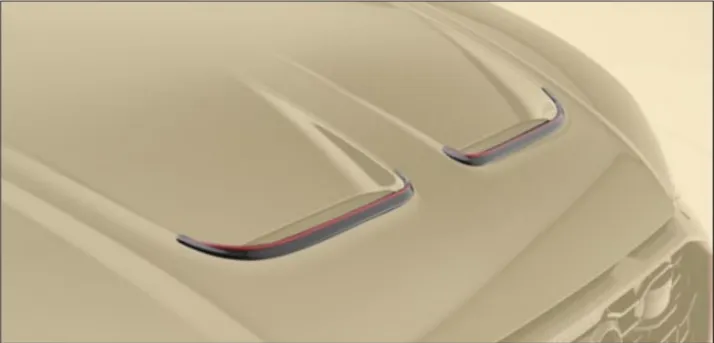
Air outtake engine bonnet splitter Mansory Carbon for Audi RS Q8


Air outtake engine bonnet splitter Mansory Carbon for Audi RS Q8
The air-outtake engine-bonnet splitter is the carbon vent insert that drops into the recess machined out of the Mansory carbon engine bonnet on the Audi RS Q8 4M. It is the functional twin of the bonnet itself, and it earns its place inside the Mansory Carbon Fiber Body kit set for Audi RS Q8 by doing real thermal work. The 4.0 TFSI biturbo V8 with 48V mild-hybrid lives directly underneath, and on a 2.3-tonne SUV that hits 305 km/h with the Dynamic+ pack, the underbonnet bay routinely soaks past 110 degrees Celsius after a sustained pull. The louvered insert opens an extraction path through the bonnet skin, takes pressure off the engine cover, and finishes the front-end aesthetic that the Mansory programme is built around. Owners specify it because the bonnet without it looks unfinished — the recess is designed for the splitter, not for a closed panel.
Construction & Materials
The insert is laid up in autoclave-cured Mansory carbon. The visible face uses 3K twill at 245 g/m squared, and the louver underside uses a finer 1K weave so the blade edges remain sharp under raking light. Two prepreg plies sandwich a Soric core in the louver-vane region, which holds geometry under the heat cycling that comes from sitting twenty centimetres above the V8's left and right turbocharger heat shields.
- Weave: 3K twill 2x2 on the show face, 1K plain on the louver underside, weave aligned to the bonnet's centreline
- Cure: autoclave at 6 bar / 130 degrees Celsius, post-cure free-standing at 95 degrees for dimensional lock
- Wall thickness: 2.4 mm in the louver vanes, 3.2 mm at the perimeter flange where it meets the bonnet recess
- Weight: 1.45 kg complete with stainless mesh insert and gaskets
- Mounting: six M5 stainless studs into rivnut threads in the bonnet substructure, EPDM gasket strip around the perimeter flange
- Mesh: 304 stainless 4 mm honeycomb screen bonded behind the louver array, anti-debris and anti-bird
- Finish: high-temperature 2K clear lacquer rated to 180 degrees Celsius continuous, UV-stabilised, gloss as standard or matte on request
- Edges: hand-finished and resin-sealed to prevent fibre weep at the louver tips
Design & Visual Function
The louver geometry is the part of this insert that engineers care about most. The vanes are tilted rearward and downward at roughly 28 degrees, which directs the hot column of air rising out of the V8 bay back over the windscreen instead of forward, where it would otherwise tumble into the high-pressure zone in front of the bumper and then get sucked through the central radiator and the side intercooler intakes. Recirculating hot exhaust-bay air through the intercoolers would defeat the purpose of having intercoolers, so the rearward bias is deliberate. The result, on a long pull or after a heat-stressed downhill braking event, is a measurable drop in intake air temperature at idle compared to a closed bonnet — the V8 stops cooking itself when you pull off the motorway.
Visually the insert is the dominant aero feature on the front-end silhouette. The louver array catches direct overhead light and breaks the bonnet's mass into rhythmic blade lines that pull the eye forward. The 3K weave reads as exposed carbon from a couple of metres, but at close range the louver mesh adds a second layer of texture that other Audi RS Q8 carbon programmes do not have. The piece sits flush with the bonnet recess — there is no proud edge, no visible fastener, and the EPDM gasket means there is no visible black gap line under the vanes.
The screen mesh tucked behind the louvers does double duty. It stops leaves, stones, large insects and small wildlife from dropping straight onto the engine cover, and it also acts as a thermal radiation shield so that the underside of the lacquer never sees a direct line-of-sight to the turbocharger heat shields. That is why the lacquer survives — the heat that reaches the underside is diffuse, not radiant.
Compatibility & Fitment
The Air outtake engine bonnet splitter Mansory Carbon for Audi RS Q8 is designed for the 4M chassis from MY2020 onward and covers both the pre-facelift 2020-2023 cars and the facelift Performance 2024+. The piece is intended to be installed exclusively into the matched Mansory carbon engine bonnet — the OEM Audi steel bonnet does not have the recess and cannot accept the insert. Fitment is identical for LHD and RHD. Mansory bonnet hinges, gas struts, washer-fluid lines and the bonnet sound-deadening pad are all retained as the bonnet supplies them. There is no interaction with parking sensors, ACC radar housing or headlight washers, since all of those live in the front bumper rather than in the bonnet plane.
Installation & Reversibility
Installation runs about 60 to 90 minutes in a clean workshop. The bonnet is opened to the service-prop position, the insert is offered up from above, the EPDM gasket is dressed into the perimeter rebate, and the six M5 stainless studs are torqued to 4 Nm in a star pattern. Tools required: 8 mm socket, torque wrench in the 1-8 Nm range, isopropyl wipes for the gasket seat, and a clean microfibre. The job is fully reversible — the bonnet recess returns to its open state with no drilling, no adhesive residue, and no paint-matched panel needed afterwards. We recommend that the bonnet itself sit on its prop strut rather than the gas-strut closed position during install, because closing the bonnet on a partly-seated insert can chip the louver tips. If the car is on air suspension, putting the chassis into entry/exit lift mode gives a more comfortable working height for shorter installers; the suspension mode does not affect the bonnet itself.
Pairing within the Mansory RS Q8 programme
This insert belongs to the genuine Mansory Carbon line, and it pairs natively within Section A. The most obvious partner is engine-bonnet-mansory-carbon-for-audi-rs-q8 — that is the bonnet this splitter is designed to drop into, and ordering one without the other leaves either a closed bonnet that looks unfinished or an insert with nowhere to go. The matched pair is how Mansory intended the front-end programme to look. Below the bonnet, when it is up at a show or on a service lift, engine-cover-mansory-carbon-for-audi-rs-q8 is the V8 biturbo bay cover that becomes visible through the louver array — owners who specify all three get a coherent carbon stack from the engine plenum upward. The third native pairing is front-fenders-with-logo-mansory-carbon-for-audi-rs-q8, which carries the carbon weave forward and outward from the bonnet plane and finishes the front-quarter sightline.
Maintenance & Durability
The lacquer is the part that needs care. Treat the louver array like exposed carbon trim: warm water, pH-neutral car shampoo, a clean lambswool mitt, two-bucket method, and a microfibre dry. Avoid alkaline wheel cleaners — overspray will dull the lacquer fast. Avoid ammonia-based glass cleaners on or near the louvers. Avoid solvent-based degreasers. A ceramic coating applied within the first month protects the lacquer from UV chalking and gives a chemical barrier against the road grime that gets driven up onto the bonnet by the front wheels. Carnauba waxes are fine but need refreshing every 6-8 weeks. Chip propagation is the long-term enemy of carbon parts; if a stone hits the louver tip and creates a star, seal it with a UV-cure clear within a week to stop water getting under the lacquer. Expected service life with a ceramic coat and indoor parking is well past ten years; the underlying carbon laminate itself does not degrade. Stainless mesh is replaced if a large impact distorts a cell — the mesh is held in by a single bonded seam and a body shop can swap it in 30 minutes.
Lead Time & Warranty
Lead time is 4-6 weeks for the standard 3K twill in gloss. Matte lacquer, soft-touch, or a 2K plain weave finish add 1-2 weeks for the additional cure schedule. The piece carries a 12-month warranty against manufacturing defects — delamination, lacquer failure not caused by chemical attack, dimensional drift, or hardware failure. Stone-chip damage and impact damage are excluded, which is universal across automotive carbon trim.
FAQ
Q: Can I run this insert in the OEM Audi steel bonnet?
A: No. The OEM bonnet has no recess. The insert is geometry-matched to the Mansory carbon bonnet only, and the bonnet substructure has the rivnuts that the studs thread into.
Q: Will the louvers let rain into the engine bay?
A: The louver geometry is back-tilted, so rain runs down the vane upper surface and then drips onto the engine cover and into the standard bonnet drain channels. There is no more water ingress than with the closed Mansory bonnet alone, because the closed bonnet also has the perimeter drain. The V8 plenum and intake tracts are sealed against water at the OEM level.
Q: Does it actually drop intake air temperatures, or is it cosmetic?
A: Both. The drop in intake air temperature at idle after a hot soak is real and measurable — typically 4-8 degrees Celsius lower over a five-minute idle versus a closed bonnet, because the heat plume vents instead of pooling. At motorway speed the bonnet underside is in a lower-pressure zone anyway, so the gain narrows. The visual function is the dominant reason most owners specify it.
Q: Is the finish raw weave or lacquered?
A: Lacquered as standard with a high-temperature 2K clear, because the proximity to the V8 turbocharger heat shields demands it. Raw weave with no lacquer is not offered for this part — UV plus heat would chalk the resin matrix within a single summer.
Q: Pre-facelift versus 2024 facelift Performance — same part?
A: Same insert. The bonnet recess geometry was carried over unchanged through the facelift, so a single SKU covers MY2020 through current production.
Q: Can I install it myself?
A: Yes. It is one of the more DIY-friendly Mansory carbon parts on the RS Q8 — six fasteners, a perimeter gasket, no paint, no drilling, no body-shop alignment. A patient owner with a torque wrench and a clean workshop can do it.
This insert and the matched Mansory carbon bonnet are sold separately for owners who want to budget the build in stages, but the front-end visual really comes together once both are on the car. To configure the pair, talk to us on WhatsApp +44 7488 818 747 or [email protected].