
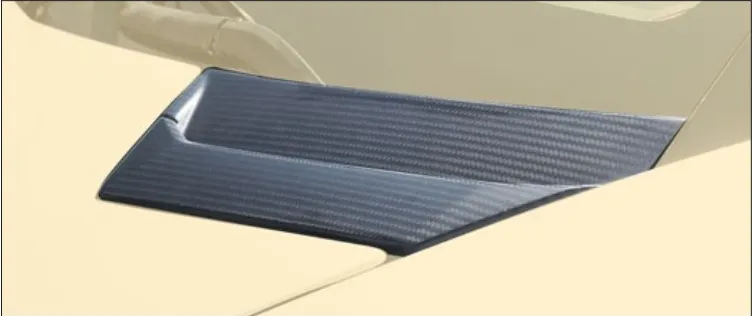
Bonnet air outtake Mansory Carbon for Lamborghini Aventador S


Mansory Carbon Bonnet Air Outtake for Lamborghini Aventador S
The Mansory carbon bonnet air outtake is a sculpted vent panel that drops into the front bonnet of the Lamborghini Aventador S (LP740-4 S) and turns the leading bodywork from a closed lid into a calibrated breather. At motorway speed the area above the nose collects a pillow of stagnant air; that pillow has nowhere to escape on a stock bonnet, so it bleeds laterally around the wheel arches and steals downforce that the splitter has just earned. This outtake punches a directional channel through the panel, so frunk and brake-cooling air follow a planned path out of the body rather than a chaotic one. The part lives inside the wider Mansory Body Kit for Lamborghini Aventador S programme, and works with both the Mansory front bonnet I and front bonnet II, or as a standalone retrofit on the OEM bonnet. It respects scissor-door geometry, the aluminium-CFRP monocoque substrate, and the lower-side exhaust architecture that defines pre-SVJ S cars.
Construction & Materials
The outtake is a CFRP sandwich with a deep-pulled vent throat and a flush perimeter flange that sits on top of the bonnet skin. The throat is the load-bearing section: it has to keep its mouth open under buffet from oncoming air without flexing, and it has to do that while withstanding heat radiating up from brake ducting and the front compartment in stop-and-go traffic. Mansory cures the assembly in autoclave, then post-cures and lacquers — the geometry is too articulated for a plain wet-lay or vacuum-bag-only process to render cleanly.
- Weave: 3K twill with a tighter 2K plain option for owners who want a closer optical grain
- Cure: autoclave prepreg cycle, controlled ramp + 6 bar pressure, post-cure for dimensional stability
- Resin: epoxy prepreg with elevated thermal limit; suitable for radiated frunk heat soak
- Wall thickness: ~1.6 mm at flange perimeter, stepping up at the throat collar to resist airflow buffet
- Mesh insert: black anodised aluminium grille, hexagonal cell, sized to debris-shield the cavity
- Weight: ~620 g per piece, replacing a heavier OEM blank section if Mansory bonnet is used
- Hardware: bonded studs + perimeter adhesive line, plus mechanical clips at the leading edge
- Finish: high-gloss UV lacquer standard, satin or raw-look on request, weave-aligned to bonnet centreline
Design & Visual Function
Treat the bonnet as a pressure map. As the Aventador S accelerates, the airflow stagnation point sits roughly a hand-span ahead of the windscreen base, where dynamic pressure peaks and static pressure climbs. Air piling up there does no aerodynamic work; it just builds and spills. The outtake gives that pile a destination. Once a calibrated escape path exists, the column of air feeding through the front-bumper intakes — the ducts cooling the front brakes and the radiators — finds an easier downstream route, and that improves mass-flow through the entire front cooling stack. None of this requires active aero; the geometry does the talking.
There is also a frunk-temperature angle that owners often underestimate. The Aventador's front compartment sits directly above the front brake pathway and absorbs heat through both the floor of the frunk and the bonnet skin itself. After a hill drive, soft luggage in the frunk arrives uncomfortably warm. A vent that bleeds the hot column upward turns the front compartment from a heat trap into a chimney, and on cool-down idle that chimney effect drops frunk temperature meaningfully faster than a sealed bonnet does.
Visually, the part is a directional cue rather than a noisy graphic. The mesh insert reads as a horizontal slit when viewed from the side, echoing the hexagonal Lamborghini DNA without copying it. Specified raw, the weave catches the light at the same angle as the bonnet skin around it, so the surface still reads as one continuous panel — only with a deliberate exhalation point. Lacquered, it gains depth and reflects the shoulder line cleanly back to the windscreen.
Compatibility & Fitment
Designed for the Lamborghini Aventador S (LP740-4 S, coupé and Roadster, 2017–2021). The flange template matches the pre-SVJ bonnet contour and respects the scissor-hinge clearance arc. Compatible with OEM bonnet, Mansory front bonnet I, and Mansory front bonnet II. Lower-side exhaust outlets and rear-wheel-steering geometry are unaffected. Parking-sensor harnessing in the front bumper is untouched, and the front-compartment latch retains its OEM throw and angle. Cars equipped with front-axle lift continue to operate normally; the outtake adds no mass on the lift sensors' work envelope.
Installation & Reversibility
Bench fit roughly 30–60 minutes, full installation 90 minutes to 2 hours. The bonnet panel is removed and inverted on a soft cradle. The cut-out template — supplied with the part — is positioned against datum holes on the underside of the bonnet, scribed, then cut with an oscillating multitool fitted with a fine carbon-friendly blade. Edges are sealed with a thin epoxy fillet and a black liner before the outtake drops in from above. Adhesive choice matters: the Aventador's CFRP-aluminium panel uses methacrylate bonded joints in places, and any adhesive that touches the substrate must be compatible with that chemistry — your installer should pick a structural epoxy or methacrylate qualified by Mansory rather than a generic panel adhesive. Mechanical clips at the leading edge take initial buffet load while the bond cures.
Reversibility is partial: the bond line is durable, and on retrofit-on-OEM bonnet the cut-out cannot be undone without a panel respray, so this is a considered modification rather than a weekend experiment. On Mansory bonnet I or II, the panel is supplied pre-prepped, so reversibility is effectively a non-issue. DIY-capable owners with body-shop experience can manage a Mansory-bonnet install; OEM-bonnet retrofits should always go to a Lamborghini-qualified body shop.
Pairing within the Mansory Aventador S programme
The outtake's natural neighbours sit on the same panel and on the glass forward of it. Specify the Mansory front bonnet if you want the outtake to live on a fully-carbon panel with the cut-out already integrated, or step up to the more sculpted front bonnet II for a deeper directional crease that visually agrees with the vent throat. To finish the cowl region, the carbon windshield wipers cover closes the visual story between bonnet and glass — the eye reads bonnet → outtake → wiper trough → A-pillar as one continuous carbon language.
Maintenance & Durability
Lacquered carbon does not like alkaline cleaners, ammonia, abrasive sponges, or pressure-washed close-range hits — all of these chalk the lacquer over time. Treat the outtake like piano-finish wood: pH-neutral shampoo, plush mitt, two-bucket method, dried with a clean microfibre. A ceramic coating is a sound investment because it sheds road grime and spares the lacquer from the constant micro-marring of mid-week dust removal. UV is the slow killer; a garage car holds gloss for many years, an outdoor car wants the ceramic top-up annually.
Heat from the front pathway will not damage a properly cured prepreg carbon panel — the resin is specified well above operating temperature. The mesh insert is replaceable; if road debris distorts a cell, a single grille swap is faster and cheaper than touching the carbon throat. Stone-chip repair on the leading face follows the standard lacquered-carbon workflow: feather, fill with low-shrinkage resin, blend, polish with a finishing compound. Done correctly the repair is invisible at arm's length.
Lead Time & Warranty
Lead time is 4–8 weeks from confirmed order, reflecting Mansory's bespoke autoclave production cycle and the post-cure window. Each piece carries a 12-month warranty against manufacturing defects from delivery. Misuse, impact damage, and chemical etching are excluded — keep your detailing log.
FAQ
Q: Will it fit a Roadster as well as a coupé?
A: Yes — the front bonnet on Aventador S is identical between coupé and Roadster, so the outtake retrofits both bodystyles without modification.
Q: Can it be installed on the stock OEM bonnet, or only on Mansory bonnet I / II?
A: Either. On Mansory bonnet I or II it is delivered pre-fitted; on the OEM bonnet it requires a templated cut-out. Both routes are factory-supported.
Q: What measurable difference does it make?
A: It bleeds front-compartment static pressure and accelerates frunk thermal cool-down. On road we describe it as relief rather than a horsepower claim — the front cooling stack breathes more freely, and the bonnet stops becoming a heat trap after a hard run.
Q: Raw weave or lacquered — what holds up better?
A: Lacquered, comfortably. Raw weave looks dramatic when fresh but absorbs road film and UV more aggressively. Lacquer + ceramic coating is the long-term-friendly combination.
Q: Will the front-axle lift system still work normally?
A: Yes. The outtake is a panel insert, not a structural change, and adds no constraint on the lift envelope or sensor logic.
Q: How does substrate chemistry affect installation?
A: The Aventador uses methacrylate bonding in places. A trained installer will pair the outtake with a structurally compatible adhesive rather than a generic panel glue. This matters for long-term durability of the bond perimeter.
Pair this outtake with a Mansory front bonnet and a carbon wiper cover for a fully resolved cowl story — the front of the car finally reads as one designed surface rather than three eras of decisions. To configure: WhatsApp +44 7488 818 747 or [email protected].