
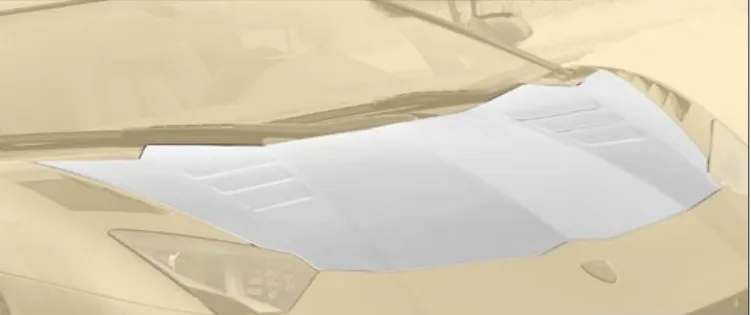
Front bonnet Mansory Carbon for Lamborghini Aventador S


Mansory Carbon Front Bonnet for Lamborghini Aventador S
The Mansory carbon front bonnet is the lid that closes the small luggage compartment ahead of the cabin on the Lamborghini Aventador S — specifically the variant-one panel, with a central duct array and exposed twill on the upper face, sitting forward of the windshield and above the frunk well. It is not an engine cover; the V12 lives behind the cabin, dry-sumped, naturally aspirated, scissor-doors flanking it. This component belongs to the wider Mansory Body Kit for Lamborghini Aventador S, where every panel forward of the A-pillar is recut to shave grams off the steering axle and to introduce purposeful venting. Owners specify it for three converging reasons: a faster steering reply through Strada and Sport modes thanks to reduced front-end inertia, a hot-soak path out of the frunk cavity after a hard run, and the visual continuity of an unbroken weave that flows from the bumper lip across the bonnet and into the A-pillar finishers.
Construction & Materials
The panel is built as a single CFRP shell with internal rib stiffening and discrete duct moulds bonded into the underside. The upper skin shows finished 3K twill in a 2x2 weave, oriented so the diagonal runs from the centreline outward, mirroring the OEM crease that bisects the original Lamborghini bonnet. The reinforcement skeleton is laid up in unidirectional tape along the high-stress vectors — front of latch, rear of hinge mounts, and the perimeter where the panel meets the bumper joint — to keep torsional stiffness within OEM expectations despite the cut-outs.
Cure is autoclave under vacuum; the post-cure bake locks dimensional accuracy across the long span of the panel, so the gap relative to fenders and headlamp surrounds remains tight after thermal cycling.
- Skin weave: 3K twill 2x2, autoclave-cured under prepreg vacuum bag
- Substructure: unidirectional CFRP tape along latch, hinge and perimeter load lines
- Wall thickness: 1.6–2.1 mm on the upper skin, 2.6–3.4 mm at hinge and latch reinforcements
- Net weight saving over OEM aluminium-composite bonnet: roughly 4.2–5.6 kg depending on duct grille spec
- Duct strakes: separately moulded, then bonded with a structural epoxy and sealed with a heat-stable gasket where the duct meets the underside cavity
- OEM hardware retention: hood pin location, gas-strut eyelets, courtesy switch and washer-jet pass-through all preserved
- Finish: gloss lacquer (UV-stable clear), satin lacquer, or raw matte sealer; bespoke painted top with exposed-weave borders on request
- Fastener kit: stainless A4 hardware, butyl seal strips for the perimeter, replacement underside felt where the OEM piece must be relocated to clear the duct cavities
Design & Visual Function
The defining feature is the central duct array. Two longitudinal strakes flank a recessed channel; air entering at the leading edge — already pressurised by the front bumper geometry — has somewhere to go now, instead of stagnating against a flat OEM panel. Part of that flow is bled into the brake-cooling channels that run inboard of the front wheel arches, helping the carbon-ceramic discs shed temperature on circuit days. The remainder vents the frunk cavity after a hot-soak, pulling out the heat that otherwise climbs from the radiator backplane and the front-mounted oil-cooling lines. The result is not a track-spec aero device on its own; it is a thermal aid that also tightens steering response by virtue of the mass cut.
Visually, the strakes give the front of the car the sense of forward motion that the Aventador S already telegraphs through its hexagonal headlamp signature and arrowhead bumper. The exposed weave reads correctly only when the lacquer is laid dead-flat, which is why the manufacturing tolerance on the upper skin is so much tighter than on a hidden structural panel. The 2x2 twill with centreline diagonal lines up with the OEM crease and continues into the bonnet-air-outtake panel behind it, so a buyer who specifies the matched pair gets a single visual sweep from the leading edge of the car to the windscreen base.
The bonnet also functions as a frame for the scissor-door theatre. When both doors are open at a static reveal, the eye runs across the carbon hood, into the door cuts, and back to the rear — the bonnet is the front anchor of that visual continuity. Mansory laid out the duct geometry to keep the centreline emphatic when viewed from the front three-quarter, the angle photographers default to.
Compatibility & Fitment
Lamborghini Aventador S, LP740-4 S, both coupé and Roadster, model years 2017–2021. The panel is cut for the pre-SVJ bumper geometry — the headlamp-to-bonnet shutline uses the Aventador S contour, not the SVJ contour, and not the original Aventador LP700-4 contour either. The component is not a Competition or JS1 part; cars on those programmes use different tooling. Lower-side exhaust outlets, hexagonal LED clusters and the Aventador S front splitter all sit unchanged once the bonnet is in place. The panel does not interact with any active aero system — Aventador S has none — so there is no calibration step on the chassis side after fitting.
OEM hood pins, the OEM latch and striker, the gas-strut mounts, the courtesy lamp and the washer-jet plumbing are all retained at their factory positions. Parking sensor wiring inside the frunk well is undisturbed.
Installation & Reversibility
A Mansory-trained or Lamborghini-certified body technician will book this as a six- to eight-hour job, single-bay. The OEM bonnet is removed at the hinges (mark the shim positions before unbolting), the loom for the courtesy lamp is unclipped, and the gas struts are released last. The Mansory panel is offered up dry, gap-checked at fenders and bumper, and then the hinge and latch hardware is torqued to factory spec. Where the underside felt has to be relocated to clear the duct cavities, replacement felt is supplied in the kit with the correct adhesive for the substrate; the Aventador's CFRP and aluminium monocoque panels rely on methacrylate adhesive bonds in places, and any rework on those joins should respect that chemistry.
Final shim work brings the panel-gap to OEM tolerance — typically 3.5–4.0 mm at the fender, with a slightly tighter target at the bumper joint to keep the front face uninterrupted. The job is fully reversible: the OEM bonnet stores flat with its original fasteners and can be refitted without trace if the car is sold on or returned to factory finish.
Pairing within the Mansory Aventador S programme
The natural matched pair is the Mansory Carbon Front Bonnet II, the more aggressive variant of this same panel — a buyer who wants a louder duct geometry and deeper strake recesses jumps directly to that part instead. For owners who keep the variant-one bonnet but want to extend the carbon sweep rearward, the Mansory Carbon Bonnet Air Outtake sits immediately behind, picking up the diagonal weave line and turning it into a vented panel just ahead of the windscreen base. Owners who want the underbonnet visual fully resolved often add the Mansory Trunk Carbon Cover, which dresses the inside of the frunk cavity in matched twill so that opening the bonnet at a static reveal does not break the carbon language with bare painted metal.
Maintenance & Durability
Lacquered carbon on a horizontal panel is exposed to the worst of the UV load, especially when the car is parked outdoors at midday. A two-stage ceramic coat applied after the first month of ownership protects the lacquer; reapplication every twelve to eighteen months keeps the weave from greying. Carnauba wax is a viable alternative for owners who prefer warmer reflectivity on the twill but it needs more frequent reapplication. What kills lacquered carbon: alkaline traffic-film removers above pH 10, ammonia-based glass sprays misted onto the panel, and any abrasive sponge that scuffs the clear before the buyer notices. A two-bucket wash with a pH-neutral shampoo and a soft microfibre is the safe baseline.
Stone chip on the leading edge is the practical risk for a front bonnet. A clear paint-protection film over the first 200 mm of the panel — extending into the duct lips — is the right preventative spec; if a chip does occur, a Mansory body shop can fill, sand and re-clear locally without re-lacquering the full panel, provided the chip is caught before moisture migrates into the weave. The CFRP itself is engineered for the Aventador's full service life; the lacquer is the sacrificial layer.
Lead Time & Warranty
Production is to-order through Mansory's bespoke programme. Lead time runs four to eight weeks from confirmed specification, depending on finish — raw matte and gloss lacquer are at the shorter end of the window; bespoke painted tops with exposed-weave borders sit at the longer end. The component carries a twelve-month manufacturer's warranty against material and manufacturing defects from the date of fitting.
FAQ
Q: Is this the engine cover?
A: No. This is the front bonnet, the lid over the small luggage compartment ahead of the cabin. The V12 is rear-mid; the engine bonnet is a separate part behind the passenger cell.
Q: Does it fit both coupé and Roadster?
A: Yes. The frunk geometry is identical between Aventador S coupé and Aventador S Roadster, so the panel is single-spec across both body styles within the 2017–2021 production window.
Q: How much weight comes off the front axle?
A: Roughly 4.2 to 5.6 kilograms net, against the OEM bonnet, depending on duct grille spec and finish. The benefit is most felt as a sharper steering reply at turn-in rather than as an outright lap-time number.
Q: Do the OEM hood pins and the latch keep working?
A: Yes. Hood-pin location, OEM latch and striker, gas-strut eyelets and the courtesy lamp pass-through are all preserved at factory positions. No bodyshell drilling is required.
Q: Raw weave or lacquered — which is right for this panel?
A: Lacquered is the recommended baseline because the panel sits horizontal and the lacquer carries the UV load. Raw matte is available for owners who prefer the drier visual, but it asks for ceramic coating as a non-negotiable part of the care plan.
Q: Does it need re-coding to the car?
A: No. The panel does not interact with any electronic system beyond the courtesy lamp — Aventador S has no active aero — so fitting is mechanical and there is no chassis calibration step.
The natural pair-with for this part is the Bonnet Air Outtake immediately behind, completing the carbon sweep from leading edge to windscreen base. To confirm spec, finish or fitting plan, message WhatsApp +44 7488 818 747 or write to [email protected].