Roof wing Mansory Carbon for Mercedes G-class G500 / AMG G63 W463A


Roof wing Mansory Carbon for Mercedes G-class G500 / AMG G63 W463A
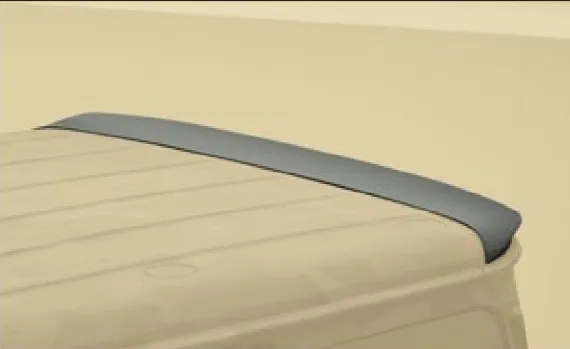
The standard Mansory roof wing sits at the entry rung of the W463A roof-wing family — the lowest-profile of four variants engineered for the 4th-generation G-class. Its job is narrow: break the dead-flat horizon line above the tailgate without committing to a high "tower" silhouette. Within the broader programme — see the Mansory Carbon Body Kit for Mercedes G-class W463A G500/G63 — this is the choice for owners who want a measured roof statement, OEM-spoiler continuity, and a modest weight penalty rather than full aero theatre. Styling-first, with a small but real influence on rear-end airflow.
The Restrained Roof Statement
Where the high roof wing reads as an aggressive declaration and the side-flap variant edges into rally-replica territory, the standard wing whispers. It rises only a few centimetres above the rear-roof edge, picking up the natural step-down where the OEM AMG G63 spoiler used to live and extending it cleanly across the full width of the tailgate. From three-quarter angles the wing reads as a factory-correct extension; from directly behind, it adds just enough shadow under the lacquered carbon lip to signal the car is no longer stock — without raising the eyebrows of a hotel valet or an insurance underwriter. This is the wing chosen by buyers who already paid for a wide-front-mask programme, full widebody arches, and a forged wheel set, and now want the roof to agree with the rest of the car without shouting over it.
Functionally, the restrained profile means minimal weight added high on the chassis (a real consideration on a 2.5-tonne SUV with a tall centre of gravity) and minimal interruption to roof-rack or roof-tent compatibility.
Profile, Lift Balance & Visual Continuity
Aerodynamically, the W463A is a brick. Its drag coefficient hovers around 0.53 in stock form — closer to a delivery van than a sports SUV — dominated by windshield rake and tailgate flatness, not by what happens on the roof. So no honest seller should claim that fitting any of the four roof wings transforms the G's highway behaviour. What this standard wing does, measurably, is two small things: it shifts the rear-edge separation point a few millimetres rearward, slightly reducing the low-pressure pocket behind the tailgate at sustained 130–150 km/h cruising, and it adds a tiny rearward-down vector that nudges static rear-axle load by a fraction of a per cent. Cd-delta lives in the third decimal — visible on a wind-tunnel chart, invisible at the fuel pump.
Visual continuity is the bigger payoff. G63 cars from AMG came with a small body-coloured lip spoiler that traced the rear-roof edge; the standard Mansory wing replaces that lip with a deeper, lacquered-carbon version of the same line. Mansory's CAD team digitised the OEM AMG spoiler and built outward from it, so the wing's leading edge mates the rear-roof skin and its trailing edge stays parallel to the tailgate seam.
Two-Piece Bonded Carbon Shell
Construction is deliberately simple — the wing's modest geometry doesn't need an elaborate lay-up.
- Weave: 3K twill 2×2, autoclave-cured, weave alignment running fore-to-aft so the diagonal pattern reads continuously along the car's length.
- Two-piece architecture: an upper aerodynamic shell and a lower mounting cap, bonded with structural epoxy along a hidden internal flange.
- Wall thickness: 1.6–1.8 mm at leading and trailing edges, stepping up to 2.4 mm at the dowel-pin bosses.
- Weight: approximately 1.4 kg complete with bonded mount cap and hardware kit.
- Hardware: four 3M VHB foam-acrylic strips pre-cut to the underside profile, plus two stainless dowel pins at the leading edge for shear location.
- Finish: high-gloss 2K clear lacquer with UV inhibitor as default; matte and satin lacquers optional, both with the same UV package so the carbon doesn't bleach in desert sun.
- Internal stiffener: a single chopped-strand mat patch laminated under the central span, killing resonance at highway-speed wind frequencies.
Compatibility (Steel-Roof vs. Sliding-Roof Cars)
Fits Mercedes-Benz G-class W463A generation (4th-gen, internal Mercedes code, 2018+ production). Confirmed for G500, G550, G400d, G350d, and AMG G63 (M177 4.0 V8 BT). The wing mounts to the rear-roof edge that is identical across all W463A variants. Pre-2018 W463 ("classic" boxy, 1979–2018) is NOT compatible — different roof contour, different rear-edge radius, different tailgate-to-roof transition. W464 / W465 Gronos cars run a separate roof programme with their own dedicated wings. Steel-roof and panoramic sliding-roof cars are both supported: the wing sits aft of the roof's last cross-member and aft of the sunroof's rearmost glass edge, so sliding-roof operation is not impeded. RHD and LHD chassis are mechanically identical for this part — no handed variant required. Cars with a roof-mounted shark-fin antenna retain it; the wing's central span clears the fin with several millimetres of margin.
Installation: VHB, Dowel Pins, Drainage
Installation is straightforward and falls within reach of a competent body-shop technician — no panel removal, no headliner work. Workshop time is 60–90 minutes including degrease and cure. Two mounting routes are supported.
Reversible (default). The underside is pre-fitted with 3M VHB 5952 foam-acrylic strips. The roof skin is degreased with isopropanol, the wing dry-fitted to confirm centring against the tailgate seam and rear-roof rivet line, then the VHB liners peeled and the wing pressed home with even hand pressure for 30 seconds along the full span. Two stainless dowel pins at the leading edge drop into pre-existing OEM panel-locating holes, providing positive shear location so the wing cannot creep rearward under wash-bay pressure jets or autobahn airflow. The car must sit at workshop temperature (≥18 °C) for 24 hours before exposure to road or wash. VHB reaches full bond strength at 72 hours.
Drilled (optional). The same wing accepts two M5 stainless mounting studs through pre-marked locations on the roof skin, sealed with butyl tape and capped with painted blanking nuts. Drilling voids reversibility but doubles long-term shear margin.
Drainage is handled by geometry: the underside is profiled with a 2 ° rearward slope so any water under the leading edge runs out the trailing edge rather than pooling against the roof skin. No closed cavity, so no risk of trapped moisture corroding the painted steel underneath. After install, a thin bead of clear silicone along the leading edge gives a belt-and-braces water-shield; renewed annually.
Pairing within the Mansory G-class W463A programme
If a customer is undecided between profiles, comparing this directly with the high roof wing in the same programme makes the volumetric difference obvious — the high wing is roughly twice the depth and reads as a much more aggressive aero statement. For owners committed to the restrained look, fitting this wing alongside the roof panel GRONOS w/ 2 lights at the leading edge of the roof creates a balanced front-to-rear carbon composition: lights up front, wing at the back. Add the A-pillar front and side-roof cover to tie the upper greenhouse together visually — the A-pillar carbon provides the bookend that lets the eye accept the rear wing as part of the same design language.
Care, Repolishing, Roof-Wash Routines
Lacquered carbon on a roof position takes more sun than any other panel, so UV management is the most important care variable. The factory lacquer carries a benzotriazole UV-absorber package rated for around 8–10 years of full-time outdoor exposure before yellowing. Carnauba waxes disappear in three months; a proper SiO₂ ceramic coat (9H, over IPA-prepped lacquer) holds 24–36 months and extends the UV package. Use pH-neutral shampoo — never dishwasher detergent, never ammonia glass cleaner, never abrasive sponges. Two-bucket method, soft microfibre mitt. For automated wash, specify "soft-touch / cloth" — nylon brushes micro-mar the lacquer. Lift bird and insect strikes within 24 hours — formic acid will etch lacquer.
Lead Time & Warranty
Lead time is 2–3 weeks from order confirmation: the geometry is well-trodden in Mansory's tooling, the lay-up is uncomplicated, the autoclave cycle short. Lacquer flash plus QC adds 4–5 days. The part ships in a fitted foam-and-plywood crate with dowel pins, VHB liners, alignment template, and silicone bead pre-packed. Warranty is 12 months from delivery against manufacturing defects: delamination of the upper-to-lower bond, voids under the lacquer, dowel-pin boss failure, or fitment outside published tolerance. Impact damage, drilled-mount routes outside marked locations, and chemical attack from non-recommended cleaners are not covered. The warranty transfers with the car within the window.
FAQ
Q: 3M VHB or drilled — which is right for my car?
A: VHB is the default and correct for 95 % of buyers — fully reversible, full-strength bond after 72 hours, no metal modification. Drilled-mount is for permanent show builds or high-pressure wash-downs where shear loads exceed normal road and rain.
Q: Can I keep my factory roof rack with this wing fitted?
A: Yes. The wing's footprint sits aft of the rearmost roof-rack tracks; OEM cross-bar and most aftermarket rack systems clear it by a comfortable margin. A roof tent's rear hinge may sit close to the wing's leading edge — measure before committing.
Q: How is drainage handled?
A: The underside is profiled with a 2 ° rearward slope so incidental water exits the trailing edge. No closed cavity, no moisture trapping against painted steel. A clear silicone bead at the leading edge is the final water shield, renewed annually.
Q: Will the wing affect my shark-fin antenna or roof-mounted GPS reception?
A: No. The wing sits aft of the shark-fin position with millimetres of clearance, and carbon — non-metallic, non-shielding for LTE / GPS / SiriusXM bands — does not attenuate the antenna's ground plane.
Q: Is this practical as a daily driver, or is it show-only?
A: Daily-drive friendly. ~1.4 kg, doesn't impede tailgate operation, doesn't whistle at autobahn speeds (chopped-strand stiffener kills resonance), survives soft-touch car washes, lacquer UV package built for full-time outdoor parking. Caveat is the same as any lacquered carbon: no baked-on bird droppings, no ammonia glass cleaner.
Pair the standard roof wing with the GRONOS roof panel and A-pillar carbon cover for a coherent, restrained upper-cabin programme. WhatsApp +44 7488 818 747 or [email protected].