
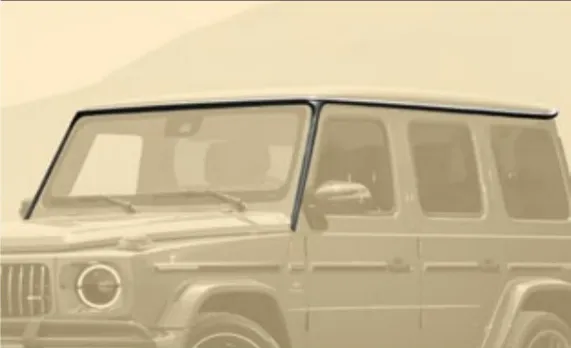
A-Pillar / front and side roof cover Mansory Carbon for Mercedes G-class G500 / AMG G63 W463A


A-Pillar / front and side roof cover Mansory Carbon for Mercedes G-class G500 / AMG G63 W463A
The A-pillar with front and side roof cover is the single biggest visible carbon trim on the upper cabin of the Mansory Mansory Carbon Body Kit for Mercedes G-class W463A G500/G63 programme. It bridges three architectural planes — windscreen pillar, front roof edge and side roof rail — in one continuous prepreg piece. Without this overlay, the painted plastic A-pillar and body-coloured roof rail orphan the carbon mirror housings and D-pillar cover from one another. Adding it closes the upper-cabin loop and turns the W463A roofline into one coherent twill ribbon running pillar-to-pillar.
The Upper-Cabin Visual Band
From three-quarter front, the eye reads three vertical accents — A-pillar, B-pillar, D-pillar — and one horizontal: the roof edge. When mirror housings, roof handles, D-pillar covers and often a roof wing are already in 3K twill, leaving the A-pillar in glossy black plastic creates an obvious break. This cover restores continuity — it converts a list of carbon items into a visual band.
Geometry-wise this is not a flat decal. The piece wraps from the windscreen pillar (near-vertical plane), over the front roof edge (a tight radius perpendicular to the windscreen), then turns 90° onto the side roof rail (horizontal, running rearward toward the B-pillar). Three planes, two transition radii, one continuous weave — that is the engineering brief.
Construction & Materials
Each side is moulded as a three-segment bonded assembly: pillar segment, corner segment, side-rail segment. They are laid up over a male mandrel that mimics OEM body curvature, then cured in a single autoclave cycle so the weave appears continuous across joints. Final sealant lip hides the bonding seam.
- Weave: 3K twill 2×2, 200 g/m² prepreg, hand-aligned at every plane transition
- Cure: autoclave at 120 °C / 6 bar, single cycle for the bonded shell
- Wall thickness: 1.6–2.0 mm with 0.4 mm clear-coat lacquer build
- Weight per side: ~ 0.55 kg pillar + ~ 0.65 kg roof-edge/side-rail = ~ 1.2 kg/side
- Mounting: combination of OEM clips into existing pillar trim sockets + 3M VHB 5952 black acrylic foam tape along the roof-rail run
- Finish options: glossy 2K clear, matte 2K satin, or visible-carbon raw (lacquer only, no pigment)
- UV stabiliser package: HALS + benzotriazole absorbers in clear coat for desert sun resistance
- Edge treatment: trimmed and lacquered so no fibre ends are exposed where the part meets the OEM windscreen seal
Three-Plane Weave Continuity
The technical signature of this trim is weave continuity through the three-plane wrap. On a part that bends through a windscreen-pillar plane, over a tight roof-edge radius, then 90° onto a side-rail plane, prepreg wants to wrinkle, fish-eye or shear at every transition. Mansory solves this two ways. The male mandrel is shaped to OEM body curvature so cloth lies under tension over a convex tool. Each plane gets a hand-aligned cloth segment with a darted overlap, co-cured under autoclave pressure so the joint disappears under clear coat. Result: 2×2 twill diamonds run uninterrupted from the windscreen base up over the roof edge and along the side rail.
Prepreg Over Male Mandrel: Autoclave Process
Production per side: mandrel released, IPA-wiped, waxed; three segments of pre-cut 3K twill prepreg laid up by hand with darts at the corner radius; breather cloth and vacuum bag applied; autoclave at 120 °C, 6 bar, 90 min dwell; demould; edge-trim with diamond burr; two-coat 2K acrylic clear with HALS UV package; flat-sand at 1500 grit, polish at 3000 grit, machine carnauba for the glossy variant. Matte variant skips polish and uses a flatted clear with silica matting agents so the satin is in the lacquer, not on the surface.
Design & Visual Function
This is a trim part, not an aero part. What it changes is the perceived horizontal stretch of the cabin: a continuous dark twill band along the roofline visually lengthens the greenhouse, exaggerates the slab-sided W463A architecture and lowers apparent ride height from three-quarter angles. The lacquer over carbon picks up a directional sheen the painted plastic OEM piece never produces. Paired with carbon mirror housings forward and a D-pillar cover aft, the upper cabin reads as one piece of carbon furniture wrapped around a glasshouse.
Compatibility: Airbag, ADAS Camera, Antenna
Three compatibility constraints define this part and they are not optional.
1. Curtain airbag tear seam. The OEM A-pillar trim has a moulded tear seam that splits along a defined line when the curtain airbag deploys. The Mansory cover sits over the painted body pillar, not over the inside-cabin trim — so it does not interfere with the cabin-side tear seam. The exterior cover uses spaced 3M VHB strips, not a structural bond across the pillar centreline, allowing the body sheet to flex normally in a side impact. Owners replacing the OEM interior A-pillar trim should specify a different SKU — this part is exterior only.
2. ADAS / multi-purpose camera. Cars with the Mercedes Multi-Purpose Camera at the upper windscreen are unaffected — the cover sits on the pillar, not on the windscreen. Rain and light sensors on the windscreen edge are similarly clear.
3. Antenna and shark-fin. The roof-mounted shark-fin antenna sits centre-rear of the roof and is not crossed by this part.
Fitment: Mercedes-Benz G-class W463A (2018+, 4th-generation platform) — G500, G550, G400d, G350d and AMG G63 (M177 4.0 V8 BT). NOT compatible with pre-2018 W463 (1979–2018 boxy) — different pillar geometry, different roof-edge radius, different windscreen seal. W464/W465 and Gronos kits use a separate cover. LHD and RHD share the same cover (symmetrical L/R per side).
Installation, Trim Removal, Sealant Renewal
Time estimate: 3–4 hours per side, 6–8 hours both sides, by a body-shop trimmer. DIY is possible but not advised — windscreen-seal interaction is the failure point.
Steps per side: protect bonnet and fender with low-tack film; lift and protect the OEM windscreen sealing rubber along the pillar; IPA-wipe the painted pillar and roof edge; dry-fit the cover, mark VHB locations; apply primer-promoter (3M 4298UV) along VHB tracks; press cover home from windscreen seal upward, working bubbles outward; clip the lower-pillar OEM tab into the cover; re-seat the windscreen rubber over the cover lip; renew exterior sealant bead at the cover-to-roof junction with Sikaflex-221 black; skin time 4 h, full cure 24 h, no car wash for 72 h.
Reversibility: yes — the cover can be removed by warming the VHB to 60 °C with a heat gun and pulling at a controlled angle. The OEM paint underneath is undamaged; residual VHB cleans with adhesive remover.
Pairing within the Mansory G-class W463A programme
This cover is an upper-cabin keystone. Functionally it asks to be specified together with parts that share the roofline:
- Carbon mirror housing Mansory for G-class W463A — sits forward of and below the A-pillar; together they bracket the front side window in carbon.
- D-pillar cover Mansory carbon for G-class W463A — closes the rear end of the side-rail run; specifying both completes the pillar-to-pillar carbon ribbon.
- Roof handles carbon Mansory for G-class W463A — interior pairing; while this product is exterior-only, owners almost always carry the carbon theme inside via the roof handles.
Care, Polish, Sealant Service Schedule
Routine: pH-neutral shampoo, microfibre, two-bucket method. Avoid dishwasher detergent (alkaline, dulls clear coat) and ammonia glass cleaners on the lacquer. Carnauba wax every 3 months for the glossy finish, or a silica ceramic top-up every 6 months. Matte variant: matte-specific shampoo only, never wax or polish — both will gloss up the satin unevenly.
UV/desert sun: the HALS package is rated for ~ 7–8 years of daily sun before yellowing becomes visible. Garaged cars retain clarity past a decade. The VHB tape along the roof-rail run is rated for the same lifetime; renewal is part of any windscreen replacement.
Sealant renewal: the Sikaflex-221 bead at the cover-to-roof junction is most exposed to weathering. Inspect annually; renew every 3–4 years or whenever the windscreen is removed. A failed bead lets water track behind the cover toward the roof drainage channel.
Chip repair: a 2K clear-coat touch-up pen handles stone strikes from the windscreen edge zone. Delamination claims (rare on autoclave parts) fall under the 12-month warranty.
Lead Time & Warranty
Lead time 4–5 weeks from confirmed order: 2 weeks lay-up and cure, 1 week lacquer and polish, 1–2 weeks crating and despatch. The bonded three-segment assembly cannot be rushed — autoclave cycle time is fixed and the lacquer must flash-off between coats. Each set ships in a foam-lined dual cradle with installation kit (VHB strips, primer-promoter wipes, Sikaflex tube, instruction sheet).
Warranty: 12 months against manufacturing defects — delamination, voids, fibre print-through, lacquer failure, fitment outside ±0.5 mm of mandrel reference. UV yellowing from a neglected wax/ceramic regime is not warranty. Stone-chip damage is not warranty. Removal-and-reinstall during accident repair is supported if a Mansory-trained installer signs off.
FAQ
Q: Will this cover interfere with curtain airbag deployment?
A: No. The cover is exterior-side only, sitting over the painted body pillar. The OEM cabin-side trim with its tear seam is untouched. The exterior uses spaced VHB strips, not a structural bond, so the body sheet retains normal flex behaviour in a side impact.
Q: Does it work with the windscreen-mounted ADAS camera?
A: Yes. The camera bracket sits at the inside upper corner of the windscreen, behind the glass — not on the pillar. Rain and light sensors on the windscreen edge are similarly clear. No ADAS calibration is required after fitment.
Q: How is water drainage handled?
A: The cover is profiled so water from the windscreen edge runs onto the roof drainage channel via the OEM path. The Sikaflex bead at the cover-to-roof junction prevents tracking behind the cover. Owners report no leaks on autoclave-cured assemblies provided the bead is inspected annually.
Q: Can a body shop remove this for accident repair without destroying it?
A: Yes — controlled removal is part of the design. The VHB strips release at 60 °C with a heat gun pulled at a shallow angle. The cover comes off intact and the OEM paint underneath is unharmed. Reinstallation uses a fresh VHB kit.
Q: Will the cover fit my W463 from 2010?
A: No. Pre-2018 W463 has different pillar curvature, roof-edge radius and windscreen seal. This part is W463A only (2018+, 4th-generation).
Specify it together with mirror housings forward and a D-pillar cover aft to close the upper-cabin loop. Order via WhatsApp +44 7488 818 747 or [email protected].