
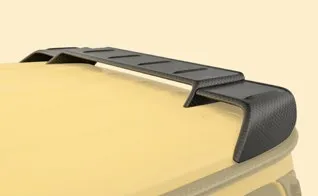
High roof wing Mansory Carbon for Mercedes G-class G500 / AMG G63 W463A


High roof wing Mansory Carbon for Mercedes G-class G500 / AMG G63 W463A
Stand a W463A G500 or AMG G63 next to the same car wearing the standard Mansory roof wing and the difference is immediate from a 3/4 rear photograph: the high roof wing pushes the trailing edge of the roof skyward, turning the otherwise shoebox-flat roofline into a deliberate ducktail. This is the middle child of the Mansory roof-aero family — taller and more theatrical than the base roof wing, but without the side flaps of the high roof wing with side flaps. It belongs to the same widebody programme as our Mansory Carbon Body Kit for Mercedes G-class W463A G500/G63 and is normally specified by owners who want the stance change without the visual mass of vertical end plates.
Re-Drawing the Rear Roofline
From dead behind, the standard W463A roof reads as a rectangle stacked on a rectangle — slab sides, square tailgate, slab roof. The high roof wing breaks that geometry by adding a 70–85 mm rise at the trailing edge, blended forward over roughly the rear quarter of the roof so the eye reads a continuous arc rather than a bolted-on shelf. Photographed from a 3/4 rear angle — Mansory's own launch-photography frame for widebody G-classes — the wing lengthens the visual roof and pulls the rear of the cabin downward in a stretched ducktail. The job here is silhouette change, not splitter-style downforce.
What you do not get with this variant are the upward-turned vertical end plates that frame the side-flaps version. The trailing edge runs cleanly off the corners of the roof, with chamfered carbon returns where it meets the existing Mansory roof skin. That clean edge keeps the wing reading as an extension of the bodywork rather than an aftermarket bolt-on.
Rake Angle & Wake Behaviour
Rake is fixed at approximately 4.5 degrees nose-down measured against the static roof plane, set by the moulds and not user-adjustable. That number keeps the upper surface attached as long as possible at motorway and Autobahn speeds — too flat and the wing only re-shapes silhouette; too steep and flow separates halfway across the chord and creates stall drag. At cruise, airstream that runs over the bonnet and the long flat W463A roof arrives at the wing already slowed by the roof boundary layer; the 4.5-degree angle re-attaches and re-energises that layer before it spills off the back of the truck.
Because the wing carries no end plates, span-wise flow at the tips spills outboard naturally. The trade-off is honest: a little less peak rear-axle download than the side-flap variant in straight-line tests, in exchange for cleaner wake behaviour at yaw — when the G is changing lanes or in side-wind on a high bridge. End-plate-less wings feel more neutral in cross-winds because they do not generate the yaw moment that vertical plates can produce on a tall, slab-sided vehicle. Owners chasing maximum rear stability typically step up to the side-flaps version.
Honeycomb Sandwich Construction
The wing is laid up as a hollow-core sandwich: outer 3K twill prepreg skin, Nomex aramid honeycomb core (6–10 mm depending on chord position), and an inner 2-ply CFRP skin, co-cured under autoclave. The reasoning is structural. A solid-laminate carbon wing of the same plan area would either be heavy or floppy; the sandwich gives bending stiffness scaling with the cube of panel thickness, while honeycomb itself adds almost no mass. Finished weight lands at roughly 1.6–2.0 kg — well under a solid-laminate or fibreglass-cored equivalent.
- Outer skin: 3K twill prepreg, 2-ply, autoclave-cured for tight weave alignment
- Core: Nomex aramid honeycomb, 6–10 mm cell depth, contoured to chord
- Inner skin: 2-ply CFRP, sealed against moisture ingress at all edges
- Wall thickness 8–12 mm depending on station along the wing
- Finish: clear UV-stable lacquer, gloss standard, satin or matte to order
- Mounting: drilled studs through the OEM roof skin with bonded base, sealed with body-shop urethane
- Hardware: stainless M6 studs, captive nuts, supplied with the wing
- Weight as fitted: approx. 1.6–2.0 kg including hardware and sealant
Compatibility & Garage Clearance
Fits the Mercedes-Benz G-class W463A — the 2018-onwards 4th-generation platform, Mercedes internal model code W463A — across G500, G550, G400d, G350d, and AMG G63 (M177 4.0 V8 BT). Pre-2018 W463 cars (the original boxy 1979–2018 platform) are NOT compatible: the roof skin curvature, gutter geometry, and panel mounting points are different. W463A Gronos and the next-gen W465 use their own roof aero programmes. Fits both LHD and RHD bodies — the wing itself is symmetric.
Garage clearance is the question we field most often on this part. A base W463A AMG G63 stands at roughly 1969 mm to the highest point of the factory roof. The high roof wing adds approximately 70–85 mm at the centre rise, so plan for an as-fitted overall height of 2040–2055 mm. Most multi-storey car parks specify a minimum 2.0 m bar, so this wing will often clip — particularly older underground parks at 1.95–2.0 m. Domestic sectional doors normally clear it but check your own track. If your daily routine puts the car under a 2.0 m bar, the standard roof wing is the friendlier option. Sunroof presence does not affect fitment. Factory roof rack must be removed before installation; the bonded base seals over the rack-mount holes.
Installation: Drilled Studs, Sealing, Underside Trim
Installation is a body-shop job, not a driveway DIY. Allow 4–6 hours for a competent installer. The wing locates by its bonded base — a contoured carbon footprint that follows the curvature of the W463A rear roof skin — and is fixed with stainless M6 studs that pass through the roof skin into captive nuts behind a removable headlining trim panel inside the cabin. That means drilling the OEM roof, which is non-reversible. Holes are sealed twice: first with body-shop urethane between the wing base and the painted roof, then with a secondary bead inside the headlining channel after the captive nuts are torqued.
Surface prep on the roof skin: clean with isopropanol, scuff the contact zone with Scotch-Brite, key the painted surface for the urethane, mask surrounding roof so any squeeze-out can be wiped without lacquer damage. Studs torque to a stainless-on-aluminium spec — typically 8–10 Nm — and we supply a torque card. Once cured (24 hours minimum before rain), the wing is fully structural and the underside is sealed against water ingress.
Pairing within the Mansory G-class W463A programme
The high roof wing reads best on a car that already carries some Mansory rear-end content. Most owners pair it with the rear door panel carbon insert to balance the upper rise with carbon mass at the tailgate, and reference the standard roof wing only if they own a second G and want one car taller and one cleaner. Owners who like this profile but want the more aggressive, end-plated alternative on a future build typically step up to the high roof wing with side flaps.
Maintenance, Wax, Detailing the Underside
The lacquered outer skin tolerates regular shampoo washes and pH-neutral snow foam. Avoid alkaline traffic-film removers — they strip lacquer gloss over repeated use and dull the weave. Carnauba wax is fine; ceramic coatings (SiO2-based) work well here because the upper surface gets the most UV and rain dwell, and a ceramic layer slows long-term lacquer ageing. Reapply every 6–12 months.
The underside is the part most owners forget. Because the wing is open at the trailing edge profile, water and road grit reach the inner skin, and the flat carbon tucks against the painted roof create a horizontal ledge that traps wash residue. After every wash, blow-dry that seam with compressed air or a leaf blower; over time, soap residue can wick under the bonded base and stain the lacquer from below. What kills carbon prematurely: dishwasher detergents, ammonia-based glass cleaners overspraying onto lacquer, and abrasive sponges on the leading edge where bug strikes accumulate — use clay bar or a dedicated bug remover instead.
Lead Time, Warranty & Replacement
Lead time is typically 3–5 weeks from order, depending on autoclave queue and lacquer build (matte and satin runs slightly longer than gloss). The part ships with hardware, sealant card, torque spec, and installation guide. Twelve-month warranty against manufacturing defects — delamination, lacquer voids, dimensional fitment errors. Warranty does not cover crash damage, garage-bar strikes (common on this part — see clearance section), or lacquer abrasion from incorrect washing.
FAQ
Q: Can the rake angle be adjusted after installation?
A: No. Rake is fixed by the mould at approximately 4.5 degrees and is not user-adjustable. No shim plates, slotted holes, or hinged mounts — Mansory designed this as a styling-led aero piece with a single validated rake position.
Q: Is it drilled-on or clip-on? Can I remove it without trace?
A: Drilled-on. Stainless M6 studs pass through the OEM roof skin into captive nuts behind the headlining trim. Removal is mechanically possible but the stud holes are not reversible without bodywork — minimum a roof respray over the patched zone. Treat this as a permanent fit.
Q: Will the wing snag on a brush car wash or hand-wash mitt?
A: The trailing edge is chamfered specifically to avoid snagging cloth in soft-touch automatic washes; brush-style automatics are still risky for any aftermarket carbon part and we recommend hand washing. A standard wash mitt rolls cleanly over the wing without catching.
Q: How does it affect garage clearance?
A: Adds roughly 70–85 mm at the centre rise. Plan for an as-fitted overall height of approximately 2040–2055 mm on a base AMG G63. Many older multi-storey and underground parks set bars at 1.95–2.0 m, so check your daily routes before specifying.
Q: Can I keep the factory roof rack with this wing?
A: No. The rack must be removed; the wing replaces it as the rear-roof feature, and the bonded base seals over the rack-mount holes.
Specify alongside a rear door panel for a balanced rear-end carbon presence. WhatsApp +44 7488 818 747 or [email protected].