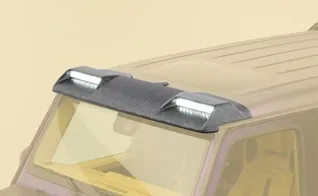
Roof panel GRONOS with 2 lights Mansory Carbon for Mercedes G-class G500 / AMG G63 W463A


Roof panel GRONOS with 2 lights Mansory Carbon for Mercedes G-class G500 / AMG G63 W463A
The GRONOS roof panel takes the wide-roof silhouette that defined Mansory's earlier G-Wagon Gronos programme and translates it onto the W463A platform as a stand-alone carbon overlay carrying two high-power LED light pods. It sits squarely between aero ornament and functional lighting hardware: a single contoured carbon shell that re-skins the metal roof of the G500 / AMG G63, fairs in a pair of forward-firing lamps, and adopts the broader, more rectangular crown that the GRONOS look is known for. Owners specifying this part are typically completing a full Mansory exterior on their W463A and want the roofline to read as a continuous carbon plane rather than a painted body panel with bolt-on lights stuck to it. See the master programme: Mansory Carbon Body Kit for Mercedes G-class W463A G500/G63.
Construction & Materials
The shell is built as a single autoclaved monocoque rather than a two-piece glue-up, which matters when the part has cutouts: a continuous fibre path around each light aperture is what stops the laminate from telegraphing stress lines into the lacquer over time. The visible weave is laid as a 3K twill skin over a structural backbone of unidirectional and biaxial plies, with localised reinforcement around the lamp recesses where the panel transitions from convex roof crown to flat lamp seat.
Hardware is split between OEM-style M6 bolts at the original roof-rail attachment points and a perimeter of high-modulus 3M VHB tape that handles vibration damping and seals the shell against the painted roof skin underneath.
- Weave: 3K 2x2 twill outer skin, biaxial + UD core plies for stiffness around the light cutouts.
- Cure: full autoclave cycle, 6 bar, 120 deg C, post-cured to lock Tg above desert-roof surface temps.
- Wall thickness: 2.4-2.8 mm across the crown, stepped to 3.6 mm around lamp apertures.
- Weight: approximately 4.6 kg dry shell, plus 0.9 kg per LED pod assembly.
- Mounting: factory roof-rail M6 capture nuts, supplemented by 3M VHB 5952 perimeter bond.
- Light cutouts: CNC-trimmed, edge-sealed with epoxy, fitted with EPDM gaskets to prevent capillary leakage.
- Finish options: high-gloss UV-stable clear lacquer, satin matte 2K, or raw-weave matte sealer.
- Wiring: pre-loomed harness with weatherproof Deutsch DT connectors exiting at the front edge.
Design & Visual Function
The GRONOS visual signature is about widening the apparent roof of the G-Class without touching the underlying steel skin. The shell adds height of roughly 25 mm at the leading edge and tapers rearward, which subtly moves the perceived centre of mass forward and up - a deliberately aggressive read that suits the wide-arch widebody programme rather than a stock-arch G500. The two lamp pods sit symmetrically inboard of the leading edge, faired into the carbon so they read as part of the panel rather than aftermarket clip-ons.
Beam-pattern integration is genuinely considered: the lamp seats are angled 4 degrees down from the roof plane so the high beams clear the bonnet bulge of the W463A and project ahead of the vehicle rather than into the windshield reflection zone. The cutouts are radiused, not square, which keeps glare off the A-pillar carbon and stops the lights creating a hot edge in the lacquer at night.
Weight on the roof is the other consideration that drives the geometry. The G-Class already runs a high centre of gravity and the GRONOS panel adds roughly 6-7 kg total once both lamp pods, harness and gaskets are included. To keep the roll moment manageable, the shell is hollowed under the crown and the lamp housings are positioned as far forward and as low as possible within the panel envelope, so the added mass sits above the front axle line rather than mid-roof.
Compatibility & Fitment
Designed for the Mercedes-Benz G-class W463A generation, the 2018+ fourth-generation platform that replaced the boxy first-gen W463 (1979-2018). Pre-2018 W463 cars are NOT compatible - the new platform changed roof-rail spacing, side-window upper trim, and A-pillar geometry, and the GRONOS panel will not seat on the older roof. The shell fits G500, G550, G400d, G350d, and AMG G63 with the M177 4.0 V8 BT. Cars optioned with the panoramic glass roof or the standard sliding sunroof both clear the shell, since the panel sits above the existing roof skin and never intersects the sunroof aperture. LHD and RHD are identical: the panel is symmetric and the harness routes equally to either A-pillar. W464/W465 and W463A Gronos use their own dedicated kits and this panel is not interchangeable.
Installation & Reversibility
Plan on a 5-7 hour install at a body-trim specialist or Mansory-trained installer. The roof rails come off first, then the OEM weatherstrip channels are masked, the painted roof is degreased with isopropyl, and the VHB perimeter is laid out using positioning shims so the panel registers off the rail bolt holes before the tape is committed. Once the shell is seated and the M6 bolts are torqued, the lamp pods drop into their seats, the EPDM gaskets are compressed, and the harness is routed down the inside of the A-pillar into the loom behind the fuse panel. There is no drilling into roof sheet metal, so the install is reversible at the panel level: removal is a heat-knife trim of the VHB and a bolt extraction. The factory roof returns to original spec after a paint detail.
Pairing within the Mansory G-class W463A G500/G63 programme
This roof panel is most often specified together with parts that share its plane and its visual logic. A common build pairs it with the high roof wing at the trailing edge to bookend the carbon roof line, and with the high front protective frame below the bonnet so the forward lighting from the pods reads as a coherent system with the bull-bar grille. Owners who want the HELLA position-light aesthetic instead of the GRONOS forward-firing pods cross-shop the HELLA two-light roof panel as a sibling alternative on the same platform.
Maintenance & Durability
Roof carbon takes the worst UV load on the car. The lacquer used here is a UV-stable two-component automotive clear, but ceramic coating is still recommended within 30 days of fitment - a 9H ceramic adds a sacrificial layer that takes the brunt of summer sun and bird-strike acid. Carnauba waxes work fine on lacquered carbon if you prefer the deeper warmth they give the weave, but a ceramic top-up every 18 months is the realistic baseline for keeping the panel from clouding. Avoid alkaline detergents: dishwasher gel and ammonia window cleaners both attack the lacquer crosslink and will eventually flatten the gloss to a hazy semi-matte. Abrasive sponges leave fine scratches that catch light at low sun angles, so two-bucket microfibre wash only. Stone chips on the lamp pod faces are repairable with a clear polyurethane drop kit; deeper laminate damage is sent back for shop repair.
Lead Time & Warranty
Lead time is 4-5 weeks from order to dispatch. The shell is autoclaved to spec rather than pulled from inventory because cure cycles are scheduled around the larger body kits, and the lamp pods are loomed and tested as a matched pair. Warranty runs 12 months from delivery against manufacturing defects: delamination, voids in the laminate, lamp-seat misregistration, or harness failures inside the moulded loom. Cosmetic wear from gravel, off-road use, or third-party detailers falls outside warranty.
FAQ
Q: Will the GRONOS panel clear my factory sliding sunroof?
A: Yes - the shell sits above the OEM roof skin and never crosses the sunroof aperture. Both the panoramic and the standard sliding sunroof on the W463A operate normally with the panel fitted.
Q: How is the lamp wiring connected without cutting into the headliner?
A: The harness exits the panel at the front edge, drops down the outside of the A-pillar inside the existing weather seal, and joins the body loom behind the fuse panel through an existing grommet. No headliner removal and no drilling.
Q: Is the panel compatible with my old 2015 G500?
A: No. The pre-2018 W463 has different roof-rail spacing and a different A-pillar profile. This panel is W463A only (2018+ fourth-gen). Older box-shape G-Wagons need a different roof solution entirely.
Q: How does the added roof weight affect handling?
A: The total addition is around 6-7 kg with both pods and harness. It is noticeable mainly at high crosswind speeds; the panel geometry keeps the mass forward and low within the shell envelope to limit roll moment, but the G-Class is a high-CG platform and adding mass on the roof always trades some on-limit stability.
Q: Can I run the lights on the road or are they off-road only?
A: The pods are sold as auxiliary forward-lighting and follow the same regulatory category as factory roof-mounted auxiliary lights - usable on private land and off-road, with on-road usage subject to local regulations on auxiliary lamp activation. Wiring includes a switched relay so the pods can be locked out when not legally usable.
Pair this GRONOS roof panel with the high roof wing and high front protective frame to complete the upper carbon plane of the W463A widebody programme. Order or spec via WhatsApp +44 7488 818 747 or [email protected].