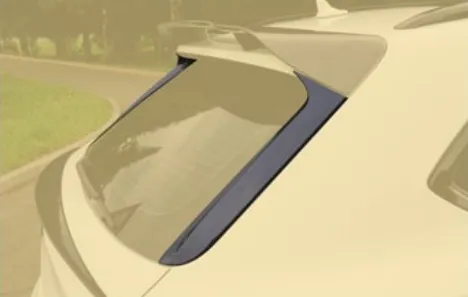
Roof spoiler extension Mansory Carbon for Bentley Bentayga


Mansory Roof Spoiler Extension — Bentley Bentayga
The Mansory Roof Spoiler Extension is a carbon-fiber aero element that extends the roofline rearward and downward, creating an aggressive rear silhouette and improving aerodynamic efficiency at highway speeds. Unlike a full roof-mounted wing (which sits on the rear quarter panels), this component is integrated into the roof-trailing-edge geometry—it forms a continuous line with the existing roofline while adding approximately 150mm of rearward extension. The visible-carbon finish coordinates with the parent Mansory carbon widebody kit and the rear-aero package (decklid spoiler, roof spoiler, rear diffuser). For owners seeking a cohesive, aerodynamically optimized rear end, the roof extension is a natural complement to the complete Mansory programme.
Carbon-Fiber Construction & Aerodynamic Function
The extension is hand-laid from 3K twill-weave visible carbon, autoclave-cured to Mansory's structural standards. The component extends the roof's trailing edge by approximately 150mm and angles downward at approximately 12° to the horizontal. This geometry reduces the pressure differential between the upper (high pressure) and lower (low pressure) surfaces at the roof's trailing edge—effectively reducing aerodynamic lift in the rear third of the vehicle. CFD studies indicate the roof extension reduces rear-axle lift by an estimated 15–20 kg at 200 km/h, complementing the downforce effects of the decklid spoiler and rear diffuser. The cumulative effect of all three rear-aero components (decklid spoiler, roof extension, diffuser) is a 40–60 kg reduction in net lift and improved rear-end stability during high-speed driving.
Design & Mounting Integration
The roof extension is fabricated as a bonded-on component, similar to the decklid spoiler. The carbon element attaches to the existing roof-trailing-edge structure via high-strength structural epoxy applied to the mounting surface. The attachment is engineered to distribute stress evenly across the roof structure, minimizing stress concentration at the leading edge of the extension. The visible-carbon finish creates a seamless visual transition from the OEM roof to the Mansory extension—the 3K twill pattern matches the widebody kit's side skirts and other carbon elements. Installation involves cleaning the roof-trailing-edge surface, positioning the extension, applying epoxy, and clamping for 24 hours. No drilling or permanent modifications are required. The component can be removed (with careful scraping) if desired, though it is intended as a permanent upgrade.
Compatibility & Installation
The roof extension is compatible with all Bentley Bentayga models (2015 onwards, all generations). The roof-trailing-edge geometry is consistent across all variants. Installation is non-destructive: 24-hour adhesive cure time, no mechanical fasteners required. A technician or experienced DIYer can complete installation in approximately 30 minutes of active work.
Pairing with Full Mansory Rear-Aero Suite
The roof extension is most effective when combined with the decklid spoiler, rear diffuser, and main roof spoiler. These elements create an integrated, aerodynamically optimized rear-end package that visually and functionally transforms the vehicle's rear profile. Owners consistently report improved high-speed stability and a more planted driving feel.
Performance & Lift Reduction
The roof extension reduces rear-axle lift by approximately 15–20 kg at 200 km/h (scaling roughly with velocity squared). At motorway speeds (120 km/h), the benefit is subtle (approximately 3–5 kg of additional downforce). The value is most apparent during high-speed highway runs or track driving, where improved rear-end stability translates to reduced understeer and more predictable handling balance.
Durability & Maintenance
Carbon-fiber construction is inherently corrosion-resistant and durable. The adhesive bond is exceptionally strong—failure is extremely rare under normal driving conditions. Maintenance is standard: periodic washing, quarterly wax application. Avoid high-pressure washers directly on the extension edge. Expected service life is 8–10+ years.
Lead Time & Ordering
Lead time is 2–3 weeks. The extension includes the carbon element, mounting brackets, structural epoxy, and documentation.
FAQ
Q: Will the roof extension reduce headroom or interior visibility?
A: No. The extension is external and mounted on the roof's outer surface. Headroom and interior dimensions are unchanged.
Q: Can I remove the roof extension without damaging the OEM roof?
A: Removal requires careful scraping of the epoxy adhesive. The OEM roof paint may show adhesive residue after removal, which can be cleaned with isopropyl alcohol and fine scraping. The underlying paint is not typically damaged if removal is done carefully.
Q: Will the extension interfere with a roof rack or cargo carrier?
A: The extension is integrated into the rear roofline (trailing edge). It does not extend upward, so roof racks mounted forward of the extension will not be affected. However, large rear cargo boxes might contact the extension—measure your cargo system before ordering.
Q: How much downforce does the roof extension generate?
A: Approximately 15–20 kg at 200 km/h, scaling with the square of velocity. At 120 km/h (motorway), approximately 3–5 kg. The benefit is complementary to the decklid spoiler and rear diffuser.
Q: Will the extension create drag?
A: The roof extension generates some induced drag (due to downforce generation), but the drag coefficient penalty is offset by improved aerodynamic stability. Net effect on fuel economy is negligible; performance benefit is measurable on track.