
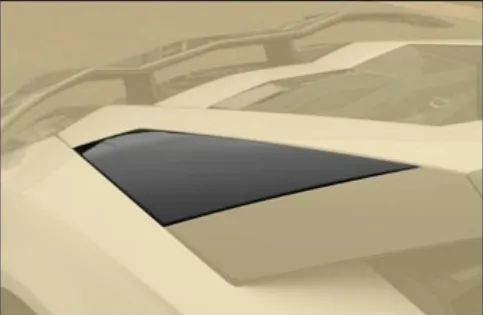
Replacement Air intake - rear Mansory Carbon for Lamborghini Aventador


Replacement Air Intake Rear Mansory Carbon for Lamborghini Aventador
The Lamborghini Aventador places its 6.5-litre naturally aspirated V12 behind the cabin, in a mid-rear layout that concentrates the car's most heat-intensive systems into the rear quarter. The rear air intake apertures, positioned along the engine bay flanks, are responsible for supplying combustion air to the V12 and cooling air to the transmission and rear brakes simultaneously. Mansory's rear replacement air intake — part of the Mansory Carbon Fiber Body kit set for Lamborghini Aventador — delivers a full-component replacement of the factory rear intake surround with a precision autoclave-cured carbon unit that maximises flow area, presents the incoming airstream with minimal entry loss, and brings the programme's material quality to one of the car's highest-thermally-loaded aperture positions.
Construction & Materials
The rear intake position presents greater thermal design challenges than the front: the engine bay ambient temperature immediately behind the intake aperture is substantially higher in sustained driving, and the resin system selected for this component must maintain structural integrity across the full thermal range the intake will encounter — from cold-start at sub-zero ambient temperatures to sustained high-speed running where the rear bay can reach 100–120 °C at the air intake inner face.
- Outer lip weave: 3K twill — visible from the car's exterior at the rear quarter position
- Duct interior: 2K plain — smooth surface to minimise turbulent entry losses at the duct throat
- Cure: Autoclave — required for void-free laminate at this operating temperature
- Resin system: high-temperature toughened epoxy — 150 °C continuous service rating for the rear thermal environment
- Throat area: 16 % increase over factory rear intake surround
- Wall thickness: 2.5 mm outer lip, 1.8 mm duct walls, 3.5 mm mounting flange
- Finish: high-gloss UV-clear lacquer on exterior; satin clear on internal duct
- Mounting: OEM rear bumper and body panel attachment points — no new holes or bracket modification
- Weight per unit: approximately 0.55 kg
The 150 °C resin specification is specific to the rear position — the Mansory front intake uses a 130 °C rated system, but the rear position demands additional thermal headroom. This is not a theoretical conservatism: rear intake inner-face temperatures on a naturally aspirated V12 in motorsport use — hill climbs, circuit sessions — have been measured above 130 °C at the intake duct inner boundary by independent thermal logging. Using a 150 °C rated system provides a meaningful safety margin across all legitimate use cases.
Design & Visual Function
The rear quarter of the Aventador, viewed from behind and to the side, is one of the car's most complex surfaces — the flying buttresses, the engine lid vents, and the lateral intake apertures all compete for attention in a compressed geometric space. The Mansory carbon rear intake's wide 3K twill lip provides a clear visual anchor for the intake zone — a deep, material-rich face that separates the painted bodywork above from the aperture opening below with a precision and depth that the factory plastic surround cannot match.
In evening lighting or under car-park fluorescents — conditions where the Aventador is most often viewed by an interested audience — the carbon intake's weave generates its characteristic alternating reflectivity, creating a surface that reads as lustrous rather than merely dark. Against the Aventador's typically dramatic paint colours (Giallo Orion, Rosso Mars, Verde Mantis), the deep-black carbon intake lip provides high-contrast framing that makes the aperture itself appear wider and more purposeful than the factory treatment.
The intake's geometric relationship to the air intake side window element above it — another Mansory programme component — means that specifying both creates a vertical carbon stack at the rear quarter: intake surround at the lower position, side window intake above, and the engine lid louvers at the highest point. This vertical layering establishes the car's rear aero architecture as a deliberate, system-designed feature rather than a collection of isolated apertures.
Compatibility & Fitment
Designed for the Lamborghini Aventador LP 700-4 (2011–2016) and LP 720-4 50° Anniversario. The rear intake aperture geometry is consistent between coupé and Roadster. Aventador S (MY2017+) has a revised rear body panel with repositioned intake apertures — the Mansory S programme supplies the correct replacements for that model. The replacement is LHD/RHD symmetric — both sides use the same duct geometry.
Installation & Reversibility
Rear intake replacement requires access to the inner attachment points, typically via rear bumper partial removal or engine lid removal sequence depending on the specific build. A Mansory-experienced workshop should allow 2.5–3.5 hours per pair. Factory intake surrounds reinstall on the OEM attachment points — full reversibility is maintained. No bonding or drilling into the car's body panels is required.
Pairing within the Mansory Aventador programme
The rear replacement intake pairs naturally with the replacement air intake — front to create a complete intake replacement programme across both ends of the car. The air intake — side window above the rear intake position continues the vertical carbon stack at the rear quarter. For owners who want to maximise rear intake capacity, the replacement big air intake — rear provides an enlarged variant with greater throat cross-section for the highest cooling-demand specifications.
Maintenance & Durability
The rear intake's high-temperature operating environment makes it the programme's most thermal-cycle-intensive exterior carbon component. Inspect the duct inner face annually for lacquer clouding — the satin lacquer at the duct interior will show the first signs of thermal stress as a very slight hazing near the duct throat after 3–5 years in regular high-performance use. This is an aesthetic matter, not a structural one; the toughened epoxy laminate retains full structural integrity throughout. The outer lip's UV lacquer should receive an annual ceramic coating refresh to protect against UV-B degradation accelerated by the rear bay's radiant heat environment — the combination of UV and thermal cycling is harder on lacquer than either factor in isolation.
Lead Time & Warranty
Lead time from order is 3–4 weeks. Mansory warrants the rear intake pair for 12 months against manufacturing defects including duct delamination, mounting flange cracking under thermal cycling, and outer lip lacquer voids. The 150 °C resin specification is verified by batch coupon test — thermal delamination within the rated temperature range is a manufacturing defect covered by warranty.
The rear intake's 150 °C resin specification has an additional implication that benefits owners in warm climates even without track use: the rear quarter of a parked Aventador in direct afternoon sunlight can reach surface temperatures approaching 80 °C through solar gain alone. A standard-temperature epoxy with a glass transition temperature near 100 °C will begin to exhibit creep deformation in this environment over multi-year service in hot climates — the duct walls gradually lose dimensional accuracy and the mounting flanges develop micro-fatigue from the repeated thermal expansion-contraction cycles. Mansory's 150 °C rated system maintains its glass-transition margin at least 70 °C above any plausible ambient-plus-solar temperature that the rear quarter will experience in a stationary vehicle, eliminating thermal creep as a failure mechanism across the component's service life.
FAQ
Q: Why does the rear intake use a 150°C resin while the front uses 130°C?
A: The rear intake inner face is exposed to radiant heat from the V12 exhaust manifolds and the transmission, which can sustain temperatures above 130 °C at the duct inner boundary during circuit use. The 150 °C system provides the safety margin required for this operating environment.
Q: Is the rear intake compatible with the Aventador Roadster's engine lid arrangement?
A: Yes. The Roadster's rear intake apertures are at the same position as the coupé — the engine lid design difference is managed by the dedicated cabrio engine bonnet component elsewhere in the programme.
Q: Can the rear intake be fitted during a regular service interval to minimise downtime?
A: Yes — rear bumper removal is a routine procedure at major service intervals for the LP 700-4. Scheduling the intake replacement to coincide with a major service avoids a separate access operation and reduces total workshop time.
Q: Does the intake require recalibration of the V12's air mass sensing after replacement?
A: No. The Mansory replacement is a purely structural/aerodynamic component at the external aperture — the V12's MAF sensor and intake manifold arrangement is not modified. No ECU recalibration is required.
Contact the Mansory team via WhatsApp +44 7488 818 747 or [email protected] for fitting and lead-time confirmation.