
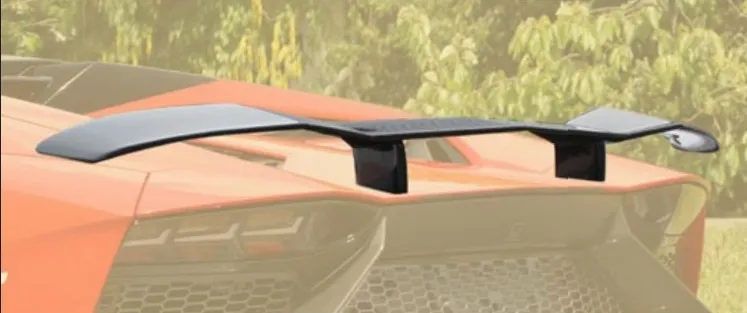
Rear performance wing Mansory Carbon for Lamborghini Aventador


Rear Performance Wing Mansory Carbon for Lamborghini Aventador
The Lamborghini Aventador's naturally aspirated 6.5-litre V12 delivers 700 horsepower to a car that weighs just over 1,600 kg — a power-to-weight ratio that generates terminal speeds where aerodynamic downforce is not optional but fundamental to safe handling. The factory LP 700-4 relies primarily on its body's passive aerodynamic surfaces and a small deployable rear spoiler for high-speed stability. Mansory's rear performance wing replaces this passive system with a dedicated carbon aerofoil element that generates consistent, adjustable rear-axle downforce at all speeds above 100 km/h, without the complexity and failure mode of the factory's electro-mechanical deployable system. As part of the Mansory Carbon Fiber Body kit set for Lamborghini Aventador, the rear performance wing is the programme's single highest-downforce contribution — the component that most directly transforms the LP 700-4's high-speed aerodynamic character from road-comfortable to track-capable.
Construction & Materials
The performance wing is the programme's most structurally demanding component: the wing element spans the full width of the Aventador's rear section, operates at high aerodynamic load at sustained speed, and must maintain its profile within tight angular tolerances to deliver consistent downforce rather than unpredictable load variation between adjustment settings. Mansory's wing element uses a multi-layer high-modulus carbon prepreg construction — not the standard 3K twill used for visual body panels, but a 12K unidirectional high-modulus carbon in the primary bending direction, covered by a 3K twill aesthetic outer skin that maintains the programme's visual character.
- Wing element primary structure: 12K UD high-modulus carbon — stiffness-critical bending direction
- Wing element outer skin: 3K twill prepreg — programme-consistent visual character
- Endplate construction: 3K twill, single-piece — visual surfaces fully visible at the wing tips
- Standoff uprights: 12K UD primary, 3K twill outer — matches wing element structural specification
- Cure: Autoclave, 135 °C / 7 bar — elevated cure cycle for high-modulus prepreg compaction
- Wing profile angle adjustment: 3-position mechanical (5 °, 8 °, 12 ° angle of attack)
- Downforce at 200 km/h: approximately 45–78 kg depending on profile angle setting
- Total wing weight: approximately 6.8 kg
- Mounting: trunk lid mounting points — OEM bolt pattern, no body modification
- Finish: high-gloss UV-clear lacquer on all visible surfaces
The 3-position angle adjustment (5 °, 8 °, 12 °) provides a useful real-world tuning range: 5 ° for road use where drag minimisation is preferred and the downforce benefit is supplementary to the car's passive aerodynamics; 8 ° for mixed track-and-road use where the handling balance change is perceptible and welcome; 12 ° for dedicated track days where maximum rear-axle load is the primary objective and fuel efficiency is secondary. Each click of angle adjustment changes the rear-axle downforce by approximately 15–18 kg at 200 km/h — a meaningful increment at each step, making the three-position system genuinely tunable rather than symbolic.
Design & Visual Function
The rear performance wing is the element that most dramatically transforms the Aventador's visual character from road GT to dedicated aero specification. Viewed from the rear, the wing spans the full width of the car above the tail section — wider than the car's painted tail treatment below, creating a horizontal emphasis that visually widens the rear stance and lowers the car's apparent centre of mass. In profile view, the wing's chord and standoff height create an immediately recognisable motorsport profile — the car reads as a machine built for speed management rather than simply speed generation, a different and more purposeful visual character than the wing-free specification.
The high-modulus carbon in the wing element's primary structure means the wing maintains its profile under aerodynamic load without the progressive bowing that softer laminate constructions exhibit at maximum downforce settings. At 12 ° angle of attack and 250 km/h, the wing element is under approximately 95 kg of total aerodynamic force, distributed across the standoff uprights and trunk mounts. The UD high-modulus laminate deflects less than 2 mm at the wing tip under this load — the type of rigidity that ensures the wing delivers its rated downforce rather than deflecting toward a lower effective angle of attack as speed builds.
The endplates contribute approximately 8 % of total wing downforce through their own lift-reduction effect at the wing tips — the endplate area generates a local suction zone that extends the wing element's effective span aerodynamically without increasing the physical span. This is a feature of correctly designed performance wings; decorative wings without endplates or with undersized endplates sacrifice this contribution.
Compatibility & Fitment
Designed for the Lamborghini Aventador LP 700-4 (2011–2016) and LP 720-4 50° Anniversario. Compatible with both coupé and Roadster — the trunk lid mounting points are shared. The factory deployable rear spoiler must be disabled or removed for wing installation (Mansory supplies a blanking panel for the deployable spoiler aperture where required). Aventador S (MY2017+) uses different trunk lid mounting geometry — the Mansory S programme covers that model. LHD and RHD cars use identical trunk lid geometry.
Installation & Reversibility
Wing installation requires trunk lid access and two technicians to manage the wing assembly's 6.8 kg weight during alignment. Installation time: 3–4 hours including factory deployable spoiler removal (where applicable), trunk mounting verification, wing standoff bolt installation, angle setting selection, and final torque. The trunk lid mounts can be restored to factory specification with the blanking panels supplied — full reversibility. Wing installation is a scheduled workshop event rather than a trackside adjustment.
Pairing within the Mansory Aventador programme
The rear performance wing is most effective as the top of a complete rear aero system. Pair it with the designed diffuser to balance front-to-rear downforce distribution — without the diffuser's underbody contribution, the wing's rear-axle loading can create an understeering balance at the highest angle settings. The rear bumper air outtake covers at the mid-bumper level complete the rear aero picture visually and thermally. For owners who want maximum downforce rather than a specific wing aesthetic, the biplane performance wing provides dual-element downforce at a higher total load for the most demanding track specifications.
Maintenance & Durability
The wing element's angle adjustment bolts should be re-torqued after the first 500 km of use at any new angle setting — the high-modulus laminate seats under load and the bolt stretch can reduce slightly from the initial torque value. After re-torque verification, annual inspection of the adjustment bolt torque is the primary structural maintenance requirement. Clean the wing surfaces with pH-neutral shampoo and microfibre — the high-modulus inner structure's specific stiffness makes the wing element more brittle to point-load impacts than a pure 3K twill component; avoid abrasive cleaning tools. The endplate lacquer at the tip extremes is susceptible to stone chip from following traffic — PPF on the endplate forward faces is advisable on cars used regularly on open roads.
Lead Time & Warranty
The rear performance wing's high-modulus construction and multi-component assembly require careful production scheduling. Mansory allocates 5–7 weeks from order. The wing carries a 12-month warranty against manufacturing defects including UD-layer delamination, standoff joint failure under rated operating load, angle-adjustment mechanism seizure, and lacquer voids on any visible surface. Wing element deflection in excess of 5 mm at the tip under the rated 78 kg maximum downforce load is a manufacturing structural defect covered under warranty.
FAQ
Q: Does the rear performance wing require recalibration of the Aventador's traction control?
A: Adding a fixed wing changes the rear tyre load in a way that existing ESC/traction control calibrations were not designed for. Mansory recommends a Lamborghini-authorised calibration review at the 8° and 12° angle settings to verify that the ESC intervention thresholds remain appropriate for the changed tyre load. At 5° the difference is minimal for road use.
Q: Is the wing element adjustable without removing the wing assembly?
A: Yes. The 3-position angle adjustment is accessible from the front face of the standoff uprights with a standard hex key — the wing can be moved between angle settings with the car on the ground in approximately 15 minutes. No workshop lift is required for angle adjustment; only the initial installation and angle torque verification require a full workshop setup.
Q: What is the effect on the Aventador's top speed at the 12° setting?
A: At maximum angle of attack, the wing's increased drag reduces the LP 700-4's theoretical top speed by approximately 15–20 km/h from its 350 km/h maximum. This is consistent with the performance trade-off of any high-downforce aero configuration — the increased cornering capability more than offsets the top-speed reduction on any circuit with braking zones.
Q: Is the performance wing compatible with Mansory's biplane wing?
A: The single-element performance wing and the biplane wing occupy the same mounting position and are alternatives, not additive — only one can be installed at the same trunk mount position. Choose the performance wing for a road-oriented specification and the biplane wing for maximum downforce in a track-focused build.
Discuss your wing specification with the team via WhatsApp +44 7488 818 747 or [email protected].