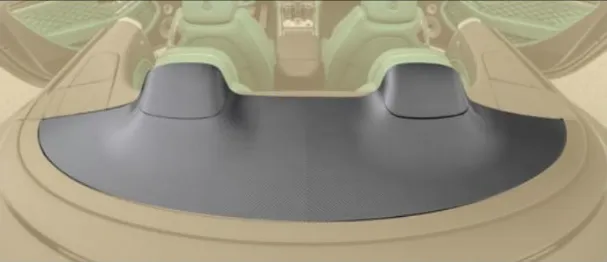
Cover of folding roof for GTC Mansory Carbon for Bentley Continental GT GTC V8


Cover of folding roof for GTC Mansory Carbon for Bentley Continental GT GTC V8
The convertible Continental GTC has a piece of bodywork the coupé does not: the flat panel that closes over the folding-roof stowage well between the cabin and the decklid. With the roof down, this is the most visible carbon surface on the entire vehicle — directly behind the rear seats, full width, rising in a soft camber. Mansory replaces the OEM panel with a one-piece carbon cover, weave-aligned to the rest of the Mansory Body Kit for Bentley Continental GT 2nd-Gen (D2A), so the GTC reads as a coherent carbon object roof-down. The cover is necessarily a GTC-only SKU — there is no equivalent panel on the coupé, because the coupé has no folding-roof stowage well.
Construction & Materials
The cover is a single autoclave laminate over a low-density foam core, dimensioned to drop into the OEM panel aperture without modification to the surrounding sheet metal. The OEM panel is removed; the carbon panel is set in place using the existing fastener pattern, and the soft-top envelope kinematic is not modified at any point. Because the panel sees significant flexural loads when the soft-top deck rises and falls during cycling, the laminate runs uniaxial reinforcement along its short axis — invisible from outside, critical for stiffness over the long term.
Inner-face geometry is the engineering tell. A flat carbon plane on the underside would foul the soft-top kinematic somewhere through the cycle; Mansory therefore mould the inner face with recessed clearances mapped to the soft-top sweep, which allows the roof envelope to pass beneath the carbon underside without contact even after years of seal compression. The recesses are not visible from outside the car, but they are the reason this part is GTC-specific tooling rather than a generic rear-deck panel.
- 3K twill outer skin, weave alignment matched to adjacent decklid carbon parts
- Autoclave cure 6 bar / 120 °C — same process and finish as bodywork pieces
- Foam-core sandwich for stiffness without mass; panel weight ≈ 2.4 kg
- Reuses OEM fastener pattern — no new pilot holes drilled
- Inner face moulded to clear the soft-top mechanism kinematic at every roof state
- EPDM soft-edge perimeter to seal against vibration and panel tap
- UV-stable two-pack clear lacquer; gloss standard, satin or matte optional
- Edges sealed and lacquer-rolled — no exposed weave at the perimeter
Design & Visual Function
This is not an aerodynamic part. It is a visible-surface trim part that exists to tie the rear deck of the GTC into the rest of the Mansory carbon language. With the roof up, the panel is hidden under the soft-top envelope; with the roof down, it is the dominant carbon surface visible behind the seats — a continuous twill plane roughly 1.4 m wide that catches light and reflects the cabin trim language outward. The weave is hand-aligned to the carbon decklid trim aft of it, so the eye reads a single carbon object spanning from the cabin rear bulkhead to the boot edge.
The unique part of the GTC roof mechanism — what sets the engineering brief — is that the panel sits directly on top of the soft-top stowage well, and the soft-top envelope rises through a kinematic that nearly contacts the underside of the cover during cycling. Mansory therefore moulds the inner face of the carbon panel with recessed clearances mapped to the kinematic, so the soft-top can cycle without rubbing the carbon underside even after years of seal compression. This is why a generic carbon cover is not viable for this part: the underside geometry is as important as the visible outer surface, and only a tooled, model-specific moulding gets it right.
Light reflectivity on the cover is calibrated through the lacquer schedule. The first clear coat is rolled flat, sanded, then a final flow coat is applied for depth — the gloss reads as wet-look without being mirror-bright, which on a rear-deck panel visible to other road users is the right level of presence. With the roof down the panel sits in direct sun for hours at a time, so the lacquer schedule is also tuned for UV durability rather than pure surface gloss; long-term colour drift in the carbon underneath is the killer of cheap aftermarket carbon trim, and this lacquer is specified to prevent it.
Compatibility & Fitment
Bentley Continental GTC convertible only (D2A platform), V8 and W12 powertrains, model years 2011 onwards. There is no coupé equivalent — the part exists only on the convertible body. Soft-top revision is verified before order; non-OEM aftermarket soft-top retrofits should be flagged at consultation, because their kinematic may differ from the OEM sweep the inner-face recess geometry was tooled against.
Installation & Reversibility
Installation takes a body shop roughly 90 minutes. The OEM panel is unfastened using the existing hardware pattern, the new carbon cover is fitted to the same fastener positions, the EPDM perimeter seal is set, and the soft-top is cycled three or four times to confirm no contact between the kinematic and the carbon underside. Reversibility is excellent — the carbon panel lifts out and the OEM panel goes back in using the same hardware. No drilling, no bonding, no paint disturbance, no impact on the soft-top mechanism itself.
Pairing within the Mansory Continental GT programme
The folding-roof cover is most often ordered alongside the rear spoiler for GTC and the performance wing for GTC so that all visible rear-deck carbon surfaces on the convertible read as one continuous object roof-down. Owners often complete the upper-surface story with the engine bonnet so the carbon language runs the full length of the car.
Maintenance & Durability
The cover sits in horizontal sun the whole time the roof is down — UV exposure is higher than on most other carbon panels on the car. A ceramic coating is strongly recommended; budget renewal every two to three years depending on climate. Rinse off pollen and bird residue promptly; both can etch lacquer if left to bake. The EPDM perimeter seal is replaceable as a service item if it ever takes a permanent set. Avoid using interior trim sprays on the carbon surface — siliconised conditioner overspray will streak the lacquer.
Lead Time & Warranty
Lead time is 2–3 weeks given that the part reuses OEM hardware and does not require custom backing plates. The 12-month warranty against manufacturing defects covers laminate, lacquer adhesion and EPDM perimeter integrity under normal roof-cycling use.
Why this is a one-of-a-kind GTC part
The folding-roof cover is the hardest part on the GTC to do correctly because it has to satisfy three requirements at once: visible-surface aesthetic continuity with the surrounding bodywork, mechanical stiffness across a wide unsupported span, and precise inner-face geometry that respects the soft-top kinematic. Most aftermarket attempts at this panel solve one of those three and ignore the others — typically by making a flat carbon overlay that looks correct from above and binds against the roof mechanism after a few hundred cycles. Mansory tools the part as a one-piece autoclave moulding with mapped underside clearances, which is expensive to produce but is the only way to deliver a panel that genuinely lasts the life of the car and never asks the soft-top mechanism to flex around it. The 12-month warranty reflects that confidence; in practice the part outlives most ownership cycles.
FAQ
Q: Is this part visible with the roof up?
A: Largely no — the soft-top envelope covers it. With the roof down, it is the most visible carbon surface behind the cabin.
Q: Does the cover affect soft-top operation?
A: No. The inner face is moulded to clear the soft-top kinematic across every roof state; the panel is tested through full cycles before shipping.
Q: Why is there no coupé version?
A: The coupé does not have a folding-roof stowage well, so the panel does not exist on that body — this SKU is convertible-specific by definition.
Q: Can the weave orientation be specified?
A: Yes. Default is centreline-aligned 0/90, but a 45-degree forged-carbon look is available on request — confirm at order.
Q: Does it require any modification of the bodywork?
A: No. It reuses the OEM panel fastener pattern; no drilling, no bonding, no paint work on surrounding bodywork.
Q: How does it sound under tap — does it ring like a hollow panel?
A: No. The foam-core sandwich gives the panel a dead, solid response when tapped, similar to a properly bonded body panel rather than a hollow aftermarket cover.
Q: Will the panel discolour over time from sun exposure?
A: The lacquer schedule is UV-stabilised against the kind of exposure a roof-down GTC sees. With ceramic coating renewed every two to three years, the panel holds its finish indefinitely under normal ownership conditions.
For a convertible Continental that reads as a true Mansory carbon object with the roof down, this cover is the part that closes the language. Specs via WhatsApp +44 7488 818 747 or [email protected].