
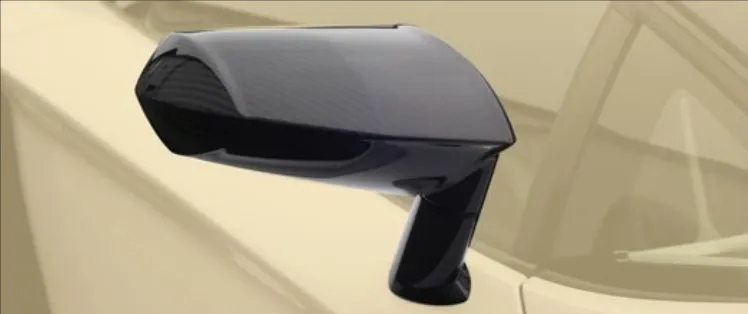
Mirror housing Mansory Carbon for Lamborghini Aventador


Mirror Housing Mansory Carbon for Lamborghini Aventador
The exterior mirror housings of the Lamborghini Aventador sit at the precise junction between the A-pillar and the door surface — the sightline of anyone standing alongside the car. Their geometric compound curvature makes them among the most technically demanding small parts to produce in visible carbon fibre: the weave must flow continuously around the housing's convex crown without the distortion lines that betray poorly mapped cloth or inadequate tool geometry. Mansory's carbon mirror housing, part of the Mansory Carbon Fiber Body kit set for Lamborghini Aventador, resolves this challenge with a multi-piece drape layup that maintains weave registration from the mirror base to the leading edge — producing a housing that looks as considered up close as it does in motion.
Construction & Materials
Each mirror housing is laid up in a matched male/female tool set machined from the exact OEM housing geometry, ensuring the replacement maintains the factory mirror-foot interface and door-surface clearance without modification. The outer skin uses 3K twill prepreg oriented so the weave diamonds align symmetrically across the housing crown — a requirement that demands hand-adjusted cloth placement and multiple-pass lamination rather than a single-drop drape. The inner shell uses 2K plain weave for dimensional stability at the mirror-arm attachment point, where vibration loads from wind buffeting at high speed concentrate.
- Outer skin weave: 3K twill, symmetrically registered across housing crown
- Inner shell weave: 2K plain — dimensional stability at arm attachment
- Cure: Autoclave — compacts resin to eliminate surface pinholes that would read as blemishes on the convex outer surface
- Wall thickness: 1.5–2.0 mm (outer), 1.0 mm (inner)
- Weight per housing: approximately 0.28 kg (vs OEM ABS/PP housing ~0.55 kg)
- Finish: high-gloss UV-clear lacquer, polished to mirror grade over the convex crown
- Mirror glass, heating element, turn-signal: transferred from OEM housing — no electrical modifications required
- Supplied: left + right pair as standard
The housing's wall geometry is verified against a CMM (coordinate measuring machine) fixture to hold the mirror-arm centre-line within ±0.3 mm of the OEM position — critical because even a small misalignment shifts the reflected driver sightline angle, which is a safety consideration as much as an aesthetic one. Mansory's quality-control protocol requires each housing pair to pass this dimensional check before lacquering.
Design & Visual Function
On the Aventador's low-slung, wedge-shaped body, the mirror housings are positioned almost at eye-level for bystanders — their surface quality is scrutinised at arm's length in every valet queue and supercar event. The Mansory carbon housing replaces the factory painted-ABS surface with a material that carries its own inherent visual language: the 3K twill weave's diagonal diamonds catch overhead light from different angles depending on the observer's position, creating a kinetic optical effect that painted surfaces cannot achieve.
The housing crown's convex geometry concentrates reflected light into a bright highlight that migrates across the surface as the viewing angle changes — a characteristic that detailers describe as "liquid depth" and that owners value precisely because it distinguishes the car at events where multiple carbon-trimmed supercars are parked side by side. Mansory aligns the housing weave with the car-body weave direction of the surrounding door panel for builds that incorporate door carbon trim, creating a continuous surface narrative rather than a grafted component.
Beyond aesthetics, the mass reduction — approximately 0.55 kg per side — at the Aventador's extremities improves the car's yaw moment of inertia very slightly, though this is imperceptible in normal road use. The practical benefit is the elimination of mirror-housing micro-vibration at high speed: the stiffer carbon wall eliminates the resonance frequency that can blur the reflected image in the factory ABS housing at 180+ km/h.
Compatibility & Fitment
Designed for the Lamborghini Aventador LP 700-4 (2011–2016) and LP 720-4 50° Anniversario. The mirror-arm interface and door-surface mounting geometry are shared between the coupé and Roadster — one housing design fits both body styles. The Aventador S (MY2017+) uses a revised mirror-arm geometry; the Mansory S programme covers that model. Both LHD and RHD vehicles use mirror housings with the same outer shell — only the internal adjustment motor bracket differs, and that component is transferred from the original housing during installation.
Installation & Reversibility
Mirror housing replacement requires no special tools beyond a plastic trim tool and a T20 Torx bit. The OEM mirror glass and electrical assembly — heating element, turn-signal repeater, blind-spot alert LED if fitted — are transferred from the factory housing to the Mansory shell in a 45–60 minute procedure per side. The Mansory housing clips onto the OEM mirror arm using the factory retention system — no drilling, no bonding. The factory housings can be refitted identically. This is one of the programme's most accessible installations for an experienced owner or a standard automotive workshop.
Pairing within the Mansory Aventador programme
The mirror housings sit at the visual intersection between the front and rear of the car. For maximum surface-material cohesion, pair them with the A-pillar cover — together they wrap the driver's sightline zone in continuous carbon from the A-pillar foot through the mirror housing. The roof cover extends this upper-surface carbon theme from the windscreen to the engine lid on the coupé, creating a complete upper-body carbon wrap. For owners starting with a standalone mirror upgrade, add the carbon panels set next to continue the surface language down the car's flanks.
Maintenance & Durability
Mirror housings collect a disproportionate volume of road grime relative to their surface area because their forward-facing leading edge acts as an impingement surface for spray and insects. Clean the housings at every wash session with a soft microfibre cloth and pH-neutral shampoo; the convex crown is vulnerable to water-spot mineralisation in hard-water areas, which can etch the lacquer surface over repeated dry-down cycles. A hydrophobic coating applied to the crown at installation — the same ceramic product used on the windscreen — repels water and simplifies cleaning. Avoid abrasive polishing compounds on the crown; if the lacquer develops micro-swirl marks from improper washing, a professional machine polish with a finishing compound and a soft foam pad restores clarity without risking lacquer burn-through.
Lead Time & Warranty
Mirror housings are precision small-part items with a shorter production cycle than large body panels. Lead time from order is 2–3 weeks. Mansory covers both housings with a 12-month warranty against manufacturing defects including delamination at the mirror-arm interface, lacquer pinholes over the convex crown, and weave misregistration visible at normal viewing distance. The warranty does not cover chip damage from road debris at the housing leading edge — a location where protective film application is advisable.
FAQ
Q: Are the mirror housings supplied as a pair or individually?
A: As a matched pair — left and right — sharing the same weave batch and lacquer run. This ensures the weave pattern and gloss level match when both housings are viewed simultaneously from the rear of the car.
Q: Does fitting carbon housings affect the mirror's power-fold function?
A: No. The power-fold motor, position sensor, and wiring loom remain on the OEM mirror arm and are unaffected by the housing replacement. Only the outer shell changes.
Q: Can I specify a matte finish on the housings to contrast with a gloss body?
A: Yes. A matte clear-lacquer finish is available at the order stage. Matte-on-gloss-body or gloss-on-matte-body contrast specifications are both valid and popular. Specify at order time — the finish cannot be changed after lacquering without re-preparation.
Q: Will the Mansory housing fit if my car has a factory camera integrated into the mirror base?
A: The camera housing on LP 700-4 variants that have the factory surround-view option is located in the mirror arm, not the outer shell. The Mansory housing does not affect camera operation. Confirm your mirror specification with your chassis number for absolute certainty.
Contact the team via WhatsApp +44 7488 818 747 or [email protected] for order confirmation and lead-time update.