
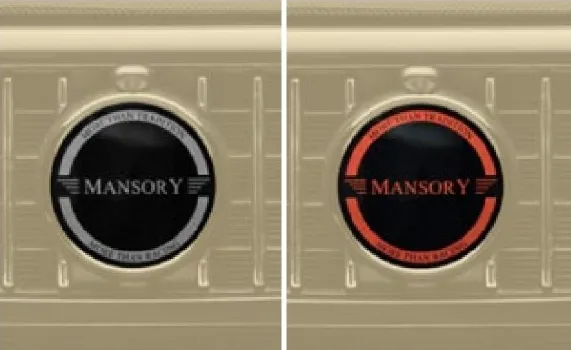
Logo for grill mask Mansory Carbon for Mercedes G-class G500 / AMG G63 W463A


Logo for grill mask Mansory Carbon for Mercedes G-class G500 / AMG G63 W463A
The grill-mask logo is the signature on the Mansory G-class W463A — a small, dense, chrome-plated emblem mounted dead-centre on the front grill mask, sitting proud of the grille bars by a millimetre and a half. As part of the wider Mansory Carbon Body Kit for Mercedes G-class W463A G500/G63 programme, this badge replaces the OEM Mercedes star on Mansory-converted cars or sits beside it on customer requests. It tells anyone walking up to the car that this is not a stock G-Wagon. Owners specify it as the final piece of the front-end conversion.
The Emblem as the Programme Signature
Most aftermarket emblems behave as decoration. The Mansory grill logo is engineered as a small piece of jewellery — a part that survives direct UV, road salt, automatic-carwash brush abrasion, freezing rain, motorway grit and the occasional pressure-washer at six bar. It is the part most photographed when an owner posts the car, and the part that, if it yellows or pits, dates the entire vehicle visually within two years. The latest spec moved away from the older brass-with-thin-flash chrome to a multi-layer plated zinc-alloy substrate with controlled deposition thickness.
The badge measures ~95 × 26 mm, weighs 38–44 g, and ships with dual-retention hardware pre-fitted: paper template, two M3 alignment dowels, pre-cut 3M VHB foam tape, and a sachet of 3M Primer 94.
Casting Method & Finish Chemistry
There are two casting traditions in the badge industry — lost-wax investment casting and high-pressure die casting. Mansory uses high-pressure die casting on a zinc-aluminium alloy known as Zamak 5 (95% zinc, 4% aluminium, 1% copper, residual magnesium). Zamak 5 cools fast, fills sharp script edges (the cursive letterforms have radii under 0.4 mm in places) and accepts plating chemistry well. Lost-wax investment is reserved for limited-run brass variants commissioned for vintage-look conversions.
- Substrate: Zamak 5 zinc-aluminium alloy, high-pressure die cast
- Plating stack: copper strike 5–8 microns, semi-bright nickel 12–15 microns, bright nickel 8–10 microns, hard chrome 0.4–0.6 microns
- Total plating thickness: 25–34 microns — measured by X-ray fluorescence on every batch
- Surface finish: mirror-bright chrome (standard) or PVD black-chrome (option)
- Mounting: 3M VHB 5952 foam tape 1.1 mm pre-applied; two M3 brass alignment dowels
- Surface prep kit: 3M Primer 94 sachet, lint-free wipe, alignment template card
- Weight: 38–44 g · Dimensions: ~95 × 26 mm (Mansory script form)
High-pressure die casting forces molten Zamak into a hardened steel die at pressures up to 100 MPa. Lost-wax investment, by contrast, builds a wax pattern, dips it in ceramic slurry, burns the wax out, pours metal into the cavity. Investment produces zero parting line — which matters on script faces where a parting line ruins reflectivity. Mansory positions the parting line on the back face of the die and polishes the front after demoulding.
Plating chemistry is where older Mansory logos went wrong. The first generation used a single bright-nickel layer of around 8 microns directly on the zinc, then a thin chrome flash. After two or three winters salt would migrate through micro-pores in the chrome, attack the nickel, and the badge would go yellow at the edges. The current spec corrects that. Copper strike first to seal the zinc and provide ductility. Then semi-bright nickel — sulphur-free, sacrificial, twelve to fifteen microns. Then bright nickel — sulphur-bearing, eight to ten microns, mirror reflectivity. Then hard chrome — half a micron, dense, scratch-resistant. The semi-bright nickel is the corrosion sink: any electrolytic attack consumes it before reaching the substrate.
Adhesive & Dowel Pin Engineering
The dual-retention system is what separates a 38-gram badge from jewellery you can mount with confidence on a panel that sees 130 km/h airflow. 3M VHB 5952 (Very High Bond) is an acrylic foam tape, 1.1 mm thick, peel strength around 35 N per 25 mm, dynamic shear above 70 N per square centimetre once fully cured. Foam thickness matters — 1.0 mm is stiffer but less forgiving of thermal expansion mismatch between zinc badge and painted steel grill mask; 1.5 mm accommodates more thermal cycling but reduces shear. The 1.1 mm spec is the compromise: survives the −30 °C to +85 °C envelope without delaminating.
3M Primer 94 surface prep is non-negotiable. The primer is a low-VOC silane that wets the surface, evaporates, and leaves a molecular bridge that lifts VHB peel strength by 30–50% on automotive 2K clearcoat. Apply, wait 60 seconds, mount within 5 minutes. The two M3 dowel pins press into pre-located holes in the badge back face and slip into corresponding holes in the grill mask — they are the alignment system, not a load-bearing fastener. They keep the badge from sliding while the VHB cures over the first 72 hours. After cure the VHB carries the load and the dowels become redundant — exactly what you want for thermal-cycling rated retention.
Compatibility with Mansory & Some OEM Grilles
The badge fits all Mansory front-mask variants for the W463A platform — both the wide front mask with performance grill and the fully-carbon front mask with grill. Mansory masks ship with alignment dowel holes pre-drilled at the centre of the grill mask, on the horizontal centreline of the upper grille bar. On non-Mansory grilles — Mansory script on an OEM AMG grill — fitment is possible but requires drilling two 3.0 mm pilot holes. Vehicle-side fitment: Mercedes-Benz G-class W463A platform (2018+, 4th-gen). Fits G500, G550, G400d, G350d and AMG G63 (M177 4.0 V8 BT). Pre-2018 boxy W463 cars are not compatible. W464/W465 Gronos use separate emblems.
Installation, Centreline Alignment, Heat-Curing the VHB
Total time is 20–30 minutes for a competent installer, an hour for a careful first-timer. Wash the grill mask with isopropanol 70% to remove wax and silicone polish residue — wax is the enemy of VHB bonding. Use the supplied paper template to locate the horizontal centreline of the upper grille bar and the vertical centreline of the mask. Mark dowel-pin entry points with a fine pencil; on a Mansory mask the holes are already there, otherwise drill 3.0 mm at slow speed. Wipe Primer 94 across the bonding zone, wait 60 seconds. Peel the VHB liner, present the badge, drop the dowels into the holes — that is your alignment. Press with both thumbs, rolling pressure across the badge for at least 30 seconds. Heat-curing accelerates the bond — a heat gun on low (60–70 °C) waved across the badge for two minutes brings VHB to roughly 70% of full strength immediately. Avoid pressure-washing for 72 hours.
Pairing within the Mansory G-class W463A programme
The grill logo is the small jewel in a larger front-end conversion. Owners commonly specify it with the illuminated front-grill logo for a back-lit night signature, the bonnet badge, and the wide front mask with performance grill as the host panel. Plating finishes can be matched across all three — chrome on chrome, or black PVD on black PVD.
Long-Term Care: Salt, Wax, Polish, Re-Plating
Care is disciplined but simple. Rinse the badge weekly in salt-belt winters — chlorides accelerate any micro-porosity in the chrome layer. Use a pH-neutral car shampoo, never alkaline degreaser, never ammonia-based glass cleaner. Carnauba wax is the friend — apply a thin layer monthly, it sits on top of the chrome and acts as a hydrophobic barrier. Ceramic coating is also fine; a 9H ceramic adds another 20–30 microns of synthetic protection and lasts 18–24 months. Avoid abrasive polishes — anything coarser than 5000-grit will dull the bright nickel layer beneath the chrome over years. If the badge ever does pit or yellow, re-plating is possible — the badge is stripped chemically and re-plated through the same copper-nickel-nickel-chrome stack at roughly 20–30% of replacement cost.
Lead Time, Warranty & Replacement
Lead time on a standard chrome badge is 2–3 weeks from order. Black-PVD variant adds another week for the PVD chamber run. Warranty is 12 months against plating defects (yellowing, pitting, delamination from the substrate) and against adhesive failure when installed per the supplied procedure. Out-of-warranty replacement is a fraction of the body-kit cost — owners often replace rather than re-plate when the next Mansory generation introduces a new script form.
FAQ
Q: How does the chrome hold up to salt and snow over a real winter?
A: With the current triple-nickel-chrome stack, very well. Salt cannot reach the zinc substrate as long as the plating is intact. The semi-bright nickel layer is the sacrificial corrosion sink — any electrolytic attack consumes it before the chrome above or zinc below. Owners report no visible degradation after three winters, provided the badge is rinsed weekly and waxed monthly.
Q: What does a replacement cost compared to the original?
A: A replacement chrome badge is a small fraction of the body-kit cost — typically the same range as a single carbon mirror housing. Black-PVD is slightly more. The badge is treated as a refreshable consumable rather than a permanent fixture.
Q: Can I remove the badge without damaging the grill mask paint?
A: Yes, but technique matters. Warm the badge with a heat gun on low (~80 °C) for two minutes to soften the VHB acrylic. Use a nylon trim tool or fishing line in a sawing motion behind the badge to cut the foam tape. Never pry with metal. Residual VHB is removed with 3M citrus-based adhesive remover, never acetone, which strips clearcoat.
Q: How is the badge aligned to the grill centreline at install?
A: The supplied paper template locates both vertical and horizontal centrelines. The two M3 brass dowels press into pre-located 3.0 mm holes in the mask, which fixes the badge in two axes the moment it touches down. The VHB then carries the load.
Q: Will the badge fit a non-Mansory AMG grill?
A: Mechanically yes — the badge does not care what grille is behind it as long as the bonding surface is flat and clearcoated. The challenge is drilling the dowel-pin holes accurately. Without dowels you can mount on VHB alone, but alignment becomes harder and shear loading at speed is borne entirely by the adhesive. We recommend the dowels and a body shop fixture for drilling.
Pair the grill badge with the illuminated front-grill logo and the bonnet badge to complete the front-end signature. For ordering and finish-matching contact WhatsApp +44 7488 818 747 or [email protected].