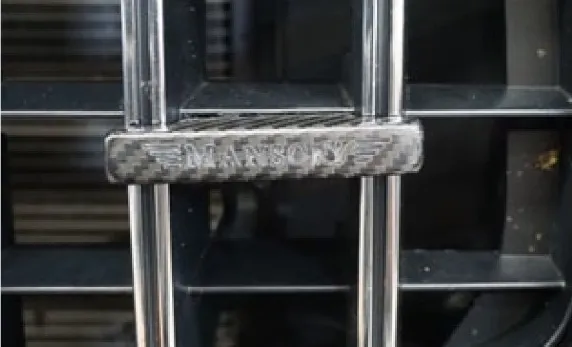
Logo for front grill - illuminated Mansory Carbon for Mercedes G-class G500 / AMG G63 W463A


Logo for front grill - illuminated Mansory Carbon for Mercedes G-class G500 / AMG G63 W463A
The illuminated Mansory front-grill emblem is the after-dark counterpart to the regular carbon badge — same crest, same forged-look weave, with a sealed LED PCB tucked behind a cast translucent rim. It is fitted dead-centre on the upper crossbar of the Mansory performance grill or a compatible OEM W463A grille bar, and earns its place when low-beams come on. Within the wider Mansory Carbon Body Kit for Mercedes G-class W463A G500/G63 programme this part exists for owners who want a recognisable night signature: a brand mark that reads at a glance in valet queues and tunnel exits, without resorting to underbody glow strips.
Night Signature & Light Discipline
The brief was simple: produce a badge that lights up when the car is "in service" — sidelights and low-beams active — and stays dark when parked or running DRLs only in jurisdictions where auxiliary front illumination is restricted in colour and intensity. Most type-approval frameworks allow auxiliary illumination on non-prescribed surfaces (a badge is not a "prescribed lamp" like a headlamp, sidelamp, indicator or fog) provided the colour is white or amber forward, intensity sits below a marker threshold, and the lamp cannot be on while the main lighting circuit is off.
Mansory's solution is a low-flux LED array with photometric output tuned below typical sidelamp candela values. The badge does not "shine" the way a fog lamp shines — it glows. Up close it reads as a crisp white ring tracing the emblem outline; from twenty metres it reads as a brand mark, not a light source. On/off logic runs through a switched accessory tap, so the badge cannot illuminate with the ignition off. No walk-up modes, no ambient pulsing — one state when the car is lit, another when it is not.
LED PCB, Light Pipe & Colour Temperature
Behind the cast emblem rim sits a small rigid PCB carrying surface-mount LEDs around the perimeter, each pointed inward toward a clear acrylic light-pipe diffuser plate. The light-pipe is the crucial bit: without it you would see individual LED hotspots through the translucent rim and the badge would look like a row of dots, not a continuous glow. The diffuser plate captures the LED output, mixes it inside its own thickness through total internal reflection, and emits it evenly along the emblem outline — the smooth, hotspot-free halo the badge is known for.
Colour temperature is set at roughly 5500K — crisp white, slightly cool, the same tone modern Mercedes Multibeam LED headlamps put on the road. Warm-white (2700–3000K) was rejected because it reads "domestic lighting" rather than "automotive", and would clash with the cool headlamp signature when both are on. A 5500K halo matches the headlamps and the LED DRL strip, and the eye reads it as a coherent front-of-car lighting language.
The PCB is conformal-coated and the light-pipe is sealed against the carbon back-plate with a silicone gasket, so moisture cannot get behind the rim. Drainage holes at the lower edge let any internal condensation escape without pooling against the electronics.
Wiring: 12V Tap, Fuse, Switched Accessory
The badge runs on a 12V DC supply at roughly 100mA draw — about 1.2W, less than a single conventional sidelamp bulb. A dedicated fused lead is supplied (typically a 3A inline blade fuse), terminating in a weather-sealed connector that exits the back of the badge through a grommeted hole in the grill bar.
Two integration paths are typical. The first is a positive-running-lights tap: the installer locates the W463A's running-light feed in the front harness, splices in via a Posi-Tap or solder-and-heatshrink, and routes the badge's positive lead through its own inline fuse to that point. Negative goes to a clean chassis ground. The badge then comes on whenever the running lights or low-beams are on, and goes out when they do.
The second path is a manufacturer-fitted switched accessory feed — many W463A cars already have an aux feed in the front bay that is hot only with ignition. The badge ties to that feed and is controlled by ignition state alone. Both paths satisfy the "off when parked" rule. Hard-wiring directly to a permanent battery feed without an ignition-controlled relay is not how the part is meant to be installed.
Compatibility with Mansory & Some OEM Grilles (W463A)
The illuminated emblem is sized to sit on the central crossbar of the Mansory performance grill (as part of the wide front mask, the fully-carbon front mask, or a standalone grill upgrade) and on the central crossbar of compatible OEM W463A grilles where bar dimensions match. Pre-2018 W463 grilles (old box) are not compatible — bar geometry, badge cut-out and harness routing are different and the depth pocket required for the LED PCB does not exist.
The part fits G500, G550, G400d, G350d and AMG G63 (M177 4.0 V8 BT) on the W463A platform identically — no engine-specific variant. LHD and RHD cars are equally served, since the badge sits on the centreline. With-AMG-package and base-trim cars are both fine; the AMG diamond-pin grille has the same central bar profile. W464 / W465 Gronos uses different front-end bodywork — separate part.
Installation, Sealant, Adhesive Cure
Fitment is a controlled-cure operation. The grill bar is degreased with isopropyl alcohol, allowed to flash off, and the badge's mounting studs (or the structural-tape footprint, depending on grill type) are presented to the bar. The wiring lead is fed through the grommeted hole before the badge is seated — fishing it afterwards is fiddly and risks pinching the cable. Studs are torqued to a light specification and the lead is dressed back along the bar with cable clips.
Where the badge sits on a structural-tape footprint, a clamping force is applied with a soft prop for 30–45 minutes to let the adhesive form its initial bond, and the car is left undisturbed for 24 hours before any pressure washing — 15–25 °C is the ideal cure window. Sealant is applied around the perimeter as a moisture barrier and tooled to a clean fillet. The wiring is routed to its tap point and the inline fuse is fitted last, so the circuit is never live during installation. Total fitting time is around 1.5–2 hours for a competent auto-electrician.
Pairing within the Mansory G-class W463A programme
The illuminated emblem is most often specified alongside the non-illuminated logo for grill mask as a like-for-like upgrade — same forged-look outline, same weave, with the night signature added. Customers also pair it with illuminated entrance panels so the lit-emblem night signature continues into the cabin entry — both pieces use the same 5500K colour temperature and switched-accessory logic. And on cars with the fully carbon front mask with performance grill, the illuminated badge is the visual full-stop that finishes the front end at night, sitting against carbon weave that absorbs ambient light and lets the halo do the work.
Long-Term Care, Replacement & PCB Service
Day-to-day care follows the same rules as any carbon-and-acrylic exterior part: pH-neutral shampoo, soft mitt, two-bucket method, no automatic brush wash, no aggressive de-greasers near the perimeter sealant. Wipe the acrylic light-pipe ring with a clean microfibre and a mild plastic-safe cleaner — never solvent, never alcohol on the acrylic, both will craze the lens.
LED life expectancy is quoted at over 50,000 hours of operation, well beyond typical ownership cycles. If a single LED fails the badge will dim slightly but not go fully dark — redundancy is built into the perimeter array. If the whole array fails, the badge has a removable rear cap secured by small fasteners that gives access to the PCB. The PCB is a serviceable item — Mansory supplies replacement boards as a spare; the light-pipe and the carbon shell remain in place.
Type-Approval & Auxiliary Lamp Considerations
This is a fitment-context note, not a geographical one. Type-approval frameworks distinguish between "prescribed lamps" (headlamps, sidelamps, indicators, fogs, reversing, brake/tail/plate lamps) and "auxiliary illumination" on non-prescribed surfaces. The illuminated emblem is the latter. Typical constraints: white or amber colour forward, intensity below a marker threshold, the lamp off whenever main vehicle lighting is off, and no flash, pulse or colour change. The Mansory part is engineered against those constraints — fixed white at ~5500K, low-flux output, ignition/running-lights-controlled, no animation. The part ships with a technical data sheet (voltage, current draw, colour temperature, photometric output) that supports any inspection paperwork.
Lead Time & Warranty
Lead time runs 2–4 weeks from order to despatch. The carbon shell is held in inventory; the LED PCB is built to the same QC standard as larger Mansory illuminated parts and is tested for output, colour and current draw before pairing. Warranty is 12 months against manufacturing defects — LED failure not caused by over-voltage, light-pipe defects, delamination, weave alignment against the drawing. Damage from over-voltage spikes, reverse polarity, or installation that bypasses the supplied inline fuse is not covered.
FAQ
Q: Is the illuminated badge legal for road use under EU and UK type approval?
A: Fitment-context note: most frameworks treat it as auxiliary illumination on a non-prescribed surface, permitted if the colour is white forward, intensity is below a marker threshold, and the lamp is off when main lighting is off. The part is engineered against those constraints. Local rules vary; the data sheet supports paperwork. Not legal advice.
Q: How long do the LEDs last?
A: The array is rated for over 50,000 hours, well beyond typical ownership cycles. Single-LED failure causes a slight dim, not full darkness, due to perimeter redundancy.
Q: How complex is the wiring? Can a body shop fit it?
A: The mechanical fit is body-shop work. The wiring tap is auto-electrician work. A shop without electrical capability should sub-let that step. Total time around 1.5–2 hours.
Q: Is there a colour-temperature option, e.g. warm white or amber?
A: Standard supply is fixed white at approximately 5500K to match modern Mercedes LED headlamps. Other colours are not offered and would not satisfy typical constraints on forward-facing auxiliary illumination.
Q: What happens if the LED fails outside warranty?
A: The badge has a removable rear cap that gives access to a serviceable PCB. Replacement boards are available as a spare part; carbon shell and light-pipe remain in place.
Q: Can the rear cap be removed without taking the badge off the car?
A: Once the grill bar is accessible (bumper or grill removed for service), yes — the cap is secured by small fasteners and the PCB lifts out. With the badge in place on the car, access is not realistic; service is done with the grill on the bench.
Pair with the non-illuminated grill-mask logo or illuminated entrance panels for a coherent night signature. CTA: WhatsApp +44 7488 818 747 or [email protected].