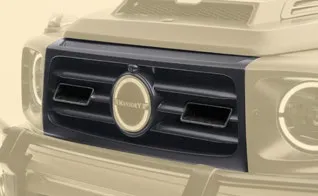
Fully carbon front mask with performance grill Mansory for Mercedes G-class G500 / AMG G63 W463A


Fully carbon front mask with performance grill Mansory for Mercedes G-class G500 / AMG G63 W463A
The fully-carbon front mask with performance grill is a finish-led specification for the standard-track W463A — owners who keep the factory wheel-arch geometry and front-axle width but want the entire front face to read as bare visible weave from any angle. It belongs to the same Mansory programme as the wider widebody kits and bonnets, but its conversation lives at the level of paint chemistry and surface decision rather than aero. See the parent system: Mansory Carbon Body Kit for Mercedes G-class W463A G500/G63. This page covers what "fully carbon" means in finish terms, how the multi-layer clear-coat is built, and why this part is dimensionally distinct from the wide-track variant.
Visible Carbon as a Total Finish
"Fully carbon" on this mask is not a phrase about the substrate — every Mansory front mask in the W463A line is laid up in carbon prepreg. The phrase is about the finish. On a body-colour mask the visible weave is buried under primer, base coat and flow-coat acrylic, so the carbon reads as a textured shadow under paint. On the fully-carbon variant the weave stays at the surface. The 3K twill is laid with cell alignment matched left-to-right across the bonnet shut-line, the centre rib, the brow above the grill, and the lower air-dam mouth. No painted sections, no two-tone breaks, no body-colour overlay around the headlight cut-outs. The whole mask is one continuous visible weave under transparent UV lacquer. A painted mask reads as colour first, surface second; this one reads as material first, geometry second.
- Substrate: 3K twill carbon prepreg, autoclave-cured at 120°C / 6 bar over high-density foam core
- Wall thickness: 2.6–3.2 mm across the mask shell, 4.0 mm through the grill mounting flanges
- Weight: approx. 8.4 kg complete (mask + grill insert + hardware), versus ~13.2 kg for the OEM plastic-and-metal assembly
- Finish: full visible 3K twill, no paint, no body-colour overlay anywhere on the visible face
- Clear coat: multi-layer 2K acrylic-urethane with HALS UV stabiliser, total film build 110–140 microns
- Hardware: stainless OEM-spec bolts, M6 captive nuts moulded into the carbon flanges, sensor harness retained
- Grill: performance grill insert with widened cell pitch, integrated into the same fully-carbon shell
- Camera bezel: factory front-camera aperture preserved, parking-sensor cut-outs match OEM dimensions
Multi-Layer Clear-Coat Schedule
A fully-visible carbon panel lives or dies on its lacquer schedule. The Mansory mask is sprayed in a controlled-humidity booth in three distinct passes. The first pass is a tie-coat — a thin, slightly-flexible 2K isocyanate primer that bonds chemically to the cured epoxy of the prepreg. Without this layer the topcoat eventually delaminates at the weave peaks. The second pass is build-coat — two medium-wet 2K acrylic layers laid wet-on-wet, sanded back at 800-1500 grit between flash cycles, brought up to a flat plane that erases the weave's high points without burying its visual depth. The third pass is the show-coat — a UV-stabilised acrylic-urethane with HALS (hindered amine light stabiliser) loaded into the binder, polished from 2000 grit to compound to fine swirl-remover. Total film build: 110–140 microns. A thin single-coat lacquer crazes in 18–24 months under hot sun; a poorly-stabilised one yellows visibly within five years. The Mansory schedule is engineered against both failure modes.
Standard-Track Fitment (Not Widebody)
This is the line that gets confused most often. There are two front masks in the Mansory W463A programme. The "wide front mask with performance grill" is dimensionally wider — it ships only with the widebody kit, because it has to bridge to flared front fenders that sit roughly 30 mm proud of the OEM wheel-arch on each side. This fully-carbon mask is the standard-track version. Its outer flank lines match the OEM front-fender shut-line of an unflared G500 or G63 exactly. Fit this mask to a widebody car and you see a step at the fender shut-line; fit the wide mask to a standard-track car and you see a hanging lip with no fender behind it. They are not interchangeable. Confirm before order whether your car runs the widebody kit; if yes, specify the wide variant. The grill cell pattern is identical between the two — only the outer envelope changes.
Performance Grill Behaviour at Speed
The performance grill insert uses a wider cell pitch than OEM — open area increases by roughly 18%. On the M177 4.0 V8 BT in the G63 that translates to lower charge-air-cooler inlet temperatures during sustained 160+ km/h running and on autobahn-style high-load cycles. On the G500's M176 the gain is smaller in absolute terms but still shows up at the IAT sensor under sustained climbs. The grill is structural carbon, not mesh-on-frame, so it adds no slap or buzz at speed. Cosmetically the wider cell pitch reads as more aggressive than the OEM tight-mesh look — from three metres the grill almost disappears into the mask; from a metre the open cells read clearly. The chrome Mansory wordmark sits centred on the upper rib and is the only painted element on the assembly.
Hardware, Sensor Cutouts & Camera Bezel
The mask carries the full OEM sensor population: four front parking sensors (PDC), the driver-assist radar aperture behind the centre lower section, the front 360°-camera bezel above the grill, and the headlight-washer cut-outs (where fitted). All sensor pockets are moulded — not cut after the fact — so dimensional accuracy holds within ±0.5 mm of the factory plastic mask. PDC sensors push through their pockets with the OEM rubber gasket and snap into the carbon flange exactly as on the original assembly. The radar aperture is closed by a moulded-in radome of low-loss polymer, the same material the factory uses; this matters because raw carbon is RF-opaque and would block the radar return. Mounting hardware: stainless M6 OEM-spec bolts, captive M6 nuts moulded into reinforced flanges at the eight chassis attachment points plus two upper bonnet-shut anchors. The harness route for parking sensors and camera is the OEM loom — no re-pinning, no splicing.
Installation, Bumper-Bar Re-Index
Fitment is a body-shop job, six to eight hours including bumper bar re-index. The OEM mask comes off in three stages: lower air-dam fasteners (eight T30), wheel-arch liner clips (six per side), upper grill cross-brace (four T40). With the OEM mask removed the steel bumper bar behind it stays in place — the carbon mask bolts to the same eight chassis points, but because the carbon shell is dimensionally slightly tighter to the bar than the factory plastic, the bar usually needs a 1–2 mm re-index on its left-right shim stack to centre the mask on the body. A trained installer does this by feel during dry-fit; an inexperienced fitter leaves the mask sitting 2 mm off-centre. After bolt-up, the front-camera and PDC sensors transfer across (gaskets re-used). Headlight aim is unaffected — the lamps remain in the OEM body, not in the mask. Final torque on the chassis bolts is 12 Nm. Fully reversible.
Pairing within the Mansory G-class W463A programme
Cross-link to siblings that hold the same standard-track, fully-visible-carbon language: Wide front mask with performance grill for owners who are running the widebody kit and need the dimensionally wider envelope; Fully-carbon front mask with standard grill for owners who want the visible-weave finish without the wider-pitch performance grill cells; and Carbon headlight covers to extend the visible weave from the mask centre out into the lamp surrounds, holding the optical language across the whole front face.
Long-Term UV Behaviour & Restoration
Visible-carbon panels are a long-term commitment. The Mansory clear-coat schedule, with HALS-loaded acrylic-urethane, is engineered for a five-year visual life under heavy sun before any service is needed. After year five the typical signs are subtle — a slight warming of the weave tone (cool blue-grey drifting toward neutral) and a softening of the highest gloss peaks. Both are recoverable: the mask can be cut back at 2000–3000 grit, polished and re-lacquered without removing it from the car, by any body shop competent with two-pack acrylic systems. What kills these panels prematurely is the wrong cleaning chemistry — strong alkaline degreasers, ammonia-based glass cleaners contacting the lacquer, abrasive sponges. Wash with pH-neutral shampoo, rinse, dry with clean microfibre. Wax: a soft carnauba every three months, or an annual ceramic-coat top-up for a longer service interval.
Lead Time & Warranty
Lead time is three to five weeks from order — the mask is not held in stock as a finished assembly because the lacquer schedule is built fresh per order to keep the show-coat at full UV potential. The performance grill is integrated into the build, not a bolt-on accessory. Warranty: 12 months against manufacturing defects (delamination of the carbon shell, voids in the laminate, dimensional fitment issues at chassis attachment points, lacquer adhesion failure within the warranty window). UV ageing in normal service is not a defect — it is a maintenance item, addressed through the cut-and-re-lacquer process above. Stone-chip damage, kerb impact and hand-tool damage during fitment are out of warranty.
FAQ
Q: Will the clear-coat yellow visibly within five years?
A: Not under the Mansory schedule. The HALS-stabilised acrylic-urethane is engineered for a five-year visual life under heavy sun. Cheaper single-stage aftermarket lacquers yellow inside two to three years — this build is not in that category. After year five a light cut-and-polish refreshes the surface; year eight to ten a full re-lacquer is sensible.
Q: Can the mask be repainted body colour later?
A: Yes. Sand the lacquer back to a flat plane at 600 grit, scuff, prime, base, flow-coat. Once painted the visible weave is buried and the conversion is functionally one-way — returning to visible carbon means stripping all the paint back to substrate. Be sure of the colour decision before committing.
Q: Weight delta versus the OEM bumper assembly?
A: Roughly 4.8 kg saved at the front overhang. OEM mask + grill + brackets weighs about 13.2 kg; the carbon mask with integrated performance grill is about 8.4 kg. The saving sits ahead of the front axle so the steering feels marginally lighter at parking speeds.
Q: How accurate are the sensor cut-outs and camera bezel?
A: Tolerance is ±0.5 mm on the moulded sensor pockets and camera aperture. PDC sensors snap home through their OEM rubber gaskets with no force; the camera bezel accepts the OEM module with no shimming. The radar aperture is closed by a moulded-in low-loss radome so front-radar driver-assist remains unaffected.
Pair with a fully-carbon bonnet and visible-weave headlight covers to lock the front face into one optical language. To confirm standard-track vs widebody before order: WhatsApp +44 7488 818 747 or [email protected].