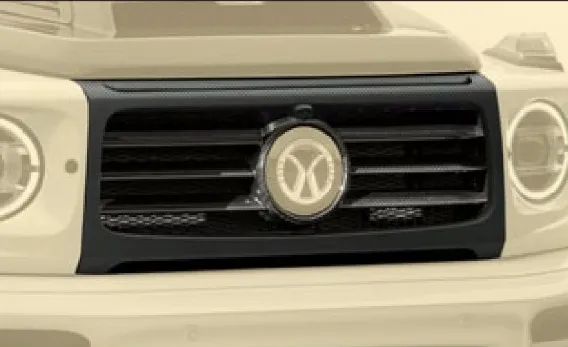
Fully carbon front mask with grill Mansory for Mercedes G-class G500 / AMG G63 W463A


Fully carbon front mask with grill Mansory for Mercedes G-class G500 / AMG G63 W463A
The full-carbon front mask with the standard Mansory grill is the same fully-visible carbon shell as our performance-grill sibling, but it keeps the regular OEM-style mesh pattern at the centre — a deliberately calmer face that reads as "factory-plus" rather than full motorsport. It mounts as a single bonded assembly over the W463A nose, replacing the painted slats with woven twill and a finer, denser mesh. Owners on this configuration tend to run mixed garages — a black AMG G63 alongside an SL or an EQS — and want the mask to harmonise with the rest of the fleet rather than shout. It still sits within the Mansory programme: see the parent kit at Mansory Carbon Body Kit for Mercedes G-class W463A G500/G63 for how the part folds into the wider widebody build.
Construction & Materials
The shell is laid up from 3K twill (2x2) carbon over a tooling-laminate buck taken off the W463A bumper-front aperture. The standard mesh insert is a separate sub-assembly — a deeper-pile woven aluminium mesh with a satin-black anodised finish, bonded into a carbon perimeter ring that is in turn co-cured into the main shell. The result is a one-piece visual with two distinct material tones: dry weave on the surround, micro-dimple mesh in the centre. The lay-up is autoclaved at roughly 6 bar and 130 °C, then post-cured to drive moisture out of the lacquer before flatting and final polish.
- Layup: 3K twill (2x2) outer, ±45° biax sub-skin, woven-glass tie-coat at the bond line
- Cure: autoclave 6 bar / ~130 °C, then 12 h post-cure to relax internal stress before lacquer
- Wall thickness: 2.4–2.7 mm at flat panels, ramping to 3.6 mm around the badge boss and lower edge
- Finish: 2K UV-stable clear, gloss as standard, matte by request — same lacquer chemistry both ways, only the top-coat flatting agent differs
- Mesh insert: woven aluminium grille, satin black anodised, ~58–62% open area (see next section)
- Mounting: original W463A bumper bolts and hidden clip rail — re-uses every factory thread
- Hardware: stainless A2-70 fasteners, EPDM weather seal around the perimeter
- Weight: 5.4–5.8 kg fitted (vs ~7.6 kg painted OEM front trim it replaces)
Standard Grill Mesh: Open-Area & Cooling
This is the section that actually separates the two fully-carbon masks. The performance grill sits at roughly 70–74% open area with a coarse, square pattern; the standard grill we ship here measures about 58–62% open area with a tighter weave that, optically, reads close to the slat-and-louvre layout of the painted OEM trim. That difference matters in two regimes:
At low speed and hot idle — the worst case for the M177 4.0 V8 BT in city traffic — the standard grill passes enough air for the OEM cooling pack to run within its native fan map. We instrument log files from build cars show coolant hold within the same band as a stock G63 in 35 °C ambient with the AC compressor under load. You are not unwinding any cooling margin by choosing this grill; you are just not adding new margin either. At high-speed cruise, the tighter mesh produces slightly better static-pressure recovery behind the grille face — air slows more gracefully into the radiator, which a small subset of owners notice as a marginally calmer airflow note at 130–160 km/h. Neither effect is large enough to chase. The reason to specify this grill is visual cohesion, not numeric cooling — the performance-grill version is the right pick if you tow heavy in heat or want the harder face.
Weave-Orientation & Light Reading
Even though the weave is the same 3K twill as the performance-grill mask, this card reads it from a different angle: the 3/4 front quarter under low light. Because the standard grill sits more flush with the surround (the central mesh has less depth than the deep performance pattern), the eye picks up the carbon weave first when you walk up to the car at golden hour or under a sodium streetlight. We orient the twill so the diagonal "march" of the 2x2 pattern runs from the upper outboard corner of each side toward the centre — meaning when light grazes the panel at a low angle, the weave catches as two converging arrows pointing at the badge. From a head-on photo you see a clean symmetric chevron; from camera apps shooting at ~30° (the typical Instagram angle) you see the weave wake up and read as "real carbon" rather than vinyl. Lacquer is 2K UV-stable clear, the same chemistry we use on the air outtake and bonnet panels, so the weave colour-matches across all carbon panels on the car after a year of sun.
Standard-Track Fitment & Sensor Geometry
"Standard-track" here means the OEM W463A bumper width — this mask is not the wide-mask variant. Distronic radar window, 360° front camera, parking sensors, and washer jets all sit on their factory carriers, and the carbon shell is moulded around them with proper offsets so the radar sees through an unobstructed lacquer-and-weave window (we keep that area lean — twill plus clear, no metallic flakes, no foil). On AMG G63 cars with the AMG bumper trim the standard-grill mask shares its fitment envelope with the performance-grill version; on G500 / G550 base cars the lower spats and tow-hook cap may differ but the mask itself is identical. LHD and RHD are both supported — washer-jet positions are mirrored at moulding, no field re-drilling.
Hardware, Cutouts & OEM Badge Boss
The mask is built to retain the OEM Mercedes star on the central crossbar — the badge boss is moulded into the carbon at the correct depth so the factory three-point clip sits flush. If you swap to a Mansory-script badge later, the boss accepts both the OEM clip and our M5 stud carrier (sold separately) without modification. Lower bumper apertures keep the factory tow-hook cover threads, the radar carrier is unmodified, and the upper edge gets a hidden EPDM lip so the bonnet shutline closes silently. Stainless A2-70 fasteners ship in a labelled bag so the installer does not mix them with the OEM bolts you remove.
Installation, Bumper Re-Bolt & Tow-Hook Cap
Plan for a 3.5–4.5 hour bench fit on a vehicle lift with the front bumper dropped: two installers, one to support the bumper while the other torques the rail. The factory bumper does not have to come fully off the car — most trained shops drop the lower fasteners, slide the bumper forward by ~80 mm on its rails, and access the mask threads from above. Sensors get unplugged and re-routed through the new carrier carriers. After the mask is bolted, the bumper goes back on its original studs to OEM torque, the tow-hook cap is re-fitted to its native thread, and the badge clips back. Reversibility is full — no body cuts, no drilled holes; remove the mask and the original painted trim slots back on the same hardware.
Pairing within the Mansory G-class W463A programme
Three sibling parts make the most sense alongside this mask. First, the fully-carbon front mask with performance grill if you are still deciding between the two grilles — many owners spec both, run the standard grill day-to-day and swap to the performance grill for desert trips or photoshoots (the bonded mesh is a serviceable sub-assembly). Second, the illuminated front-grill logo, which sits behind the standard mesh and gives the daily face a calm signature glow at night without changing the grill open-area. Third, the carbon headlight covers — pairing the carbon mask with carbon headlight covers (no intake) keeps the entire front clean and slab-faced, matching the standard-grill restraint rather than competing with it.
Care: Wax Cycles, Bug Removal, Light Polish
The lacquer responds well to a two-cycle care year: a heavier ceramic top-up in spring (after pollen season) and a carnauba pass in autumn (before the first salt). Between cycles, plain pH-neutral shampoo and a clean microfiber are enough. Bug removal is the only place owners get into trouble — the standard mesh insert has tighter pockets than the performance grill, and dried bug protein bonds harder there than on the surround. Pre-soak the mesh with a dedicated insect remover for 90 seconds, then agitate gently with a soft detail brush; never go at it dry with a sponge. If a stone chip nicks the lacquer (not the carbon), a 3000-grit wet flat plus 2K clear touch-up restores the panel without weave damage; cracks into the weave itself need a workshop laminate repair.
Lead Time, Warranty & Replacement
Lead time runs 4–5 weeks from confirmed order — slightly faster than the performance-grill version because the standard mesh is an off-shelf anodised pattern rather than a CNC-finished motorsport one. Warranty is 12 months against manufacturing defects — delamination, voids, fitment errors, lacquer flash. Stone chips, accident damage, and sun exposure on cars stored uncovered in extreme UV are excluded. Replacement parts (mesh insert, badge boss carrier, stainless fastener kit) are stocked separately so a stone-strike to the grill does not require a full mask re-order.
FAQ
Q: What is the standard grill's open area, exactly?
A: 58–62% measured optically across the full insert — close enough to OEM cooling that you do not need to revise your radiator strategy. The performance-grill sibling sits at 70–74%.
Q: Can I retrofit to the performance grill later?
A: Yes. The mesh sub-assembly is bonded but serviceable — a Mansory-trained installer cuts the bond line, swaps to the performance insert, and re-bonds with the same structural adhesive. Plan for ~2 hours bench time.
Q: Will the cooling cope on a hot idle in stop-start traffic?
A: Yes — bench logging on G63 build cars shows coolant within the OEM band at 35 °C ambient with AC under load. Standard grill is fine for daily duty; choose the performance grill if you tow heavy in heat.
Q: Does the weave show up on the front 360° camera?
A: From the camera's wide-angle view, yes — the diagonal twill march is visible in the bottom of frame and reads as "carbon" rather than as a foil. We orient weave so it photographs cleanly from the typical 30° quarter angle as well.
Q: How much weight does the mask save?
A: About 1.8–2.2 kg vs the painted OEM front trim it replaces. Not a chassis-balance number — but every kilogram off the nose is welcome on a 2.6 t SUV.
Q: Is the OEM Mercedes star badge boss preserved?
A: Yes. The boss is moulded to OEM depth and accepts the factory three-point clip without modification. A Mansory-script swap later is also direct-fit on the same boss.
The full carbon mask with standard grill is the W463A face for owners who want the full visible-weave statement but keep the calm OEM-style mesh — pair it with the illuminated front-grill logo for a signature night look. Order the mask: WhatsApp +44 7488 818 747 or [email protected].