
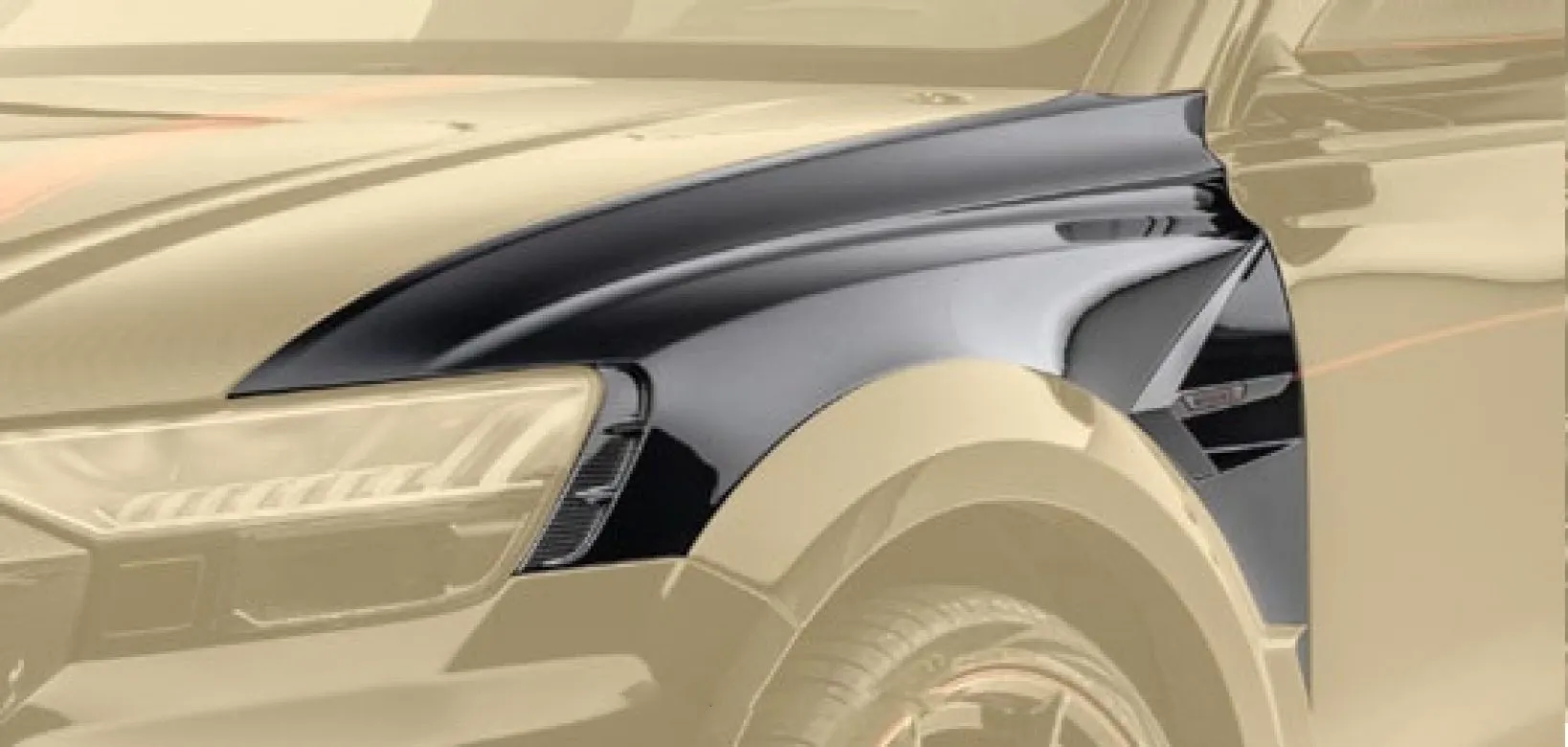
Front fenders with logo Mansory style Carbon for Audi RS Q8


Front Fenders with Logo Mansory Style Carbon for Audi RS Q8
The Mansory-style front fenders for the Audi RS Q8 (4M chassis) are the visual cornerstone of the entire wide-body conversion — without them, every other panel reads as bolt-on. This pair, laid in full prepreg carbon to the same geometry as the genuine Mansory fender, widens each front arch by roughly thirty to fifty millimetres at the wheel-arch crown, opening clearance for deeper-offset 22- and 23-inch wheels and re-cutting the sidewall airflow path that feeds the V8 biturbo's side-mounted intercoolers behind the fender liner. Position this part within the larger Mansory Carbon Fiber Body kit set for Audi RS Q8: the embossed Mansory wing logo at the upper rear corner of each fender is the line's signature, and once these panels are mounted the bonnet, mirror caps and bumper covers all align to a coherent silhouette. The RS Q8 leaves Ingolstadt as a 2,315 kg performance SUV-coupe with a four-litre TFSI biturbo V8, 48-volt mild hybrid, quattro all-wheel drive and air suspension; the Mansory-style fender preserves every one of those systems while replacing OEM stamped steel with autoclave-cured prepreg carbon at a sharper price point than the genuine Mansory factory part.
Construction & Materials
Each fender is a single-piece prepreg carbon shell over a structural inner frame. The visible side is laid in 3K twill at 200 g/m² weave with a controlled bias so that the diagonal pattern flows continuously across the arch crown and into the door shut-line. The inner structure uses a heavier 6K satin layer for stiffness, with localised reinforcement around the OEM marker-light cut-out, the wheel-liner attachment lugs, the side-repeater housing and the front-door shut-line edge. Cure happens in a heated autoclave at 1.6 bar with a programmed ramp profile that keeps resin viscosity under control across the deeper draw of the widened arch. Surface finish is a high-build clear lacquer over UV-stable epoxy, hand-flatted and machine-polished to the same depth of gloss as the rest of the carbon programme.
- Weave: 3K twill outer, 6K satin structural inner, ~0.40 mm shell weave layer.
- Cure: autoclave 1.6 bar with ramped profile, post-cure tempering for dimensional stability.
- Wall thickness: 2.4–3.2 mm across the panel, locally to 4.5 mm at mounting bosses.
- Pair weight: ~6.4 kg (vs. ~9.1 kg for the OEM stamped-steel fenders) — net unsprung-adjacent saving on the front axle.
- Mounting: OEM Audi bolt pattern retained at six points per side; supplied with stainless fasteners and butyl edge gasket.
- Logo: embossed Mansory wing crest at the upper rear corner, lacquered flush, no separate badge to peel.
- Apertures: pre-cut for OEM marker light, side repeater, wheel-liner clips, fender-skirt attachment.
- Finish: gloss clear lacquer standard; matte 2K and satin available on request.
Design & Visual Function
The Audi RS Q8 in OEM trim already wears assertive arch flares, but the Mansory-style fender pushes the visual width by another inch per side — enough to make a 23-inch wheel with negative offset look planted rather than tucked. The widening is not a flat box; it follows the arch crown in a continuous curve that re-enters the door shut-line cleanly, so the eye reads a single sculpted volume rather than a bolt-on lip. The replica geometry is sampled directly from the genuine Mansory fender: same arc, same vertical drop at the lower edge, same shoulder line, same recess for the marker light and side repeater. Visual parity at three metres is indistinguishable.
Under-skin, the widened arch is more than a styling exercise. The RS Q8's V8 biturbo lives between two side-mounted intercoolers; cooling air enters through the bumper cheeks, washes across the cooler cores and exits via the wheel-arch liner. A wider arch creates a calmer low-pressure zone in front of the wheel, reducing the back-pressure that builds against the intercooler exit on a hard pull. The Mansory-style fender replicates the genuine geometry of this exit path — the inner liner sits at the same depth, the lower trailing edge clears the same wheel-well stone shield, and the upper crown follows the same chord. Heat extraction at sustained 250 km/h cruising is unchanged from the genuine part.
The embossed Mansory wing logo sits high on the rear edge of each fender, just ahead of the door cut-line, where it catches reflected light from the quattro arch shadow. The crest is sculpted into the carbon shell, lacquered under the same clear coat as the surrounding weave, and reads the same regardless of the body colour underneath.
Compatibility & Fitment
Audi RS Q8 (4M chassis, MY 2020+). Pre-facelift cars from 2020-2023 and the facelift Performance from 2024 onward use the same fender bolt pattern and shut-line geometry, so a single fender pair fits both. The Performance facelift brought a revised front bumper but did not alter the fender mounting points or the marker-light cut-out, so the Mansory-style pair drops onto either generation without modification. OEM Audi components retained: front side markers, side repeater LEDs, wheel-liner with sound deadening, headlight washer feed (where fitted), fender liner clips, drive-mode air-suspension level sensor harness routing along the inner fender. The fender accepts the OEM 22-inch wheel range and clears 23-inch wheels with up to 305-section tyres on negative-offset rims; verify wheel offset and tyre profile against arch clearance with the air suspension at lift-stop position before final torque.
Installation & Reversibility
Removing the OEM steel fenders on an RS Q8 requires lifting the bonnet, releasing the front bumper end-cap clips, peeling the inner wheel-liner forward, and undoing the six fender bolts per side along with two hidden fasteners under the A-pillar trim. Allow three to four hours per pair for a competent body shop, plus an additional two hours for paint match if you want a body-colour stripe along the arch lip. The Mansory-style fenders use the OEM bolt pattern exactly, so no drilling, no body-mods. Carbon panels are supplied in clear-lacquered prepreg; if you want body-colour blending under the lacquer, send the pair to your installer's paint booth before fitment. Reversibility is full — the OEM steel fenders bolt straight back on if you ever revert. We strongly recommend a certified body shop for this fitment because the front bumper end-caps must be reseated against the new fender shoulder, and shut-line gap to the front door has to be set with the door already on its hinges. Use the air-suspension lift mode for under-arch access during installation; do not jack the vehicle on the rocker pinch-welds with the bumper detached.
Pairing within the Mansory RS Q8 programme
Within the Mansory-style line, this fender pair is a logical match with the front bonnet Mansory style carbon for Audi RS Q8 — the bonnet's outer edge meets the fender crown, and only the matching pair gives a clean weave-to-weave transition at the shut-line. For visual sidewall continuity, pair with the mirror housing Mansory style carbon for Audi RS Q8, which carries the same 3K twill weave at the same lacquer depth and aligns the carbon language across the side profile. If you are committing to the full conversion, the body kit Mansory style carbon for Audi RS Q8 bundles the bumpers, splitters, diffuser and skirts that complete the wide-body silhouette these fenders open up. Mixing genuine Mansory carbon parts with style replicas is technically possible but visually risky — keep the section consistent for a coherent panel-to-panel read.
Maintenance & Durability
Lacquered carbon on the front fenders sees more abuse than any other panel on the car: stone chips from the front wheels, road salt thrown by the leading axle, brake-dust drift from the front calipers. Treat the lacquer with a UV-stable ceramic coating within the first month of fitment; an SiO₂-based two-year coating is the right specification. Avoid alkaline wheel cleaners migrating onto the fender lower edge — they soften clear lacquer and lift the resin substrate. Avoid ammonia-based glass cleaners drifting onto the painted edge during routine washes. Bird-strike damage and small chips at the leading edge of the arch are repairable with a graded sand-and-respray of the affected zone; do not let chips propagate before treatment, because moisture migration into the resin layer will lift larger lacquer islands later. Carnauba wax is fine for occasional use over a ceramic, but a hard ceramic remains the long-term protective layer. Expect a properly maintained lacquered fender to hold its gloss depth for seven to ten years; matte 2K finishes need a different chemistry — never apply gloss-restorer products to a matte panel.
Lead Time & Warranty
Lead time is four to seven weeks from order to dispatch, depending on production queue and finish specification. Custom matte 2K, satin, or body-colour-blended lacquer adds one to two weeks. Each pair ships with a fitment guide, hardware kit, and a serial-numbered card. Twelve-month warranty against manufacturing defects: lacquer micro-cracking, resin print-through, weave delamination, mounting-boss failure under correct torque. Stone-chip damage and impact failure are not covered; both are repairable through the body-shop network. Customer-side returns require panels in unfitted, unpainted condition.
FAQ
Q: How much wider is the front track once these fenders are fitted?
A: The fenders themselves do not alter track width — the OEM hubs, control arms and ride height are unchanged. What they do is open arch clearance by 30–50 mm per side, allowing wider rims with more aggressive offset. If you fit OEM-spec wheels, visual width grows but mechanical track stays the same.
Q: Are these the same as the genuine Mansory carbon fenders?
A: Geometry, fitment and visual signature are matched. Material is full prepreg carbon, autoclave cured. The difference is the production line: these are made on the hodoor production line to the same drawings, at a lower price point than the genuine Mansory factory parts. From three metres they are indistinguishable.
Q: Will the OEM side markers and repeaters still work?
A: Yes. The fender shells are pre-cut for the OEM marker light and the side repeater LED housing, and the inner harness routing is preserved. Plug-and-play, no rewiring.
Q: Can I have the embossed logo painted body-colour instead of carbon?
A: The crest is sculpted into the carbon and sits under the lacquer, so a body-colour fill is feasible at order time as a custom-paint option. Once lacquered standard, the logo cannot be painted over without removing and re-lacquering the entire panel.
Q: Do the fenders fit both pre-facelift and the Performance facelift?
A: Yes. Audi did not change the fender bolt pattern or the marker-light cut-out for the 2024 Performance facelift, so a single fender pair fits both generations. Bumper geometry differs between the two, but that affects the front bumper, not the fender pair.
Specify the front fenders Mansory style alongside the matching Mansory-style bonnet, mirror housings and front bumper for the cleanest panel-to-panel weave continuity across the front quarter. Reach us on WhatsApp +44 7488 818 747 or [email protected] for finish options, paint-blend pricing, and current production lead times.