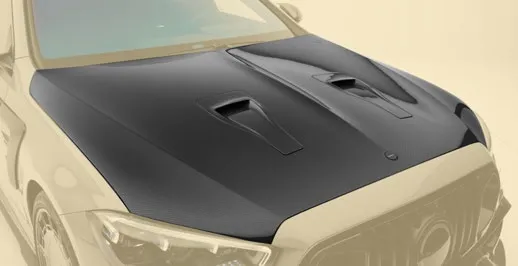
Front bonnet Mansory for Mercedes-AMG S63E


Mansory Front Bonnet for Mercedes-AMG S63E
Few components on a flagship long-wheelbase AMG saloon shift the visual register as decisively as a full-replacement front bonnet, and the Mansory front bonnet for the S 63 E PERFORMANCE pulls double duty: it lowers the closing weight of the front clamshell by several kilograms, and it carves an exhaust path for the considerable thermal load the AMG biturbo V8 + 13.1 kWh HV battery + auxiliary radiator stack produces beneath it. The OEM AMG bonnet is already an aluminium pressing — it is light, but it is sealed across the upper plane and it lets engine-bay heat soak rather than vent. The Mansory item replaces the entire panel with a structural carbon clamshell that is hinged on the OEM points, latches on the OEM lock, and seals against the OEM bulkhead and front-fender shut-lines. It is a centrepiece of the parent Mansory Carbon Fiber Body kit set for Mercedes-AMG S63E.
Construction & Materials
The bonnet is a structural-grade carbon part: outer cosmetic skin, structural inner skeleton, and a co-bonded reinforcement frame that follows the OEM stamped-aluminium load path. The vent channels are formed in the layup rather than cut into a finished panel.
- 3K 2×2 twill A-side cosmetic skin (forged-look option, 2K plain weave option)
- Inner structural frame in unidirectional carbon ribbed lattice, co-bonded to the outer skin
- Pre-preg autoclave cure at 130–140 °C, multi-axial fibre orientation in the hinge zones
- Wall thickness 2.4–3.2 mm in the show face, 5–7 mm at the hinge brackets and lock catch
- Net dry weight roughly 7.5–9.0 kg (vs ~12–14 kg for the OEM aluminium pressing)
- OEM-style hinge bracket inserts in stainless, lock catch reused from the donor car
- UV-stable 2K clear lacquer (gloss / satin / matte / forged-look raw)
- Substrate prep on hinge flange: solvent wipe, 3M Cleaner-Primer 94, masked masked low-tack
Design & Visual Function
Heat under the bonnet of an AMG V8 + HV battery saloon does not come from a single source — the OEM cooling pack rejects radiator heat forward, the V8 itself radiates upward off the rocker covers, and the HV battery's low-temperature loop has its own coolant flow that adds to engine-bay air temperature on long runs. A solid bonnet retains all of that under the panel, which raises intake-air temperature on subsequent throttle events. The Mansory bonnet's vent geometry creates a top-of-bay extraction path: hot-air column rises through the engine bay, finds the lowered-pressure zone above the bonnet at speed, and exits without re-circulating. The practical benefit on a sustained autobahn run or on a hot-day track day is a more stable intake temperature and a less heat-soaked under-hood environment for the auxiliary electronics.
Visually, the bonnet is the longest single carbon plane on the car. The 3K twill is biased forward so the diagonals draw the eye toward the AMG vertical-bar grille, and the vent geometry is set with negative-rake inlets so the eye reads the vents as part of the panel rather than as added scoops. The sculpted upper crown is co-cured with the panel to keep the surface continuous from the windscreen base to the leading edge, which is something a glued-on scoop conversion cannot achieve.
For AMG Night Package cars, a satin lacquer disappears the bonnet into the blacked-out trim. For AMG Carbon Package cars whose original spec included exposed-carbon roof and rear-quarter trim, the same forged-look or satin finish is available so the carbon palette stays coordinated.
Compatibility & Fitment
Engineered for the Mercedes-AMG S 63 E PERFORMANCE (W223), 2023+, saloon. Hinges are the OEM AMG points; the bonnet latch reuses the OEM lock and safety catch. The fender shut-line and bulkhead seal are matched to the OEM AMG fascia so panel-gap variance is within ±0.5 mm against neighbouring body panels. AMG Night Package and AMG Carbon Package cars are supported. The bonnet does not require modification of the OEM washer-jet nozzles or the under-hood insulation — both transfer from the donor panel during install. AIRMATIC ride height is irrelevant since the part is upper-body. The OEM under-hood acoustic foam is reused; if the foam is degraded or missing the Mansory part will perform its thermal task but cabin NVH will be marginally noisier than OEM.
Installation & Reversibility
Plan 90–150 minutes with two technicians on a workshop bench plus the car. Required tools: trim picks for under-hood foam transfer, Torx and 8/10 mm sockets for hinge bolts, alignment gauge or panel-gap feeler set, lock-pin punch, isopropyl alcohol, 3M Primer 94. Workflow: support the existing OEM bonnet on a transit cart, transfer washer hose and under-hood foam, swap hinge bolts to the carbon panel on the bench, refit to OEM hinges, set panel gap with shimmed hinge bolts, set lock height with the OEM safety catch threaded stem. Reversibility is full — no chassis modification is performed and the OEM bonnet can be reinstalled at any time. The hinge bolts are reusable; if a torque-to-yield is specified by service literature, replace those at refit.
Pairing within the Mansory Mercedes-AMG S63E programme
The bonnet is most often combined with the Engine cover so the underside of the open-bonnet view shows a coordinated carbon plane, with the Engine bonnet emblem for the AMG-style centre badge, and with the Sport outtake for front fender to coordinate the upper and side hot-air exit paths.
Maintenance & Durability
The bonnet is the largest UV target on the front of the car and the panel that sees the most stone-strike. Hand wash only with pH-neutral shampoo and the two-bucket method. Avoid alkaline pre-wash dwell longer than 60 seconds — the long, flat carbon plane will haze visibly along its length within a few seasons if alkaline chemistry is used routinely. Wax routine: a soft carnauba twice a year for natural depth, a ceramic spray sealant every wash if the car lives outside, or a paint-protection film over the leading 30 cm if track days are anticipated. Stone chips along the leading edge should be sealed with clear UV epoxy within seven days. Keep ammonia glass cleaners off the carbon — they will dull the lacquer over months. The under-hood face of the bonnet sees direct heat from the V8 valve covers; the elevated-Tg layup is rated for it but a yearly inspection of the inner foam-pad bond is recommended for cars driven hard. Expected cosmetic-finish lifespan is 8–12 years if waxed and garaged.
Lead Time & Warranty
Lead time is 4–6 weeks. The bonnet is one of the longer-format pieces in the kit, and the dimensional-stability bake cycle is longer than for trim parts. Custom finishes (matte, satin, forged-look) add roughly one week. Warranty: 12 months against manufacturing defects — delamination, voids, fitment, clear blistering, hinge-bracket bond — counted from delivery. Damage from impact (hail, stone strike, frontal collision) and chip propagation are not covered. Each bonnet ships in a custom plywood crate with internal foam blocks under the hinge brackets and the lock catch, and a separate sealed bag carries the OEM-pattern stainless inserts and the QC inspection sheet.
FAQ
Q: How much weight is saved versus the OEM AMG aluminium bonnet?
A: Roughly 4–6 kg net — the carbon item is 7.5–9.0 kg dry; the OEM bonnet is 12–14 kg.
Q: Will the OEM safety catch and bonnet lock continue to work?
A: Yes. The Mansory bonnet uses the OEM lock and OEM safety catch. The mounting points for both are co-bonded into the carbon during cure.
Q: Does the panel disturb the AMG biturbo V8 thermal calibration?
A: No — the OEM ECU has no closed-loop awareness of bonnet venting. The benefit shows up as more stable intake-air temperature on sustained loads, which is felt by the driver as more consistent on-throttle response after a long pull.
Q: Is the panel painted from the factory or supplied raw?
A: Standard supply is in 2K UV-stable clear lacquer over the visible carbon. Owners who want body-colour paint can specify a primer-finish version that the local body shop can paint to PPG/Standox match.
Q: What about under-hood acoustic foam and washer hose?
A: Both transfer from the OEM bonnet during install. The Mansory panel is supplied with the bond pads in place; the foam transfers with its OEM clips reused.
Q: Does swapping the bonnet affect the front-end crash structure?
A: No. The crash structure is in the front longitudinals and the bumper-skeleton tray below — the bonnet itself is a hinged closure panel and does not carry crash load on the W223 platform.
Q: Will hail damage the panel more than the OEM aluminium bonnet?
A: Carbon and aluminium respond differently to hail. Aluminium dents and stays dented; carbon either survives intact or, beyond a threshold, develops a delamination that is visible from the underside. In practice the carbon panel is at least as hail-resistant as the OEM item for typical hail-stone sizes.
Pair the bonnet with the engine cover and the bonnet emblem to lock the open-hood view into a consistent carbon palette. To configure your build, message WhatsApp +44 7488 818 747 or write to [email protected].