
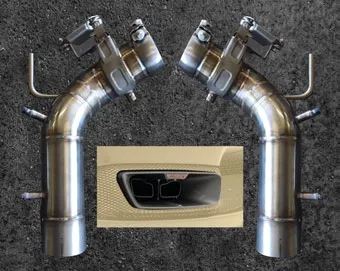
Exhaust Mansory for Ferrari 296 GTB


Exhaust Mansory for Ferrari 296 GTB
The Mansory Exhaust System for the Ferrari 296 GTB replaces the complete OEM cat-back exhaust assembly with a performance-engineered stainless-steel system that reduces exhaust back-pressure, increases exhaust gas scavenging efficiency at the turbocharger turbine outlet, and introduces an acoustic signature calibrated to the character of the 2.992 L twin-turbo hot-vee V6 — a powerplant whose 663 hp combustion output is delivered with a distinctly different sonic character than a traditional Ferrari NA GT. The F163 V6's hot-vee layout concentrates both turbocharger assemblies inside the 120° bank angle directly above the engine: the turbos absorb the exhaust energy impulse before the exhaust reaches the cat-back section, significantly attenuating the high-frequency content of the combustion note. The Mansory system works downstream of this turbine extraction point to recover exhaust pressure recovery efficiency and maximise the acoustic energy that reaches the tail section, where it is allowed to exit through a larger-bore outlet than the OEM permits. As part of the Mansory Carbon Fiber Body kit set for Ferrari 296 GTB, this system represents the most significant mechanical upgrade in the programme — altering the car's acoustic experience as fundamentally as any exterior modification alters its visual one.
Construction & Materials
The primary pipes from the turbocharger outlets to the catalytic converter section are mandrel-bent from 63.5 mm OD grade 304 stainless steel tube at 1.5 mm wall thickness. Mandrel bending maintains tube cross-section throughout the bend radius — unlike rotary-draw bending, which collapses the inner radius and restricts flow — preserving the full bore area that is critical to back-pressure reduction at the turbocharger turbine outlet. The mid-pipe section from the primary cat-back junction to the rear silencer is fabricated in 70 mm OD stainless at 1.5 mm wall, sized to provide the correct back-pressure relationship between the OEM primary cat assembly and the Mansory rear silencer. The rear silencer housing is TIG-welded 316 stainless at 2.0 mm, with an internal absorptive packing of stainless-steel wool and a perforated core tube — a straight-through design that reduces restriction relative to the OEM baffled silencer while maintaining sufficient sound attenuation for street legality in road-use configurations. The outlet tips are formed from 90 mm OD 304 stainless with a mirror-polished outlet flange matching the OEM-compatible tip set. Total system weight is approximately 6.8 kg versus approximately 11.2 kg for the OEM assembly — a saving of approximately 4.4 kg from the rear of the car, which has a measurable effect on rear-axle polar moment of inertia.
- Primary pipes: mandrel-bent 63.5 mm OD grade 304 SS, 1.5 mm wall
- Mid-pipe: 70 mm OD 304 SS, 1.5 mm wall, maintains optimal turbo-to-silencer back-pressure ratio
- Rear silencer: TIG-welded 316 SS, 2.0 mm, straight-through with perforated core and SS wool packing
- Outlet tips: 90 mm OD 304 SS, mirror-polished outlet flange, matched to OEM bumper apertures
- All joints: TIG-welded to aerospace weld quality, full-penetration at all seam junctions
- System weight: ≈ 6.8 kg (saving ≈ 4.4 kg vs. OEM)
- Compatibility: fits cat-back of OEM catalytic converter assembly; retains OEM primary cats
- Acoustic: increases exhaust volume by approximately 8–12 dB over OEM across 2000–7000 rpm range
Design & Visual Function
The acoustic character of the Mansory exhaust is shaped by the combination of the straight-through silencer design and the larger-bore outlet. The 296 GTB's turbocharged V6 has a compressed, flat exhaust note through the OEM silencer — substantial rumble under load but limited harmonic richness compared to a traditional Ferrari NA GT. The Mansory system's reduced back-pressure allows exhaust pulses from the turbo outlets to propagate more completely through the cat-back section, recovering frequency content above 2 kHz that the OEM silencer absorbs. The result is a fuller, more complex harmonic stack at the tailpipe — preserving the turbo-whoosh and wastegate signature while adding mid-frequency body to the note that enriches the cabin acoustic experience without producing the tinny, resonant character of low-quality stainless exhaust systems. The PHEV system's EV-only mode below approximately 135 km/h means the exhaust is completely silent in this operating range; when the V6 ignites — at the threshold of hybrid operation or at driver request — the Mansory system's improved acoustic signature provides a more immediate, recognisable announcement of the combustion engine's engagement.
Back-pressure reduction at the turbocharger turbine outlet has a direct effect on boost response: lower downstream resistance allows the turbine to spin up faster from low shaft speed, reducing the rotational inertia that causes turbo lag. The twin turbos of the hot-vee V6 are compact units positioned in the heat-dense V between the cylinder banks; their operating efficiency is sensitive to both exhaust temperature — which the hot-vee concentrates at the turbine inlet — and exhaust back-pressure, which the Mansory system reduces. The 8-speed DCT's shift logic is calibrated by Ferrari to the OEM exhaust's pressure profile; on a road-registered car the ECU will adapt to the changed exhaust condition within a short running period without requiring reflashing. Owners seeking maximum performance benefit may wish to pair the exhaust with an ECU optimisation service for the updated back-pressure and acoustic signature parameters.
The mirror-polished 90 mm outlet tips at the rear of the car complete the visual statement of the Mansory programme at the tail — their larger diameter versus the OEM tips fills the bumper apertures more completely, and the polished stainless surface against the carbon diffuser or painted bumper creates a material contrast that anchors the rear face of the car at the drivetrain's exit point. The system's weight saving of 4.4 kg at the rear of the car — a position well behind the rear axle centreline — reduces polar moment of inertia around the yaw axis, marginally improving the car's rotational responsiveness in directional changes.
Compatibility & Fitment
The Mansory Exhaust System fits the Ferrari 296 GTB coupé (2022+), 296 GTS spider (2023+), and 296 Assetto Fiorano, replacing the cat-back section while retaining the OEM primary catalytic converters. The system connects to the OEM flange at the primary cat exit using supplied stainless V-band clamps. The OEM lambda sensors and OEM exhaust valves (where fitted on the electric exhaust valve option) require relocation to the Mansory system's sensor bosses, which are pre-welded to the specified positions. The 296 GTB's OEM lambda sensor circuit is retained — no ECU modification is required for the exhaust valve function. LHD and RHD configurations use the same system.
Installation & Reversibility
Installation requires a two-post lift and access to the underside of the car; a qualified exhaust specialist or Ferrari dealer service workshop is recommended. Time estimate 3–4 hours for a technician familiar with Ferrari turbocharged cat-back removal procedures. The OEM system is unmodified on removal and can be refitted in equivalent time. The Mansory system includes all gaskets, clamps, and sensor boss adapters in the supply set. Lambda sensor transfer is straightforward; any OEM exhaust valve wiring connects to the pre-wired adapter harness supplied.
Pairing within the Mansory 296 GTB programme
The exhaust system pairs naturally with the Down Pipes with 200-Cell Catalysts Mansory for Ferrari 296 GTB for a comprehensive drivetrain acoustic and performance upgrade — the down pipe change complements the cat-back upgrade by addressing primary flow restriction closer to the turbocharger outlet. The Exhaust Tip for OEM Exhaust Mansory for Ferrari 296 GTB is not compatible with the Mansory full exhaust system, which ships with its own outlet tips. For visual context at the rear, the Rear Diffuser with Brake Light Mansory for Ferrari 296 GTB frames the exhaust outlets in the rear fascia programme.
Maintenance & Durability
Grade 304 stainless steel exhaust systems require minimal maintenance under normal operating conditions. The straight-through silencer packing of stainless wool is durable but will compact over extended use — system acoustic output may increase slightly over the first 10,000 km as the packing settles. The V-band clamps at the primary cat junction should be inspected and torqued to specification at the first service interval (typically 12 months) and every 2 years thereafter. Mirror-polished outlet tips should be maintained as described for the OEM-compatible tip set. The TIG weld seams should be visually inspected at each service for any signs of heat-stress cracking at the joint radii — the hot-vee engine layout generates elevated exhaust gas temperatures that can initiate thermal fatigue at weld heat-affected zones over extended mileages at sustained full-turbo operation. Any observed weld crack should be repaired by a qualified TIG welder before the crack propagates to the tube wall.
Lead Time & Warranty
Exhaust systems are built-to-order and carry a lead time of 4–5 weeks from order confirmation. The 12-month manufacturer's warranty covers all TIG weld seams, V-band clamp fitment, and sensor boss integrity. Acoustic output and back-pressure values are as-designed; individual variation in these metrics due to normal manufacturing tolerances is not a warranty claim basis. Contact Hodoor with order reference and workshop report for any structural warranty enquiries.
FAQ
Q: Is the Mansory exhaust compatible with the 296 GTB's electric exhaust valve option?
A: Yes — the Mansory system is supplied with a pre-wired adapter harness for the OEM exhaust valve actuator. The valve functionality — open at high RPM, closed for quiet mode — is retained through the Mansory system.
Q: Does the system require an ECU remap after installation?
A: The 296 GTB's lambda-managed ECU adapts to changed exhaust conditions within a short running period without requiring a remap for street use. Owners seeking maximum power optimisation from the changed back-pressure profile may benefit from an ECU recalibration — this is optional and beyond the scope of the Mansory exhaust supply.
Q: How loud is the Mansory exhaust compared to OEM at idle and at highway speed?
A: At idle the difference is noticeable but not dramatic — the PHEV system often starts the V6 at lower throttle positions where the idle-to-light-load acoustic difference is modest. At 4000+ rpm under load, the increased volume and richer harmonic content are clearly perceptible. At motorway speed in hybrid mode the system is within comfortable road-trip acoustic levels for most occupants.
Q: Does the weight saving affect the car's PHEV balance or handling?
A: The 4.4 kg saving is at the rear of the car, behind the rear axle centreline. This marginally reduces the rear polar moment and slightly reduces the rear static weight contribution. The effect on handling is subtle — the 296 GTB's fundamental balance is set by the battery and drivetrain mass — but the yaw-axis rotational improvement is measurable in test conditions.
To order the Mansory exhaust system for your 296 GTB or discuss pairing with the down pipe programme, contact us via WhatsApp +44 7488 818 747 or [email protected].